


Page 477 - Clinical Immunology_ Principles and Practice ( PDFDrive )
P. 477
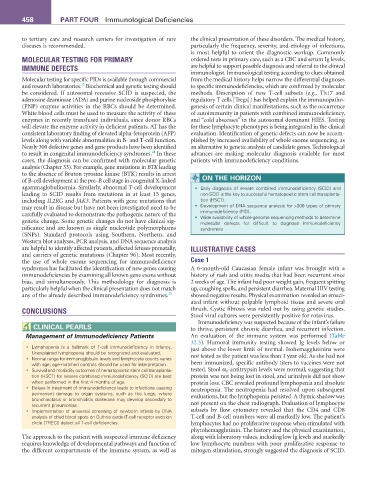
458          ParT FOur  Immunological Deficiencies


        to tertiary care and research centers for investigation of rare   the clinical presentation of these disorders. The medical history,
        diseases is recommended.                               particularly the frequency, severity, and etiology of infections,
                                                               is most helpful to orient the diagnostic workup. Commonly
        MOLECULAR TESTING FOR PRIMARY                          ordered tests in primary care, such as a CBC and serum Ig levels,
        IMMUNE DEFECTS                                         are helpful to support possible diagnosis and referral to the clinical
                                                               immunologist. Immunological testing according to clues obtained
        Molecular testing for specific PIDs is available through commercial   from the medical history helps narrow the differential diagnoses
                            23
        and research laboratories.  Biochemical and genetic testing should   to specific immunodeficiencies, which are confirmed by molecular
        be considered. If autosomal recessive SCID is suspected, the   methods. Description of new T-cell subsets (e.g., Th17 and
        adenosine deaminase (ADA) and purine nucleoside phosphorylase   regulatory T cells [Tregs]) has helped explain the immunopatho-
        (PNP) enzyme activities in the RBCs should be determined.   genesis of certain clinical manifestations, such as the occurrence
        White blood cells must be used to measure the activity of these   of autoimmunity in patients with combined immunodeficiency,
        enzymes in recently transfused individuals, since donor RBCs   and “cold abscesses” in the autosomal dominant HIES. Testing
        will elevate the enzyme activity in deficient patients. AT has the   for these lymphocyte phenotypes is being integrated in the clinical
        consistent laboratory finding of elevated alpha-fetoprotein (AFP)   evaluation. Identification of genetic defects can now be accom-
        levels along with variable abnormalities in B- and T-cell function.   plished by increased availability of whole exome sequencing, as
        Nearly 300 defective genes and gene products have been identified   an alternative to genetic analysis of candidate genes. Technological
                                                   24
        to result in congenital immunodeficiency syndromes.  In these   advances  are  making  molecular  diagnosis  available  for  most
        cases, the diagnosis can be confirmed with molecular genetic   patients with immunodeficiency conditions.
        analysis (Chapter 33). For example, gene mutations in BTK leading
        to the absence of Bruton tyrosine kinase (BTK) results in arrest
        of B-cell development at the pre–B cell stage in congenital X-linked    ON THE HOrIZON
        agammaglobulinemia. Similarly, abnormal T-cell development   •  Early diagnosis of severe combined immunodeficiency (SCID) and
        leading  to  SCID  results  from mutations  in  at  least 15  genes,   non-SCID is the key to successful hematopoietic stem cell transplanta-
        including IL2RG and JAK3. Patients with gene mutations that   tion (HSCT).
        may result in disease but have not been investigated need to be   •  Development of DNA sequence analysis for >300 types of primary
                                                                   immunodeficiency (PID).
        carefully evaluated to demonstrate the pathogenic nature of the   •  Wide availability of whole-genome sequencing methods to determine
        genetic change. Some genetic changes do not have clinical sig-  molecular defects for difficult to diagnose immunodeficiency
        nificance and are known as single nucleotide polymorphisms   syndromes
        (SNPs).  Standard  protocols  using  Southern,  Northern,  and
        Western blot analyses, PCR analysis, and DNA sequence analysis
        are helpful to identify affected patients, affected fetuses prenatally,   ILLUSTRATIVE CASES
        and carriers of genetic mutations (Chapter 96). Most recently,
        the use of whole exome sequencing for immunodeficiency   Case 1
        syndromes has facilitated the identification of new genes causing   A 6-month-old Caucasian female infant was brought with a
        immunodeficiencies by examining all known gene exons without   history of rash and otitis media that had been recurrent since
        bias, and simultaneously. This methodology for diagnosis is   2 weeks of age. The infant had poor weight gain, frequent spitting
        particularly helpful when the clinical presentation does not match   up, coughing spells, and persistent diarrhea. Maternal HIV testing
        any of the already described immunodeficiency syndromes. 25  showed negative results. Physical examination revealed an emaci-
                                                               ated infant without palpable lymphoid tissue and severe oral
        CONCLUSIONS                                            thrush. Cystic fibrosis was ruled out by using genetic studies.
                                                               Stool viral cultures were persistently positive for rotavirus.
                                                                  Immunodeficiency was suspected because of the infant’s failure
            CLINICaL PEarLS                                    to thrive, persistent chronic diarrhea, and recurrent infection.
         Management of Immunodeficiency Patients               An  evaluation  of  the  immune  system was  performed (Table
                                                               32.3). Humoral immunity testing showed Ig levels below or
          •  Lymphopenia is a hallmark of T-cell immunodeficiency in infancy.   just above the lower limit of normal. Isohemagglutinins were
           Unexplained lymphopenia should be recognized and evaluated.
          •  Normal range for immunoglobulin levels and lymphocyte counts varies   not tested as the patient was less than 1 year old. As she had not
           with age; age-matched controls should be used for interpretation.  been immunized, specific antibody titers to vaccines were not
          •  Survival and morbidity outcomes of hematopoietic stem cell transplanta-  tested. Stool α 1 -antitrypsin levels were normal, suggesting that
           tion (HSCT) for severe combined immunodeficiency (SCID) are best   protein was not being lost in stool, and urinalysis did not show
           when performed in the first 4 months of age.        protein loss. CBC revealed profound lymphopenia and absolute
          •  Delays in treatment of immunodeficiency leads to infections causing   neutropenia. The neutropenia had resolved upon subsequent
           permanent damage to organ systems, such as the lungs, where   evaluations, but the lymphopenia persisted. A thymic shadow was
           bronchiectasis or bronchiolitis obliterans may develop secondary to
           recurrent pneumonias.                               not present on the chest radiograph. Evaluation of lymphocyte
          •  Implementation of universal screening of newborn infants by DNA   subsets  by  flow  cytometry  revealed  that  the  CD4  and  CD8
           analysis of dried blood spots on Guthrie cards (T-cell receptor excision   T-cell and B-cell numbers were all markedly low. The patient’s
           circle [TREC]) detect all T-cell deficiencies.      lymphocytes had no proliferative response when stimulated with
                                                               phytohemagglutinin. The history and the physical examination,
        The approach to the patient with suspected immune deficiency   along with laboratory values, including low Ig levels and markedly
        requires knowledge of developmental pathways and function of   low lymphocyte numbers with poor proliferative response to
        the different compartments of the immune system, as well as   mitogen stimulation, strongly suggested the diagnosis of SCID.

