


Page 473 - Clinical Immunology_ Principles and Practice ( PDFDrive )
P. 473
454          ParT FOur  Immunological Deficiencies


        trait can sometimes be traced back to many generations. A social
        history should be obtained for risk factors associated with
        increased risk of acquiring HIV infection. Socioeconomic factors
        often determine malnutrition, known to be of a significant impact
        on immune function. 12

            KEY CONCEPTS
         Genetic Immunodeficiencies
          •  Diagnosis of genetic immunodeficiencies require high clinical suspicion
           and confirmation with molecular studies.
          •  In a minority of cases, genetic immunodeficiencies might not present
           with all clinical elements of classic descriptions. For example, patients
           with Bruton agammaglobulinemia might have residual B-cell and
           immunoglobulin production.


        PHYSICAL EXAMINATION FINDINGS
        The physical examination might provide findings that indirectly
        address the immune system; for example, scarred bilateral tympani
        suggest recurrent ear infections. More commonly, patients with
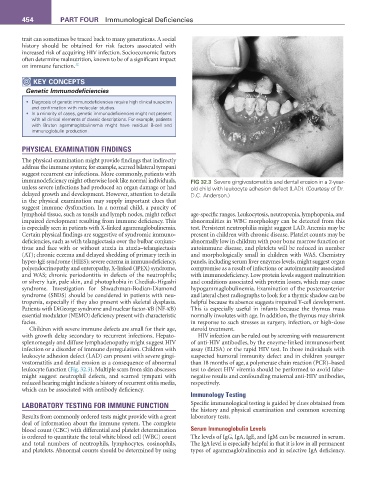
        immunodeficiency might otherwise look like normal individuals,   FIG 32.3  Severe gingivostomatitis and dental erosion in a 2-year-
        unless severe infections had produced an organ damage or had   old child with leukocyte adhesion defect (LAD). (Courtesy of Dr.
        delayed growth and development. However, attention to details   D.C. Anderson.)
        in the physical examination may supply important clues that
        suggest immune dysfunction. In a normal child, a paucity of
        lymphoid tissue, such as tonsils and lymph nodes, might reflect   age-specific ranges. Leukocytosis, neutropenia, lymphopenia, and
        impaired development resulting from immune deficiency. This   abnormalities in WBC morphology can be detected from this
        is especially seen in patients with X-linked agammaglobulinemia.   test. Persistent neutrophilia might suggest LAD. Anemia may be
        Certain physical findings are suggestive of syndromic immuno-  present in children with chronic disease. Platelet counts may be
        deficiencies, such as with telangiectasia over the bulbar conjunc-  abnormally low in children with poor bone marrow function or
        tivae and face with or without ataxia in ataxia–telangiectasia   autoimmune disease, and platelets will be reduced in number
        (AT); chronic eczema and delayed shedding of primary teeth in   and  morphologically  small  in  children  with WAS.  Chemistry
        hyper-IgE syndrome (HIES); severe eczema in immunodeficiency,   panels, including serum liver enzymes levels, might suggest organ
        polyendocrinopathy and enteropathy, X-linked (IPEX) syndrome,   compromise as a result of infections or autoimmunity associated
        and WAS; chronic periodontitis in defects of the neutrophils;   with immunodeficiency. Low protein levels suggest malnutrition
        or silvery hair, pale skin, and photophobia in Chediak-Higashi   and conditions associated with protein losses, which may cause
        syndrome. Investigation for Shwachman-Bodian-Diamond   hypogammaglobulinemia. Examination of the posteroanterior
        syndrome (SBDS) should be considered in patients with neu-  and lateral chest radiographs to look for a thymic shadow can be
        tropenia, especially if they also present with skeletal dysplasia.   helpful because its absence suggests impaired T-cell development.
        Patients with DiGeorge syndrome and nuclear factor-κB (NF-κB)   This is especially useful in infants because the thymus mass
        essential modulator (NEMO) deficiency present with characteristic   normally involutes with age. In addition, the thymus may shrink
        facies.                                                in response to such stresses as surgery, infection, or high-dose
           Children with severe immune defects are small for their age,   steroid treatment.
        with growth delay secondary to recurrent infections. Hepato-  HIV infection can be ruled out by screening with measurement
        splenomegaly and diffuse lymphadenopathy might suggest HIV   of anti-HIV antibodies, by the enzyme-linked immunosorbent
        infection or a disorder of immune dysregulation. Children with   assay (ELISA) or the rapid HIV test. In those individuals with
        leukocyte adhesion defect (LAD) can present with severe gingi-  suspected humoral immunity defect and in children younger
        vostomatitis and dental erosion as a consequence of abnormal   than 18 months of age, a polymerase chain reaction (PCR)–based
        leukocyte function (Fig. 32.3). Multiple scars from skin abscesses   test to detect HIV viremia should be performed to avoid false-
        might suggest neutrophil  defects, and scarred tympani  with   negative results and confounding maternal anti-HIV antibodies,
        reduced hearing might indicate a history of recurrent otitis media,   respectively.
        which can be associated with antibody deficiency.
                                                               Immunology Testing
        LABORATORY TESTING FOR IMMUNE FUNCTION                 Specific immunological testing is guided by clues obtained from
                                                               the history and physical examination and common screening
        Results from commonly ordered tests might provide with a great   laboratory tests.
        deal of information about the immune system. The complete
        blood count (CBC) with differential and platelet determination   Serum Immunoglobulin Levels
        is ordered to quantitate the total white blood cell (WBC) count   The levels of IgG, IgA, IgE, and IgM can be measured in serum.
        and total numbers of neutrophils, lymphocytes, eosinophils,   The IgA level is especially helpful in that it is low in all permanent
        and platelets. Abnormal counts should be determined by using   types of agammaglobulinemia and in selective IgA deficiency.

