


Page 478 - Clinical Immunology_ Principles and Practice ( PDFDrive )
P. 478
CHaPTEr 32  Approach to the Evaluation of the Patient With Suspected Immunodeficiency                459


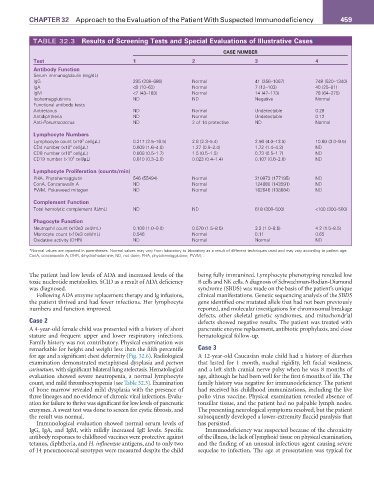
            TABLE 32.3  results of Screening Tests and Special Evaluations of Illustrative Cases*
                                                                          CaSE NuMBEr
            Test                             1                  2                   3                   4
            antibody Function
            Serum immunoglobulin (mg/dL)
            IgG                              235 (208–686)      Normal              41 (256–1067)       748 (520–1340)
            IgA                              <8 (10–62)         Normal              7 (12–103)          40 (25–81)
            IgM                              <7 (43–183)        Normal              14 (47–173)         78 (64–275)
            Isohemagglutinins                ND                 ND                  Negative            Normal
            Functional antibody tests
            Antitetanus                      ND                 Normal              Undetectable        0.28
            Antidiphtheria                   ND                 Normal              Undetectable        0.12
            Anti-Pneumococcus                ND                 2 of 14 protective  ND                  Normal

            Lymphocyte Numbers
            Lymphocyte count (×10  cell/µL)  0.217 (2.5–16.5)   2.8 (2.3–5.4)       2.56 (4.0–13.5)     10.60 (3.0–9.5)
                            3
            CD4 number (×10  cell/µL)        0.009 (1.6–4.0)    1.27 (0.9–2.4)      1.72 (1.4–4.3)      ND
                        3
                        3
            CD8 number (×10  cell/µL)        0.008 (0.5–1.7)    1.5 (0.5–1.5)       0.73 (0.5–1.7)      ND
                         3
            CD19 number (×10  cell/µL)       0.010 (0.3–2.0)    0.023 (0.4–1.4)     0.107 (0.6–2.6)     ND
            Lymphocyte Proliferation (counts/min)
            PHA, Phytohemagglutin            546 (55494)        Normal              210973 (177195)     ND
            ConA, Concanavalin A             ND                 Normal              124680 (143591)     ND
            PWM, Pokeweed mitogen            ND                 Normal              162646 (138684)     ND
            Complement Function
            Total hemolytic complement (U/mL)  ND               ND                  618 (300–500)       <100 (300–500)
            Phagocyte Function
            Neutrophil count (×10e3 cell/mL)  0.109 (1.0–9.0)   0.570 (1.5–8.5)     3.3 (1.0–8.5)       4.2 (1.5–8.5)
            Monocyte count (×10e3 cell/mL)   0.546              Normal              0.11                0.65
            Oxidative activity (DHR)         ND                 Normal              Normal              ND

           *Normal values are reported in parentheses. Normal values may vary from laboratory to laboratory as a result of different techniques used and may vary according to patient age.
           ConA, concanavalin A; DHR, dihydrorhodamine; ND, not done; PHA, phytohemagglutinin; PVVM, .


           The patient had low levels of ADA and increased levels of the   being fully immunized. Lymphocyte phenotyping revealed low
           toxic nucleotide metabolites. SCID as a result of ADA deficiency   B cells and NK cells. A diagnosis of Schwachman-Bodian-Diamond
           was diagnosed.                                         syndrome (SBDS) was made on the basis of the patient’s unique
             Following ADA enzyme replacement therapy and Ig infusions,   clinical manifestations. Genetic sequencing analysis of the SBDS
           the patient thrived and had fewer infections. Her lymphocyte   gene identified one mutated allele that had not been previously
           numbers and function improved.                         reported, and molecular investigations for chromosomal breakage
                                                                  defects, other skeletal genetic syndromes, and mitochondrial
           Case 2                                                 defects showed negative results. The patient was treated with
           A 4-year-old female child was presented with a history of short   pancreatic enzyme replacement, antibiotic prophylaxis, and close
           stature and frequent upper and lower respiratory infections.   hematological follow-up.
           Family history was not contributory. Physical examination was
           remarkable for height and weight less than the fifth percentile   Case 3
           for age and a significant chest deformity (Fig. 32.6). Radiological   A 12-year-old Caucasian male child had a history of diarrhea
           examination demonstrated metaphyseal dysplasia and pectum   that lasted for 1 month, nuchal rigidity, left facial weakness,
           carinatum, with significant bilateral lung atelectasis. Hematological   and a left sixth cranial nerve palsy when he was 8 months of
           evaluation showed severe  neutropenia,  a normal lymphocyte   age, although he had been well for the first 6 months of life. The
           count, and mild thrombocytopenia (see Table 32.3). Examination   family history was negative for immunodeficiency. The patient
           of bone marrow revealed mild dysplasia with the presence of   had received his childhood immunizations, including the live
           three lineages and no evidence of chronic viral infections. Evalu-  polio virus vaccine. Physical examination revealed absence of
           ation for failure to thrive was significant for low levels of pancreatic   tonsillar tissue, and the patient had no palpable lymph nodes.
           enzymes. A sweat test was done to screen for cystic fibrosis, and   The presenting neurological symptoms resolved, but the patient
           the result was normal.                                 subsequently developed a lower-extremity flaccid paralysis that
             Immunological evaluation showed normal serum levels of   has persisted.
           IgG, IgA, and IgM, with mildly increased IgE levels. Specific   Immunodeficiency was suspected because of the chronicity
           antibody responses to childhood vaccines were protective against   of the illness, the lack of lymphoid tissue on physical examination,
           tetanus, diphtheria, and H. influenzae antigens, and to only two   and the finding of an unusual infectious agent causing severe
           of 14 pneumococcal serotypes were measured despite the child   sequelae to infection. The age at presentation was typical for

