


Page 475 - Clinical Immunology_ Principles and Practice ( PDFDrive )
P. 475
456          ParT FOur  Immunological Deficiencies


                 10 3                                             10 3
                     A1          A2                                   A1          A2


                 10 2                                             10 2


               CD4 PE  10 1                                     CD4 PE  10 1


                 10 0  A3        A4                               10 0  A3        A4


                             10 0     10 1      10 2      10 3                10 0      10 1     10 2      10 3
              A                      CD3 FITC                  B                      CD3 FITC
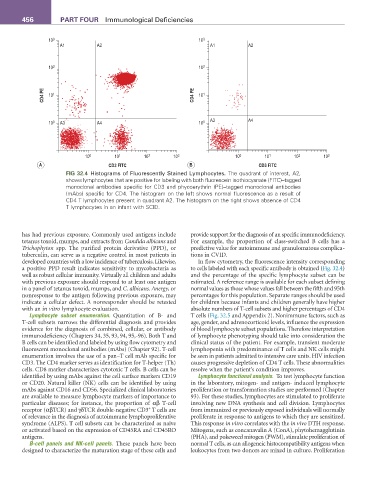
                       FIG 32.4  Histograms of Fluorescently Stained Lymphocytes. The quadrant of interest, A2,
                       shows lymphocytes that are positive for labeling with both fluorescein isothiocyanate (FITC)–tagged
                       monoclonal antibodies specific for CD3 and phycoerythrin (PE)–tagged monoclonal antibodies
                       (mAbs) specific for CD4. The histogram on the left shows normal fluorescence as a result of
                       CD4 T lymphocytes present in quadrant A2. The histogram on the right shows absence of CD4
                       T lymphocytes in an infant with SCID.


        has had previous exposure. Commonly used antigens include   provide support for the diagnosis of an specific immunodeficiency.
        tetanus toxoid, mumps, and extracts from Candida albicans and   For example, the proportion  of class-switched B cells  has a
        Trichophyton  spp.  The  purified  protein  derivative  (PPD),  or   predictive value for autoimmune and granulomatous complica-
        tuberculin, can serve as a negative control in most patients in   tions in CVID.
        developed countries with a low incidence of tuberculosis. Likewise,   In flow cytometry, the fluorescence intensity corresponding
        a  positive  PPD  result  indicates sensitivity  to  mycobacteria  as   to cells labeled with each specific antibody is obtained (Fig. 32.4)
        well as robust cellular immunity. Virtually all children and adults   and the percentage of the specific lymphocyte subset can be
        with previous exposure should respond to at least one antigen   estimated. A reference range is available for each subset defining
        in a panel of tetanus toxoid, mumps, and C. albicans. Anergy, or   normal values as those whose values fall between the fifth and 95th
        nonresponse to the antigen following previous exposure, may   percentages for this population. Separate ranges should be used
        indicate a cellular defect. A nonresponder should be retested   for children because infants and children generally have higher
        with an in vitro lymphocyte evaluation.                absolute numbers of T-cell subsets and higher percentages of CD4
           Lymphocyte subset enumeration.  Quantitation of B- and   T cells (Fig. 32.5 and Appendix 2). Nonimmune factors, such as
        T-cell subsets narrows the differential diagnosis and provides   age, gender, and adrenocorticoid levels, influence the expression
        evidence for the diagnosis of combined, cellular, or antibody   of blood lymphocyte subset populations. Therefore interpretation
        immunodeficiency (Chapters 34, 35, 93, 94, 95,-96). Both T and   of lymphocyte phenotyping should take into consideration the
        B cells can be identified and labeled by using flow cytometry and   clinical status of the patient. For example, transient moderate
        fluorescent monoclonal antibodies (mAbs) (Chapter 92). T-cell   lymphopenia with predominance of T cells and NK cells might
        enumeration involves the use of a pan–T cell mAb specific for   be seen in patients admitted to intensive care units. HIV infection
        CD3. The CD4 marker serves as identification for T-helper (Th)   causes progressive depletion of CD4 T cells. These abnormalities
        cells. CD8 marker characterizes cytotoxic T cells. B cells can be   resolve when the patient’s condition improves.
        identified by using mAbs against the cell surface markers CD19   Lymphocyte functional analysis.  To test lymphocyte function
        or CD20. Natural killer (NK) cells can be identified by using   in the laboratory, mitogen- and antigen- induced lymphocyte
        mAbs against CD16 and CD56. Specialized clinical laboratories   proliferation or transformation studies are performed (Chapter
        are available to measure lymphocyte markers of importance to   93). For these studies, lymphocytes are stimulated to proliferate
        particular diseases; for instance, the proportion of  αβ T-cell   involving new DNA synthesis and cell division. Lymphocytes
                                                  +
        receptor (αβTCR) and γδTCR double-negative CD3  T cells are   from immunized or previously exposed individuals will normally
        of relevance in the diagnosis of autoimmune lymphoproliferative   proliferate in response to antigens to which they are sensitized.
        syndrome (ALPS). T cell subsets can be characterized as naïve   This response in vitro correlates with the in vivo DTH response.
        or activated based on the expression of CD45RA and CD45RO   Mitogens, such as concanavalin A (ConA), phytohemagglutinin
        antigens.                                              (PHA), and pokeweed mitogen (PWM), stimulate proliferation of
           B-cell panels and NK-cell panels.  These panels have been   normal T cells, as can allogeneic histocompatibility antigens when
        designed to characterize the maturation stage of these cells and   leukocytes from two donors are mixed in culture. Proliferation

