


Page 531 - Clinical Immunology_ Principles and Practice ( PDFDrive )
P. 531
510          ParT fOur  Immunological Deficiencies


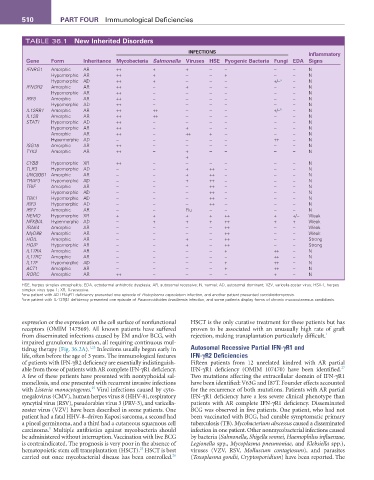
         TABLE 36.1  New Inherited Disorders
                                                               INfECTIONS                             Inflammatory
          Gene    form      Inheritance Mycobacteria Salmonella Viruses  HSE Pyogenic Bacteria fungi  EDa Signs
          IFNRG1  Amorphic  AR         ++          +          +       −    −               −     −    N
                  Hypomorphic  AR      ++          +          −       −    +               −     −    N
                  Hypomorphic  AD      ++          +          −       −    −               +/− a  −   N
          IFNGR2  Amorphic  AR         ++          −          +       −    −               −     −    N
                  Hypomorphic  AR      ++          −          −       −    −               −     −    N
          IRF8    Amorphic  AR         ++          −          −       −    −               −     −    N
                  Hypomorphic  AD      ++          −          −       −    −               −     −    N
          IL12RB1  Amorphic  AR        ++          ++         −       −    −               +/− b  −   N
          IL12B   Amorphic  AR         ++          ++         −       −    −               −     −    N
          STAT1   Hypomorphic  AD      ++          −          −       −    −               −     −    N
                  Hypomorphic  AR      ++          −          +       −    −               −     −    N
                  Amorphic  AR         ++          −          ++      +    −               −     −    N
                  Hypermorphic  AD     −           −          −       −    −               ++    −    N
          ISG15   Amorphic  AR         ++          −          −       −    −               −     −    N
          TYK2    Amorphic  AR         ++          −          +       −    −               −     −    N
                                                              +
          CYBB    Hypomorphic  XR      ++          −          −       −    −               −     −    N
          TLR3    Hypomorphic  AD      −           −          +       ++   −               −     −    N
          UNC93B1  Amorphic  AR        −           −          +       ++   −               −     −    N
          TRAF3   Hypomorphic  AD      −           −          +       ++   −               −     −    N
          TRIF    Amorphic  AR         −           −          −       ++   −               −     −    N
                  Hypomorphic  AD      −           −          −       ++   −               −     −    N
          TBK1    Hypomorphic  AD      −           −          −       ++   −               −     −    N
          IRF3    Hypomorphic  AD      −           −          −       ++   −               −     −    N
          IRF7    Amorphic  AR         −           −          Flu     −    −               −     −    N
          NEMO    Hypomorphic  XR      +           +          +       +    ++              +     +/−  Weak
          NFKBIA  Hypermorphic  AD     −           +          +       +    ++              +     +    Weak
          IRAK4   Amorphic  AR         −           −          −       −    ++              −     −    Weak
          MyD88   Amorphic  AR         −           −          −       −    ++              −     −    Weak
          HOIL    Amorphic  AR         −           −          +       −    ++              −     −    Strong
          HOIP    Hypomorphic  AR      −           −          +       −    ++              −     −    Strong
          IL17RA  Amorphic  AR         −           −          −       −    +               ++    −    N
          IL17RC  Amorphic  AR         −           −          −       −    −               ++    −    N
          IL17F   Hypomorphic  AD      −           −          −       −    +               ++    −    N
          ACT1    Amorphic  AR         −           −          −       −    +               ++    −    N
          RORC    Amorphic  AR         ++          −          −       −    −               +     −    N

        HSE, herpes simplex encephalitis; EDA, ectodermal anhidrotic dysplasia; AR, autosomal recessive; N, normal; AD, autosomal dominant; VZV, varicella-zoster virus; HSV-1, herpes
        simplex virus type 1; XR, X-recessive.
        a one patient with AD IFN-γR1 deficiency presented one episode of Histoplasma capsulatum infection, and another patient presented coccidioidomycosis.
        b one patient with IL-12Rβ1 deficiency presented one episode of Paracoccidioides brasiliensis infection, and some patients display forms of chronic mucocutaneous candidiasis.


        expression or the expression on the cell surface of nonfunctional   HSCT is the only curative treatment for these patients but has
        receptors (OMIM 147569). All known patients have suffered   proven to be associated with an unusually high rate of graft
        from disseminated infections caused by EM and/or BCG, with   rejection, making transplantation particularly difficult. 1
        impaired granuloma formation, all requiring continuous mul-
        tidrug therapy (Fig. 36.2A). 1,25  Infections usually began early in   Autosomal Recessive Partial IFN-γR1 and
        life, often before the age of 3 years. The immunological features   IFN-γR2 Deficiencies
        of patients with IFN-γR2 deficiency are essentially indistinguish-  Fifteen patients from 12 unrelated kindred with  AR partial
                                                                                                                 27
        able from those of patients with AR complete IFN-γR1 deficiency.   IFN-γR1 deficiency (OMIM 107470) have been identified.
        A few of these patients have presented with nontyphoidal sal-  Two mutations affecting the extracellular domain of IFN-γR1
        monellosis, and one presented with recurrent invasive infections   have been identified: V63G and I87T. Founder effects accounted
                               25
        with Listeria monocytogenes.  Viral infections caused by cyto-  for the recurrence of both mutations. Patients with AR partial
        megalovirus (CMV), human herpes virus 8 (HHV-8), respiratory   IFN-γR1 deficiency have a less severe clinical phenotype than
        syncytial virus (RSV), pseudorabies virus 3 (PRV-3), and varicella-  patients with AR complete IFN-γR1 deficiency. Disseminated
        zoster virus (VZV) have been described in some patients. One   BCG was observed in five patients. One patient, who had not
        patient had a fatal HHV-8–driven Kaposi sarcoma, a second had   been vaccinated with BCG, had curable symptomatic primary
        a pineal germinoma, and a third had a cutaneous squamous cell   tuberculosis (TB). Mycobacterium abscessus caused a disseminated
                 1
        carcinoma.  Multiple antibiotics against mycobacteria should   infection in one patient. Other nonmycobacterial infections caused
        be administered without interruption. Vaccination with live BCG   by bacteria (Salmonella, Shigella sonnei, Haemophilus influenzae,
        is contraindicated. The prognosis is very poor in the absence of   Legionella spp., Mycoplasma pneumoniae, and Klebsiella spp.),
                                               25
        hematopoietic stem cell transplantation (HSCT).  HSCT is best   viruses (VZV, RSV,  Molluscum contagiosum), and parasites
                                                         26
        carried out once mycobacterial disease has been controlled.    (Toxoplasma gondii, Cryptosporidium) have been reported. The

