


Page 532 - Clinical Immunology_ Principles and Practice ( PDFDrive )
P. 532
CHaPTEr 36  Immunodeficiencies at the Interface of Innate and Adaptive Immunity                 511


                                                           ISG15


                                                            p19   IL-12Rβ1     TYK2
                                Mycobacteria                        IL-23R     JAK2
                                                            p40   IL-12Rβ1     TYK2

                                               gp91phox  IL-12 p35  IL-12Rβ2   JAK2
                                           NF-κB NEMO
                                                         CD40           CD40L
                                 IRF-8  IRF-1
                                                         IFNγR1  IFNγ

                                           STAT1         IFNγR2                 IFNγR1
                                                                       IFNγ     IFNγR2

                                    Antigen presenting cell             T lymphocyte and NK cell
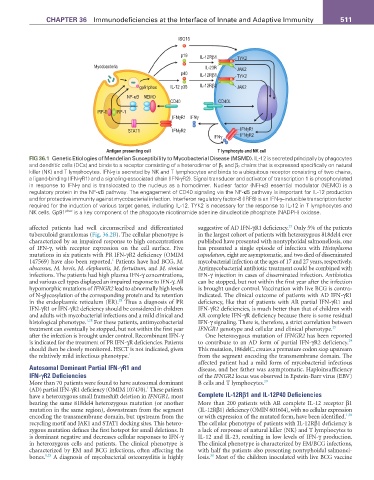
           fIG 36.1  Genetic Etiologies of Mendelian Susceptibility to Mycobacterial Disease (MSMD). IL-12 is secreted principally by phagocytes
           and dendritic cells (DCs) and binds to a receptor consisting of a heterodimer of β 1  and β 2  chains that is expressed specifically on natural
           killer (NK) and T lymphocytes. IFN-γ is secreted by NK and T lymphocytes and binds to a ubiquitous receptor consisting of two chains,
           a ligand-binding (IFN-γR1) and a signaling-associated chain (IFN-γR2). Signal transducer and activator of transcription 1 is phosphorylated
           in response to IFN-γ and is translocated to the nucleus as a homodimer. Nuclear factor (NF)-κB essential modulator (NEMO) is a
           regulatory protein in the NF-κB pathway. The engagement of CD40 signaling via the NF-κB pathway is important for IL-12 production
           and for protective immunity against mycobacterial infection. Interferon regulatory factor-8 (IRF8) is an IFN-γ–inducible transcription factor
           required for the induction of various target genes, including IL-12. TYK2 is necessary for the response to IL-12 in T lymphocytes and
           NK cells. Gp91 phox  is a key component of the phagocyte nicotinamide adenine dinucleotide phosphate (NADPH) oxidase.

                                                                                               25
           affected patients had well circumscribed and differentiated   suggestive of AD IFN-γR1 deficiency.  Only 5% of the patients
           tuberculoid granulomas (Fig. 36.2B). The cellular phenotype is   in the largest cohort of patients with heterozygous 818del4 ever
           characterized by an impaired response to high concentrations   published have presented with nontyphoidal salmonellosis, one
           of IFN-γ, with receptor expression  on the  cell surface.  Five   has presented a single episode of infection with  Histoplasma
           mutations in six patients with PR IFN-γR2 deficiency (OMIM   capsulatum, eight are asymptomatic, and two died of disseminated
                                      1
           147569) have also been reported.  Patients have had BCG, M.   mycobacterial infection at the ages of 17 and 27 years, respectively.
           abscessus, M. bovis, M. elephantis, M. fortuitum, and M. simiae   Antimycobacterial antibiotic treatment could be combined with
           infections. The patients had high plasma IFN-γ concentrations,   IFN-γ injection in cases of disseminated infection. Antibiotics
           and various cell types displayed an impaired response to IFN-γ. All   can be stopped, but not within the first year after the infection
           hypomorphic mutations of IFNGR2 lead to abnormally high levels   is brought under control. Vaccination with live BCG is contra-
           of N-glycosylation of the corresponding protein and its retention   indicated. The clinical outcome of patients with AD IFN-γR1
                                        28
           in the endoplasmic reticulum (ER).  Thus a diagnosis of PR   deficiency, like that of patients with AR partial IFN-γR1 and
           IFN-γR1 or IFN-γR2 deficiency should be considered in children   IFN-γR2 deficiencies, is much better than that of children with
           and adults with mycobacterial infections and a mild clinical and   AR complete IFN-γR deficiency because there is some residual
           histological phenotype. 1,28  For these patients, antimycobacterial   IFN-γ signaling. There is, therefore, a strict correlation between
           treatment can eventually be stopped, but not within the first year   IFNGR1 genotype and cellular and clinical phenotype. 25
           after the infection is brought under control. Recombinant IFN-γ   One heterozygous mutation of IFNGR2 has been reported
                                                                                                                   29
           is indicated for the treatment of PR IFN-γR deficiencies. Patients   to contribute to an AD form of partial IFN-γR2 deficiency.
           should then be closely monitored. HSCT is not indicated, given   This mutation, 186delC, creates a premature codon stop upstream
           the relatively mild infectious phenotype. 1            from the segment encoding the transmembrane domain. The
                                                                  affected patient had a mild form of mycobacterial infectious
           Autosomal Dominant Partial IFN-γR1 and                 disease, and her father was asymptomatic. Haploinsufficiency
           IFN-γR2 Deficiencies                                   of the IFNGR2 locus was observed in Epstein-Barr virus (EBV)
           More than 70 patients were found to have autosomal dominant   B cells and T lymphocytes. 29
                                                 1
           (AD) partial IFN-γR1 deficiency (OMIM 107470).  These patients
           have a heterozygous small frameshift deletion in IFNGR1, most   Complete IL-12Rβ1 and IL-12P40 Deficiencies
           bearing the same 818del4 heterozygous mutation (or another   More than 200 patients with AR complete IL-12 receptor β1
           mutation in the same region), downstream from the segment   (IL-12Rβ1) deficiency (OMIN 601604), with no cellular expression
           encoding the transmembrane domain, but upstream from the   or with expression of the mutated form, have been identified. 1,30
           recycling motif and JAK1 and STAT1 docking sites. This hetero-  The cellular phenotype of patients with IL-12Rβ1 deficiency is
           zygous mutation defines the first hotspot for small deletions. It   a lack of response of natural killer (NK) and T lymphocytes to
           is dominant negative and decreases cellular responses to IFN-γ   IL-12 and IL-23, resulting in low levels of IFN-γ production.
           in heterozygous cells and patients. The clinical phenotype is   The clinical phenotype is characterized by EM/BCG infections,
           characterized  by  EM  and  BCG  infections,  often  affecting  the   with half the patients also presenting nontyphoidal salmonel-
                                                                      30
           bones. 1,25  A diagnosis of mycobacterial osteomyelitis is highly   losis.  Most of the children inoculated with live BCG vaccine

