


Page 533 - Clinical Immunology_ Principles and Practice ( PDFDrive )
P. 533
512          ParT fOur  Immunological Deficiencies


                                                               produce abnormally low levels of IFN-γ because of a lack of
                                                               stimulation through the IL-12R. This defect can be partially
                                                               corrected, in a dose-dependent manner, with exogenous recom-
                                                               binant IFN-γ. 1,33  All children inoculated with live BCG vaccine
                                                               developed clinical infection, and infections caused by EM or M.
                                                               tuberculosis have also been reported. Other infections, such as
                                                               salmonellosis, klebsiellosis, and nocardiosis, have been described.
                                                               Five of the reported patients are asymptomatic. Thirteen of the
                                                               50 patients died before the age of 8 years, and one patient died
                                                               at the age of 34 years. 1,33
                                                                  For IL-12p40 and IL-12Rβ1 deficiencies, antibiotic treatment
                                                               can be combined with IFN-γ injection in cases of disseminated
                                                                       1
                                                               infection.  Antibiotics can be stopped, but not within the first
                                                               year after the infection is brought under control. Infectious
                                                               Salmonella disease should be treated with antibiotics or with
                                                               IFN-γ and antibiotics in patients with recurrent salmonellosis.
                                                               Thus a diagnosis of IL-12p40 or IL-12Rβ1 deficiency should be
                                                               considered in children and adults with mycobacterial and Sal-
          A
                                                               monella infections or mycobacterial infections and CMC with
                                                               a mild clinical and histological phenotype. The vaccination of
                                                                                                    1,33
                                                               these patients with live BCG is contraindicated.  The prognosis
                                                               is, nevertheless, good, partly because of the incomplete clinical
                                                               penetrance of primary mycobacterial infection, the favorable
                                                               response of infections to treatment, and the rarity of recurrent
                                                               or multiple mycobacterial infections. Indeed, children with
                                                               primary mycobacterial disease can mount a fully protective
                                                               immune response against a secondary mycobacterial disease.
                                                                   THEraPEuTIC PrINCIPLES
                                                                 Treatment of Mendelian Susceptibility to
                                                                 Mycobacterial Disease (MSMD) Patients
                                                                 •  Vaccination with live Bacille Calmette-Guérin (BCG) is contraindicated.
                                                                 •  Multiple antibiotics against mycobacteria should be administered
                                                                   without interruption in patients with complete interferon (IFN)-γR1 or
          B                                                        IFN-γR2 deficiency.
                                                                 •  Antimycobacterial antibiotics may be associated with IFN-γ injections
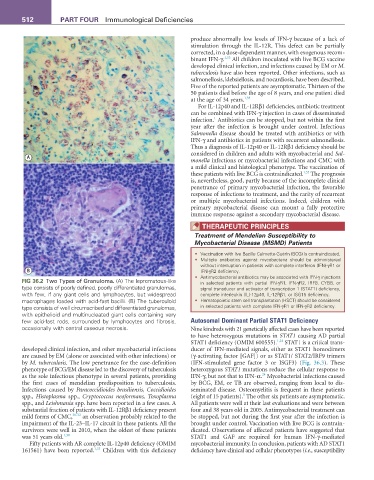
        fIG 36.2  Two Types of Granuloma. (A) The lepromatous-like   in selected patients with partial IFN-γR1, IFN-γR2, IRF8, CYBB, or
        type consists of poorly defined, poorly differentiated granulomas,   signal transducer and activator of transcription 1 (STAT1) deficiency,
        with few, if any giant cells and lymphocytes, but widespread   complete interleukin (IL)-12p40, IL-12Rβ1, or ISG15 deficiency.
        macrophages loaded with acid-fast bacilli. (B) The tuberculoid   •  Hematopoietic stem cell transplantation (HSCT) should be considered
        type consists of well circumscribed and differentiated granulomas,   in selected patients with complete IFN-γR1 or IFN-γR2 deficiency.
        with epithelioid and multinucleated giant cells containing very
        few acid-fast rods, surrounded by lymphocytes and fibrosis,   Autosomal Dominant Partial STAT1 Deficiency
        occasionally with central caseous necrosis.            Nine kindreds with 21 genetically affected cases have been reported
                                                               to have heterozygous mutations in STAT1 causing AD partial
                                                               STAT1 deficiency (OMIM 600555). 1,24  STAT1 is a critical trans-
        developed clinical infection, and other mycobacterial infections   ducer of IFN-mediated signals, either as STAT1 homodimers
        are caused by EM (alone or associated with other infections) or   (γ-activating factor [GAF]) or as STAT1/ STAT2/IRF9 trimers
        by M. tuberculosis. The low penetrance for the case-definition   (IFN-stimulated gene factor 3 or ISGF3) (Fig. 36.3). These
        phenotype of BCG/EM disease led to the discovery of tuberculosis   heterozygous STAT1 mutations reduce the cellular response to
                                                                                       24
        as the sole infectious phenotype in several patients, providing   IFN-γ, but not that to IFN-α.  Mycobacterial infections caused
        the first cases of mendelian predisposition to tuberculosis.   by BCG, EM, or TB are observed, ranging from local to dis-
        Infections  caused  by  Paracoccidioides  brasiliensis,  Coccidioides   seminated disease. Osteomyelitis is frequent in these patients
                                                                                 1
        spp.,  Histoplasma spp.,  Cryptococcus  neoformans, Toxoplasma   (eight of 15 patients).  The other six patients are asymptomatic.
        spp., and Leishmania spp. have been reported in a few cases. A   All patients were well at their last evaluations and were between
        substantial fraction of patients with IL-12Rβ1 deficiency present   four and 38 years old in 2005. Antimycobacterial treatment can
        mild forms of CMC, 30-32  an observation probably related to the   be stopped, but not during the first year after the infection is
        impairment of the IL-23–IL-17 circuit in these patients. All the   brought under control. Vaccination with live BCG is contrain-
        survivors were well in 2010, when the oldest of these patients   dicated. Observations of affected patients have suggested that
        was 51 years old. 1,30                                 STAT1 and GAF are required for human IFN-γ-mediated
           Fifty patients with AR complete IL-12p40 deficiency (OMIM   mycobacterial immunity. In conclusion, patients with AD STAT1
        161561) have been reported. 1,33  Children with this deficiency   deficiency have clinical and cellular phenotypes (i.e., susceptibility

