


Page 536 - Clinical Immunology_ Principles and Practice ( PDFDrive )
P. 536
CHaPTEr 36  Immunodeficiencies at the Interface of Innate and Adaptive Immunity                 515


                                                            TLR-1, 2, 5, 6, 10  IL-1Rs
                     RANK/                                                              TLR-4
                    VEGFR3/          TNFR-S
                     EDAR    TCR/BCR
                                                                                           MD2


                                                     TLR-7,
                                                      8, 9
                                                               MyD88
                                                                                         TRIF
                                                                                                   TLR-3
                                                     UNC-93B
                                                                                        TRAF3
                                                               IRAK4                             UNC-93B
                                                               IRAK1                     IKK
                              NEMO                                                       TBK1
                           IKK
                               αβ
                                       p  p  Iκ Bα
                        Iκ Bα
                        Iκ Bα       Iκ Bα                      MAPK                      IRF3
                                    κ
                                     B
                                      α
                                    I
                                    Iκ Bα
                   NF-κB  p50  p65  p50  p65
                              p50  p65                         AP1                       IRF3
                                        IL-6, IL-1, TNFα                 IL-6, IL-1, TNFα            IFNβ

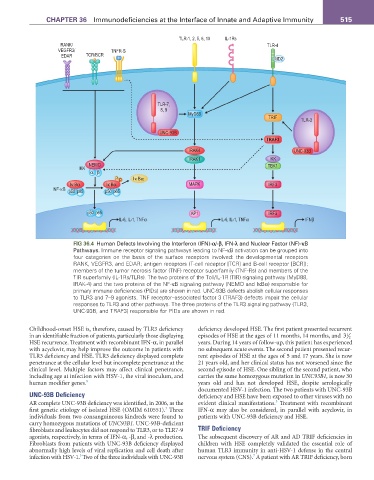
                         fIG 36.4  Human Defects Involving the Interferon (IFN)-α/-β, IFN-λ and Nuclear Factor (NF)-κB
                         Pathways. Immune receptor signaling pathways leading to NF-κB activation can be grouped into
                         four categories on the basis of the surface receptors involved: the developmental receptors
                         RANK, VEGFR3, and EDAR; antigen receptors (T-cell receptor [TCR] and B-cell receptor [BCR]);
                         members of the tumor necrosis factor (TNF) receptor superfamily (TNF-Rs) and members of the
                         TIR superfamily (IL-1Rs/TLRs). The two proteins of the Toll/IL-1R (TIR) signaling pathway (MyD88,
                         IRAK-4) and the two proteins of the NF-κB signaling pathway (NEMO and IκBα) responsible for
                         primary immune deficiencies (PIDs) are shown in red. UNC-93B defects abolish cellular responses
                         to TLR3 and 7–9 agonists. TNF receptor–associated factor 3 (TRAF3) defects impair the cellular
                         responses to TLR3 and other pathways. The three proteins of the TLR3 signaling pathway (TLR3,
                         UNC-93B, and TRAF3) responsible for PIDs are shown in red.

           Childhood-onset HSE is, therefore, caused by TLR3 deficiency   deficiency developed HSE. The first patient presented recurrent
           in an identifiable fraction of patients, particularly those displaying   episodes of HSE at the ages of 11 months, 14 months, and  3 2
                                                                                                                  1
           HSE recurrence. Treatment with recombinant IFN-α, in parallel   years. During 14 years of follow-up, this patient has experienced
           with acyclovir, may help improve the outcome in patients with   no subsequent acute events. The second patient presented recur-
           TLR3 deficiency and HSE. TLR3 deficiency displayed complete   rent episodes of HSE at the ages of 5 and 17 years. She is now
           penetrance at the cellular level but incomplete penetrance at the   21 years old, and her clinical status has not worsened since the
           clinical level. Multiple factors may affect clinical penetrance,   second episode of HSE. One sibling of the second patient, who
           including age at infection with HSV-1, the viral inoculum, and   carries the same homozygous mutation in UNC93B1, is now 30
           human modifier genes. 8                                years old and has not developed HSE, despite serologically
                                                                  documented HSV-1 infection. The two patients with UNC-93B
           UNC-93B Deficiency                                     deficiency and HSE have been exposed to other viruses with no
                                                                                           3
           AR complete UNC-93B deficiency was identified, in 2006, as the   evident clinical manifestations.  Treatment with recombinant
                                                       3
           first genetic etiology of isolated HSE (OMIM 610551).  Three   IFN-α may also be considered, in parallel with acyclovir, in
           individuals from two consanguineous kindreds were found to   patients with UNC-93B deficiency and HSE.
           carry homozygous mutations of UNC93B1. UNC-93B-deficient
           fibroblasts and leukocytes did not respond to TLR3, or to TLR7-9   TRIF Deficiency
           agonists, respectively, in terms of IFN-α, -β, and -λ production.   The subsequent discovery of AR and AD TRIF deficiencies in
           Fibroblasts from patients with UNC-93B deficiency displayed   children with HSE completely validated the essential role of
           abnormally high levels of viral replication and cell death after   human TLR3 immunity in anti-HSV-1 defense in the central
                           3
                                                                                    7
           infection with HSV-1.  Two of the three individuals with UNC-93B   nervous system (CNS).  A patient with AR TRIF deficiency, born

