


Page 538 - Clinical Immunology_ Principles and Practice ( PDFDrive )
P. 538
CHaPTEr 36  Immunodeficiencies at the Interface of Innate and Adaptive Immunity                 517


           cells differentiated in vitro from patient-specific induced plu-
           ripotent stem cells displayed uncontrolled virus replication and
           impaired IFN-β production. The patient had no other serious
           viral infections despite being seropositive for a myriad respiratory
                                                    10
           viruses and is currently healthy at the age of 8 years.  Thus the
           IRF7-dependent IFN amplification pathway is crucial for the
           mounting of antiviral responses to influenza virus but may be
           redundant for other viruses.

           GENETIC DISORDERS OF
           NF-κB–MEDIATED IMMUNITY                                  A

           This group of inherited disorders leads to impaired NF-κB signal-
           ing and strong susceptibility to pyogenic bacteria. Affected patients
           bear mutations of NEMO, NFKBIA, IRAK4, MYD88, HOIL1, or
           HOIP (see Fig. 36.4). 16,41,42  Patients with ectodermal dysplasia,
           anhidrotic (EDA) and immunodeficiency (EDA-ID) syndrome
           carry either XR hypomorphic mutations of NEMO, AD hyper-
           morphic mutations of NFKBIA, or AR amorphic mutations of
               43
           IKKB.  Diverse mutations have been found in NEMO, associated   B
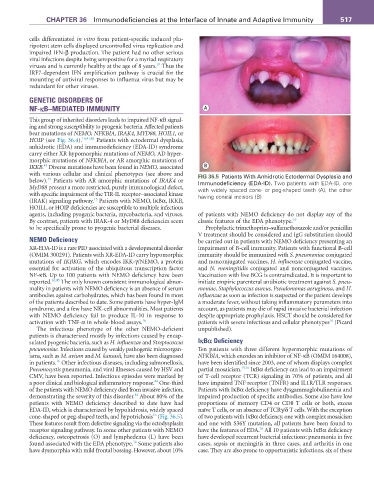
           with various cellular and clinical phenotypes (see above and   fIG 36.5  Patients With Anhidrotic Ectodermal Dysplasia and
                 44
           below).  Patients with AR amorphic mutations of IRAK4 or   Immunodeficiency (EDA-ID). Two patients with EDA-ID, one
           MyD88 present a more restricted, purely immunological defect,   with widely spaced cone- or peg-shaped teeth (A), the other
           with specific impairment of the TIR-IL receptor–associated kinase   having conical incisors (B).
                                13
           (IRAK) signaling pathway.  Patients with NEMO, IκBα, IKKB,
           HOIL1, or HOIP deficiencies are susceptible to multiple infectious
           agents, including pyogenic bacteria, mycobacteria, and viruses.   of patients with NEMO deficiency do not display any of the
           By contrast, patients with IRAK-4 or MyD88 deficiencies seem   classic features of the EDA phenotype. 16
           to be specifically prone to pyogenic bacterial diseases.  Prophylactic trimethoprim–sulfamethoxazole and/or penicillin
                                                                  V treatment should be considered and IgG substitution should
           NEMO Deficiency                                        be carried out in patients with NEMO deficiency presenting an
           XR-EDA-ID is a rare PID associated with a developmental disorder   impairment of B-cell immunity. Patients with functional B-cell
           (OMIM 300291). Patients with XR-EDA-ID carry hypomorphic   immunity should be immunized with S. pneumoniae conjugated
           mutations of IKBKG, which encodes IKK-γ/NEMO, a protein   and nonconjugated vaccines, H. influenzae conjugated vaccine,
           essential for activation of the ubiquitous transcription factor   and  N. meningitidis conjugated and nonconjugated vaccines.
           NF-κB. Up to 100 patients with NEMO deficiency have been   Vaccination with live BCG is contraindicated. It is important to
           reported. 16,43  The only known consistent immunological abnor-  initiate empiric parenteral antibiotic treatment against S. pneu-
           mality in patients with NEMO deficiency is an absence of serum   moniae, Staphylococcus aureus, Pseudomonas aeruginosa, and H.
           antibodies against carbohydrates, which has been found in most   influenzae as soon as infection is suspected or the patient develops
           of the patients described to date. Some patients have hyper-IgM   a moderate fever, without taking inflammatory parameters into
           syndrome, and a few have NK-cell abnormalities. Most patients   account, as patients may die of rapid invasive bacterial infection
           with NEMO deficiency fail to produce IL-10 in response to   despite appropriate prophylaxis. HSCT should be considered for
                                                                                                             16
           activation with TNF-α in whole-blood assays. 16        patients with severe infectious and cellular phenotypes  (Picard
             The  infectious  phenotype of  the  other  NEMO-deficient   unpublished).
           patients is characterized mostly by infections caused by encap-
           sulated pyogenic bacteria, such as H. influenzae and Streptococcus   IκBα Deficiency
           pneumoniae. Infections caused by weakly pathogenic microorgan-  Ten patients with three different hypermorphic mutations of
           isms, such as M. avium and M. kansasii, have also been diagnosed   NFKBIA, which encodes an inhibitor of NF-κB (OMIM 164008),
                    16
           in patients.  Other infectious diseases, including salmonellosis,   have been identified since 2003, one of whom displays complex
           Pneumocystis pneumonia, and viral illnesses caused by HSV and   partial mosaicism. 15,16  IκBα deficiency can lead to an impairment
           CMV, have been reported. Infectious episodes were marked by   of T-cell receptor (TCR) signaling in 70% of patients, and all
                                                    44
           a poor clinical and biological inflammatory response.  One-third   have impaired TNF receptor (TNFR) and IL1R/TLR responses.
           of the patients with NEMO deficiency died from invasive infection,   Patients with IκBα deficiency have dysgammaglobulinemia and
                                             44
           demonstrating the severity of this disorder.  About 80% of the   impaired production of specific antibodies. Some also have low
           patients with NEMO deficiency described to date have had   proportions of memory CD4 or CD8 T cells or both, excess
           EDA-ID, which is characterized by hypohidrosis, widely spaced   naïve T cells, or an absence of TCRγ/δ T cells. With the exception
                                                   16
           cone-shaped or peg-shaped teeth, and hypotrichosis  (Fig. 36.5).   of two patients with IκBα deficiency, one with complex mosaicism
           These features result from defective signaling via the ectodysplasin   and one with S36Y mutation, all patients have been found to
                                                                                      16
           receptor signaling pathway. In some other patients with NEMO   have the features of EDA.  All 10 patients with IκBα deficiency
           deficiency, osteopetrosis (O) and lymphedema (L) have been   have developed recurrent bacterial infections: pneumonia in five
                                             16
           found associated with the EDA phenotype.  Some patients also   cases, sepsis or meningitis in three cases, and arthritis in one
           have dysmorphia with mild frontal bossing. However, about 10%   case. They are also prone to opportunistic infections, six of these

