


Page 563 - Clinical Immunology_ Principles and Practice ( PDFDrive )
P. 563
540          Part four  Immunological Deficiencies


                                                        Defective GALT


                                                      Inflammatory mediators
                               Epithelial dysfunction    TNF-α, IL6            Tissue degeneration


                                                                                Age-associated
                                                                                 adipogenesis
                                                       Increase in PAMPs      Senescence-associated
                                                         and alarmins           gene activation

                                                                                Accumulation of
                                                                                effector T cells


                                  Defective innate immunity  Frailty  Coronary artery disease
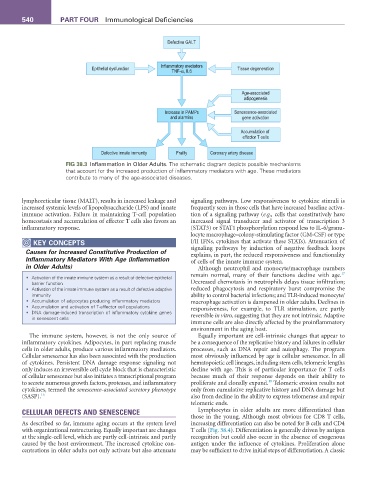
                       fIG 38.3  Inflammation in Older Adults. The schematic diagram depicts possible mechanisms
                       that account for the increased production of inflammatory mediators with age. These mediators
                       contribute to many of the age-associated diseases.


        lymphoreticular tissue (MALT), results in increased leakage and   signaling pathways. Low responsiveness to cytokine stimuli is
        increased systemic levels of lipopolysaccharide (LPS) and innate   frequently seen in those cells that have increased baseline activa-
        immune activation. Failure in maintaining T-cell population   tion of a signaling pathway (e.g., cells that constitutively have
        homeostasis and accumulation of effector T cells also favors an   increased signal transducer and activator of transcription 3
        inflammatory response.                                 (STAT3) or STAT1 phosphorylation respond less to IL-6/granu-
                                                               locyte macrophage–colony-stimulating factor (GM-CSF) or type
            KEY CoNCEPtS                                       I/II IFNs, cytokines that activate these STATs). Attenuation of
         Causes for Increased Constitutive Production of       signaling pathways by induction of negative feedback loops
                                                               explains, in part, the reduced responsiveness and functionality
         Inflammatory Mediators With Age (Inflammation         of cells of the innate immune system.
         in Older Adults)                                         Although neutrophil and monocyte/macrophage numbers
                                                                                                                 17
          •  Activation of the innate immune system as a result of defective epithelial   remain normal, many of their functions decline with age.
           barrier function                                    Decreased chemotaxis in neutrophils delays tissue infiltration;
          •  Activation of the innate immune system as a result of defective adaptive   reduced phagocytosis and respiratory burst compromise the
           immunity                                            ability to control bacterial infections; and TLR-induced monocyte/
          •  Accumulation of adipocytes producing inflammatory mediators  macrophage activation is dampened in older adults. Declines in
          •  Accumulation and activation of T-effector cell populations  responsiveness,  for  example,  to  TLR  stimulation,  are  partly
          •  DNA damage-induced transcription of inflammatory cytokine genes   reversible in vitro, suggesting that they are not intrinsic. Adaptive
           in senescent cells
                                                               immune cells are also directly affected by the proinflammatory
                                                               environment in the aging host.
           The immune system, however, is not the only source of   Equally important are cell-intrinsic changes that appear to
        inflammatory cytokines. Adipocytes, in part replacing muscle   be a consequence of the replicative history and failures in cellular
        cells in older adults, produce various inflammatory mediators.   processes, such as DNA repair and autophagy. The program
        Cellular senescence has also been associated with the production   most obviously influenced by age is cellular senescence. In all
        of cytokines. Persistent DNA damage response signaling not   hematopoietic cell lineages, including stem cells, telomeric lengths
        only induces an irreversible cell cycle block that is characteristic   decline with age. This is of particular importance for T cells
        of cellular senescence but also initiates a transcriptional program   because much of their response depends on their ability to
                                                                                         18
        to secrete numerous growth factors, proteases, and inflammatory   proliferate and clonally expand.  Telomeric erosion results not
        cytokines, termed the senescence-associated secretory phenotype   only from cumulative replicative history and DNA damage but
        (SASP). 16                                             also from decline in the ability to express telomerase and repair
                                                               telomeric ends.
        CELLULAR DEFECTS AND SENESCENCE                           Lymphocytes in older adults are more differentiated than
                                                               those in the young. Although most obvious for CD8 T cells,
        As described so far, immune aging occurs at the system level   increasing differentiation can also be noted for B cells and CD4
        with organizational restructuring. Equally important are changes   T cells (Fig. 38.4). Differentiation is generally driven by antigen
        at the single-cell level, which are partly cell-intrinsic and partly   recognition but could also occur in the absence of exogenous
        caused by the host environment. The increased cytokine con-  antigen under the  influence of cytokines. Proliferation alone
        centrations in older adults not only activate but also attenuate   may be sufficient to drive initial steps of differentiation. A classic

