


Page 560 - Clinical Immunology_ Principles and Practice ( PDFDrive )
P. 560
CHaPtEr 38  Immune Deficiencies at the Extremes of Age                537


           (primarily IgG) through opsonization, neutralization, or antibody-  The reduced antibody titers observed during infancy can be
           dependent cellular cytotoxicity (ADCC). However, infants   accounted for by the functional inability of infant B cells to
           demonstrate significantly lower levels of IgG and IgA compared   undergo class-switching from IgM to IgA or IgG upon antigen
                                                                           5
           with adults throughout the first year of life, in both the periphery   stimulation  and the poor survival of antibody-secreting plasma
           and mucosae.                                           cells within the infant bone marrow. Moreover, infant B cells
                                                                  have lower rates of somatic hypermutation compared with those
           INFANCY AND FUNCTIONAL DIFFERENTIATION OF              of adults, which is important for affinity maturation and the
           ADAPTIVE IMMUNE CELLS                                  generation of high-affinity antibodies. Although these defects
                                                                  can be partially attributed to extrinsic T-cell defects, such as
           The acquisition of a mature adaptive immune system requires   poor Tfh generation, intrinsic defects in infant B cells (e.g., lack
           exposure to antigens for cells to form immunological memory.   of costimulatory molecules and receptors to T cell–independent
           Not only are infants born with limited antigen exposure and thus   factors) also prevent effective antibody responses. Collectively,
           little memory, infant responses to antigenic stimulation in the   these neonatal B-cell defects lead to less effective and shorter-lived
           T- and B-cell compartments display altered functions compared   antibody responses against infectious pathogens and vaccines
           with that of adults. The most striking alterations are seen within   during early infancy.
           the CD4 T-cell compartment, characterized by significantly
           increased frequency of immunosuppressive T regulatory cells    KEY CoNCEPtS
                                                4
           (Tregs; 30–40% in infants vs 1–10% in adults).  These changes
           accompany increased Th2 subsets and defective differentiation   Characteristics of the Developing Adaptive
           to effector Th1 and T-follicular helper (Tfh) cells during early   Immune System
           infancy. Moreover, decreased expression of Lck in infant CD4 T   •  High frequencies of naïve and immature T and B cells
                                                            2
           cells leads to decreased T-cell activation upon antigen exposure.    •  Skewing of CD4 T-cell population towards immunosuppressive regula-
           Altered differentiation of CD4 Th subsets and blunted T-cell   tory T cells and T-helper 2 (Th2) cells
           activation promotes a tolerance-inducing environment good for   •  Reduced functionality and memory responses of CD8 T cells to viral
           controlling unnecessary responses to foreign antigen exposure   infections
           after birth. However, it also leads to inhibition of effective cytotoxic   •  Limited ability of B cells to produce high-affinity, class-switched antibod-
           T cells and limits B-cell antibody responses against infectious   ies in response to both T cell–dependent and T cell–independent
                                                                     antigens
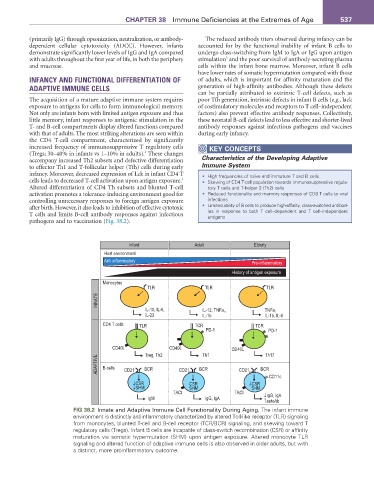
           pathogens and to vaccination (Fig. 38.2).


                                           Infant                Adult              Elderly
                                   Host environment
                                   Anti-inflammatory                               Pro-inflammatory
                                                                             History of antigen exposure
                                   Monocytes
                                                 TLR                TLR                 TLR
                                 INNATE
                                                IL-10, IL-6,       IL-12, TNFa,,        TNFa,
                                                IL-23              IL-1b                IL-1b, IL-6
                                   CD4 T cells  TLR              TCR                 TCR
                                                                    PD-1                 PD-1

                                      CD40L     Treg, Th2  CD40L   Th1       CD40L      Th17
                                 ADAPTIVE  B cells  CD21  BCR  CD21  BCR       CD21   BCR


                                                                                         CD11c
                                            ↓CSR               CSR                ↓CSR
                                            ↓SHM               SHM                  SHM
                                                          TACI                TACI     ↓IgG, IgA
                                                 IgM                IgG, IgA
                                                                                       ↑autoAb
                         fIG 38.2  Innate and Adaptive Immune Cell Functionality During Aging. The infant immune
                         environment is distinctly antiinflammatory characterized by altered Toll-like receptor (TLR) signaling
                         from monocytes, blunted T-cell and B-cell receptor (TCR/BCR) signaling, and skewing toward T
                         regulatory cells (Tregs). Infant B cells are incapable of class-switch recombination (CSR) or affinity
                         maturation via  somatic hypermutation  (SHM) upon antigen  exposure. Altered monocyte  TLR
                         signaling and altered function of adaptive immune cells is also observed in older adults, but with
                         a distinct, more proinflammatory outcome.

