


Page 561 - Clinical Immunology_ Principles and Practice ( PDFDrive )
P. 561
538          Part four  Immunological Deficiencies


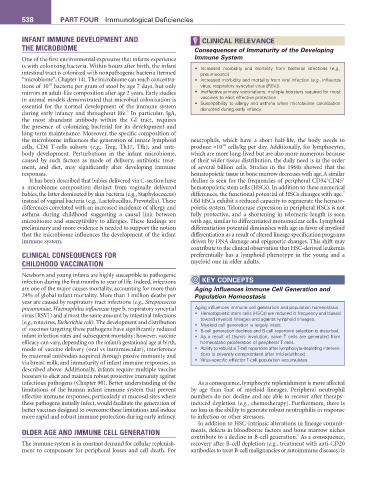
        INFANT IMMUNE DEVELOPMENT AND                              CLINICaL rELEVaNCE
        THE MICROBIOME                                           Consequences of Immaturity of the Developing

        One of the first environmental exposures that infants experience   Immune System
        is with colonizing bacteria. Within hours after birth, the infant   •  Increased  morbidity and  mortality  from  bacterial  infections  (e.g.,
        intestinal tract is colonized with nonpathogenic bacteria (termed   pneumococci)
        “microbiome”; Chapter 14). The microbiome can reach concentra-  •  Increased morbidity and mortality from viral infection (e.g., influenza
                 10
        tions of 10  bacteria per gram of stool by age 7 days, but only   virus, respiratory syncytial virus [RSV])
        mirrors an adult-like composition after age 2 years. Early studies   •  Ineffective primary vaccinations; multiple boosters required for most
        in animal models demonstrated that microbial colonization is   vaccines to elicit effective protection
        essential for the normal development of the immune system   •  Susceptibility to allergy and asthma when microbiome colonization
                                                                   disrupted during early infancy
                                          6
        during early infancy and throughout life.  In particular, IgA,
        the most abundant antibody within the GI tract, requires
        the presence of colonizing bacterial for its development and
        long-term maintenance. Moreover, the specific composition of
        the microbiome influences the generation of innate lymphoid   neutrophils, which have a short half-life, the body needs to
                                                                          10
        cells, CD4 T-cells subsets (e.g., Treg, Th17, Tfh), and anti-  produce ≈10  cells/kg per day. Additionally, for lymphocytes,
        body development. Perturbations in the infant microbiome,   which are more long-lived but are also more numerous because
        caused  by  such  factors  as  mode  of  delivery,  antibiotic  treat-  of their wider tissue distribution, the daily need is in the order
        ment, and diet, may significantly alter developing immune     of several billion cells. Studies in the 1960s showed that the
        responses.                                             hematopoietic tissue in bone marrow decreases with age. A similar
                                                                                                            +
                                                                                                                 +
           It has been described that babies delivered via C-section have   decline is seen for the frequencies of peripheral CD34 CD45
        a microbiome composition distinct from vaginally delivered   hematopoietic stem cells (HSCs). In addition to these numerical
                                                                                                                 7
        babies, the latter dominated by skin bacteria (e.g., Staphylococcus)   differences, the functional potential of HSCs changes with age.
        instead of vaginal bacteria (e.g., Lactobacillus, Prevotella). These   Old HSCs exhibit a reduced capacity to regenerate the hemato-
        differences correlated with an increased incidence of allergy and   poietic system. Telomerase expression in peripheral HSCs is not
        asthma  during  childhood  suggesting  a  causal  link  between   fully protective, and a shortening in telomeric length is seen
        microbiome and susceptibility to allergies. These findings are   with age, similar to differentiated mononuclear cells. Lymphoid
        preliminary and more evidence is needed to support the notion   differentiation potential diminishes with age in favor of myeloid
        that the microbiome influences the development of the infant   differentiation as a result of altered lineage specification programs
        immune system.                                         driven by DNA damage and epigenetic changes. This shift may
                                                               contribute to the clinical observation that HSC-derived leukemia
        CLINICAL CONSEQUENCES FOR                              preferentially has a lymphoid phenotype in the young and a
        CHILDHOOD VACCINATION                                  myeloid one in older adults.

        Newborn and young infants are highly susceptible to pathogenic
        infection during the first months to year of life. Indeed, infections    KEY CoNCEPtS
        are one of the major causes mortality, accounting for more than   Aging Influences Immune Cell Generation and
        24% of global infant mortality. More than 1 million deaths per   Population Homeostasis
        year are caused by respiratory tract infections (e.g., Streptococcus
        pneumoniae, Haemophilus influenzae type b, respiratory syncytial   Aging influences immune cell generation and population homeostasis.
        virus [RSV]) and almost the same amount by intestinal infections   •  Hematopoietic stem cells (HSCs) are reduced in frequency and biased
                                                                   toward myeloid lineages and against lymphoid lineages.
        (e.g., rotavirus, Escherichia coli). The development and distribution   •  Myeloid cell generation is largely intact.
        of vaccines targeting these pathogens have significantly reduced   •  B-cell generation declines and B-cell repertoire selection is disturbed.
        infant infection rates and subsequent mortality; however, vaccine   •  As a result of thymic involution, naïve T cells are generated from
        efficacy can vary, depending on the infant’s gestational age at birth,   homeostatic proliferation of peripheral T cells.
        mode of vaccine delivery (oral vs intramuscular), interference   •  Ability to rebuild a T-cell repertoire after lymphocyte-depleting interven-
        by maternal antibodies acquired through passive immunity and   tions is severely compromised after mid-adulthood.
        via breast milk, and immaturity of infant immune responses, as   •  Virus-specific effector T-cell population accumulates.
        described above. Additionally, infants require multiple vaccine
        boosters to elicit and maintain robust protective immunity against
        infectious pathogens (Chapter 90). Better understanding of the   As a consequence, lymphocyte replenishment is more affected
        limitations of the human infant immune system that prevent   by age than that of myeloid lineages. Peripheral neutrophil
        effective immune responses, particularly at mucosal sites where   numbers do not decline and are able to recover after therapy-
        these pathogens initially infect, would facilitate the generation of   induced depletion (e.g., chemotherapy). Furthermore, there is
        better vaccines designed to overcome these limitations and induce   no loss in the ability to generate robust neutrophilia in response
        more rapid and robust immune protection during early infancy.  to infection or other stressors.
                                                                  In addition to HSC-intrinsic alterations in lineage commit-
        OLDER AGE AND IMMUNE CELL GENERATION                   ments, defects in bloodborne factors and bone marrow niches
                                                                                                  8
                                                               contribute to a decline in B-cell generation.  As a consequence,
        The immune system is in constant demand for cellular replenish-  recovery after B-cell depletion (e.g., treatment with anti-CD20
        ment to compensate for peripheral losses and cell death. For   antibodies to treat B-cell malignancies or autoimmune diseases) is

