


Page 586 - Clinical Immunology_ Principles and Practice ( PDFDrive )
P. 586
562          ParT FOur  Immunological Deficiencies


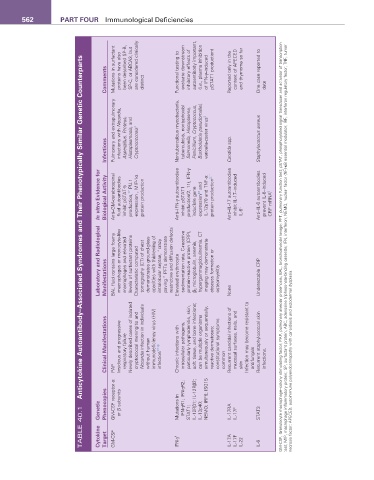
                            anticytokine autoantibody–associated Syndromes and Their Phenotypically Similar Genetic Counterparts

                                    Comments  Mutations in surfactant   proteins have also   been described SP-B,   SP-C, or ABCA3, but  are considered clinically   distinct  Functional testing to   evaluate downstream   inhibitory effects of  autoantibody important,   (i.e., plasma inhibition   of IFN-γ–induced   pSTAT1 production)  Reported only in the   context of APECED   and thymoma so far  One case reported to   date


                                      Pulmonary and extrapulmonary  infections with Nocardia,   Aspergillus, Proteus,   Histoplasmosis, and   Nontuberculous mycobacteria,  tuberculosis, nontyphoidal  Salmonella, Histoplasma,  Penicillium, Cryptococcus,  Burkholderia pseudomallei,   varicella-zoster virus 2  Staphylococcus aureus


                                    Infections  Cryptococcosis 1             Candida spp.


                                  In vitro Evidence for   Biological activity  Anti–GM-cerebrospinal   fluid autoantibodies   inhibit pSTAT-5   production, 17  PU.1   expression , MIP-1α   protein production  Anti–IFN-γ autoantibodies   inhibit pSTAT1   production(2, 11), IFN-γ   inducible gene   expression 29  and   IL-12p70 and TNF-α   protein production 2,11  Anti–IL-17 autoantibodies   inhibit IL-17–induced   IL-6 4  Anti–IL-6 autoantibodies   prevent IL-6–induced   CRP mRNA 5


                                  Laboratory and radiological   Manifestations  BAL fluid contains large foamy  macrophages or monocyte-like  macrophages and elevated  levels of surfactant proteins Characteristic computed  tomography (CT) of chest  demonstrates ground-glass  opacities with thickening of  intralobular septae, “crazy  paving.” PFTs demonstrate  restrictive and diffusion defects 1  Elevated erythrocyte  sedimentation rate, C-reactive  protein-reactive protein (CRP),  β


                                    Clinical Manifestations  PAP Insidious and progressive   respiratory failure Newly described cases of isolated  cryptococcal meningitis and  Nocardia infection in individuals   without human  immunodeficiency virus (HIV)   infection 17-19  Chronic infections with  intracellular pathogens,  particularly lymphadenitis, skin,  soft tissue, and bone infections;  can be multiple organisms  simultaneously or sequentially;   reactive dermatoses;   constit


                            TABLE 40.1   Genetic   Cytokine   Phenocopies  Target  GM-CSF receptor α   GM-CSF  or β subunits  Mutations in   IFN-γ h  IFN-γR1; IFN-γR2;  STAT1;  IL-12Rβ1; IL-12Rβ2;  IL-12p40;  NEMO; IRF8; ISG15  IL-17RA  IL-17A  IL-17F  IL-17F  IL-22  STAT3  IL-6

