


Page 589 - Clinical Immunology_ Principles and Practice ( PDFDrive )
P. 589
CHaPTEr 40  Autoantibody-Mediated Phenocopies of Primary Immunodeficiency Diseases                   565


                                                                  and IL-17RC heterodimeric receptor complexes, ultimately
                                                                  activating NF-κB. IL-22, produced by T lymphocytes and NK
                                                                  cells, also signals via a heterodimeric receptor composed of
                                                                  IL-22R1 and IL-10R2 subunits, expressed mainly on epithelial
                                 B lymphocytes                    and other nonimmune cells. IL-17A/F and IL-22 cooperate to
                                                                  induce proinflammatory cytokines involved in granulopoiesis
                                                                  and neutrophil recruitment as well as antimicrobial peptides,
                                                                  such as β defensins and S100 proteins, which are thought to be
                                                                  important in mucosal immunity. Clinical evidence for a protective
                                                                  role of IL-17 in CMC arose from the observation of this infectious
                                                                  complication in diseases with varying degrees of Th17 impairment,
                                                                  including STAT3-deficient hyper-IgE syndrome (HIES, or Job’s
              Monocyte/           IFN-γ                           syndrome), dectin-1 deficiency, CARD9 deficiency, and, to a
              macrophage                            Th1 cell      lesser degree, IL-12 receptor β 1  deficiency.  Strong support of
                                                                                                    27
                         IFN-γ
                        receptor                                  this hypothesis came via instances of two families that demon-
                                                                  strated inherited susceptibility to mucosal candidiasis: one with
                                                IL-12             an autosomal recessive mutation in IL-17RA, and another with
                                               receptor           an autosomal dominant negative mutation in IL-17F. 27
                                  IL-12
                                                                    APECED syndrome is another mendelian disorder associated
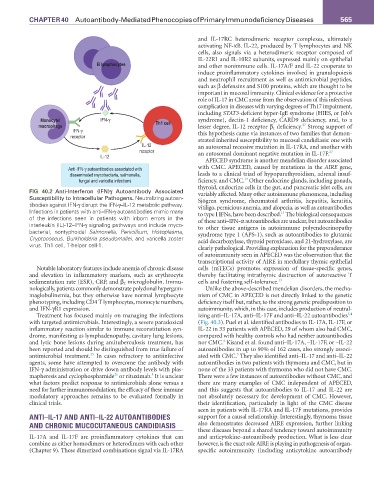
                       Anti-IFN-γ autoantibodies associated with  with CMC. APECED, caused by mutations in the AIRE gene,
                        disseminated mycobacteria, salmonella,    leads to a clinical triad of hypoparathyroidism, adrenal insuf-
                                                                                 13
                           fungal and varicella infections        ficiency, and CMC.  Other endocrine glands, including gonads,
                                                                  thyroid, endocrine cells in the gut, and pancreatic islet cells, are
           FIG 40.2  Anti-Interferon  (IFN)γ Autoantibody  Associated   variably affected. Many other autoimmune phenomena, including
           Susceptibility to Intracellular Pathogens. Neutralizing autoan-  Sjögren syndrome, rheumatoid arthritis, hepatitis, keratitis,
           tibodies against IFN-γ disrupt the IFN-γ–IL-12 metabolic pathway.   vitiligo, pernicious anemia, and alopecia, as well as autoantibodies
           Infections in patients with anti–IFN-γ autoantibodies mimic many   to type I IFNs, have been described.  The biological consequences
                                                                                             13
           of the infections seen in patients with inborn errors in the   of these anti–IFN-α autoantibodies are unclear, but autoantibodies
           interleukin (IL)-12–IFN-γ signaling pathways and include myco-  to  other tissue antigens in  autoimmune  polyendocrinopathy
           bacterial, nontyphoidal  Salmonella, Penicillium, Histoplasma,   syndrome type 1 (APS-1), such as autoantibodies to glutamic
           Cryptococcus, Burkholderia pseudomallei, and varicella zoster   acid decarboxylase, thyroid peroxidase, and 21-hydroxylase, are
           virus. Th1 cell, T-helper cell-1.
                                                                  clearly pathological. Providing explanation for the preponderance
                                                                  of autoimmunity seen in APECED was the observation that the
                                                                  transcriptional activity of AIRE in medullary thymic epithelial
             Notable laboratory features include anemia of chronic disease   cells (mTECs) promotes expression of tissue-specific genes,
           and elevation in inflammatory markers, such as erythrocyte   thereby facilitating intrathymic destruction of autoreactive T
           sedimentation rate (ESR), CRP, and β 2  microglobulin. Immu-  cells and fostering self-tolerance. 13
           nologically, patients commonly demonstrate polyclonal hypergam-  Unlike the above-described mendelian disorders, the mecha-
           maglobulinemia, but they otherwise have normal lymphocyte   nism of CMC in APECED is not directly linked to the genetic
           phenotyping, including CD4 T lymphocytes, monocyte numbers,   deficiency itself but, rather, to the strong genetic predisposition to
           and IFN-γR1 expression.                                autoimmunity, which, in this case, includes production of neutral-
                                                                                                                   3,4
             Treatment has focused mainly on managing the infections   izing anti–IL-17A, anti–IL-17F and anti–IL-22 autoantibodies
           with targeted antimicrobials. Interestingly, a severe paradoxical   (Fig. 40.3). Puel et al. identified antibodies to IL-17A, IL-17F, or
           inflammatory reaction similar to immune reconstitution syn-  IL-22 in 33 patients with APECED, 29 of whom also had CMC,
           drome, manifesting as lymphadenopathy, cavitary lung lesions,   compared with healthy controls who had neither autoantibodies
                                                                          4
           and lytic bone lesions during antituberculosis treatment, has   nor CMC.  Kisand et al. found anti–IL-17A, –IL-17F, or –IL-22
           been reported and should be distinguished from true failure of   autoantibodies in up to 90% of 162 cases, also strongly associ-
                                                                              3
                               25
           antimicrobial treatment.  In cases refractory to antiinfective   ated with CMC.  They also identified anti–IL-17 and anti–IL-22
           agents, some have attempted to overcome the antibody with   autoantibodies in two patients with thymoma and CMC, but in
           IFN-γ administration or drive down antibody levels with plas-  none of the 33 patients with thymoma who did not have CMC.
                                                   8
                                      26
           mapheresis and cyclophosphamide  or rituximab.  It is unclear   There were a few instances of autoantibodies without CMC, and
           what factors predict response to antimicrobials alone versus a   there are many examples of CMC independent of  APECED,
           need for further immunomodulation; the efficacy of these immune   and this suggests that autoantibodies to IL-17 and IL-22 are
           modulatory approaches remains to be evaluated formally in   not  absolutely  necessary  for  development  of  CMC.  However,
           clinical trials.                                       their  identification, particularly  in  light  of the  CMC  disease
                                                                  seen in patients with IL-17RA and IL-17F mutations, provides
           ANTI–IL-17 AND ANTI–IL-22 AUTOANTIBODIES               support for a causal relationship. Interestingly, thymoma tissue
           AND CHRONIC MUCOCUTANEOUS CANDIDIASIS                  also demonstrates decreased AIRE expression, further linking
                                                                  these diseases beyond a shared tendency toward autoimmunity
           IL-17A  and  IL-17F  are  proinflammatory  cytokines  that  can   and anticytokine–autoantibody production. What is less clear
           combine as either homodimers or heterodimers with each other   however, is the exact role AIRE is playing in pathogenesis of organ-
           (Chapter 9). These dimerized combinations signal via IL-17RA   specific autoimmunity (including anticytokine autoantibody

