


Page 582 - Clinical Immunology_ Principles and Practice ( PDFDrive )
P. 582
CHaPTEr 39  HIV and Acquired Immunodeficiency Syndrome                   559


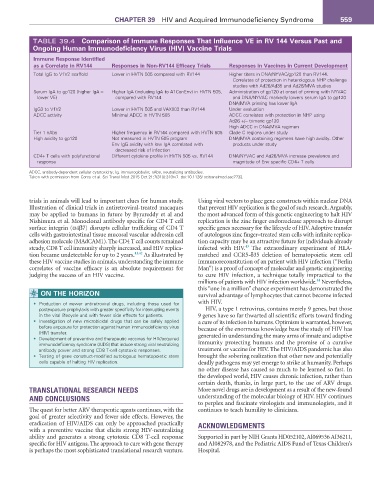
            TABLE 39.4  Comparison of Immune responses That Influence VE in rV 144 Versus Past and
            Ongoing Human Immunodeficiency Virus (HIV) Vaccine Trials
            Immune response Identified
            as a Correlate in rV144   responses in Non-rV144 Efficacy Trials  responses in Vaccines in Current Development
            Total IgG to V1V2 scaffold  Lower in HVTN 505 compared with RV144  Higher titers in DNA/NYVAC/gp120 than RV144.
                                                                             Correlates of protection in heterologous NHP challenge
                                                                             studies with Ad26/Ad35 and Ad26/MVA studies
            Serum IgA to gp120 (higher IgA =   Higher IgA (including IgA to A1ConEnv) in HVTN 505,   Administration of gp120 at onset of priming with NYVAC
             lower VE)                 compared with RV144                   and DNA/NYVAC markedly lowers serum IgA to gp120
                                                                            DNA/MVA priming has lower IgA
            IgG3 to V1V2              Lower in HVTN 505 and VAX003 than RV144  Under evaluation
            ADCC activity             Minimal ADCC in HVTN 505              ADCC correlates with protection in NHP using
                                                                            Ad26 +/− trimeric gp120
                                                                            High ADCC in DNA/MVA regimen
            Tier 1 nAbs               Higher frequency in RV144 compared with HVTN 505  Clade C regions under study
            High avidity to gp120     Not measured in HVTN 505 program      DNA/MVA containing regimens have high avidity. Other
                                      Env IgG avidity with low IgA correlated with   products under study
                                       decreased risk of infection
            CD4+ T cells with polyfunctional   Different cytokine profile in HVTN 505 vs. RV144  DNA/NYVAC and Ad26/MVA increase prevalence and
             response                                                        magnitude of Env specific CD4+ T cells

           ADCC, antibody-dependent cellular cytotoxicity; Ig, immunoglobulin; nAbs, neutralizing antibodies.
           Taken with permission from Corey et al. Sci Transl Med 2015 Oct 21;7(310):310rv7. doi:10.1126/ scitranslmed.aac7732.


           trials in animals will lead to important clues for human study.   Using viral vectors to place gene constructs within nuclear DNA
           Illustration of clinical trials in antiretroviral-treated macaques   that prevent HIV replication is the goal of such research. Arguably,
           may be applied to humans in future by Byrareddy et al and   the most advanced form of this genetic engineering to halt HIV
           Nishimura et al. Monoclonal antibody specific for CD4 T cell   replication is the zinc finger endonuclease approach to disrupt
           surface integrin (α4β7) disrupts cellular trafficking of CD4 T   specific genes necessary for the lifecycle of HIV. Adoptive transfer
           cells with gastrointestinal tissue mucosal vascular addressin cell   of autologous zinc finger–treated stem cells with infinite replica-
           adhesion molecule (MAdCAM1). The CD4 T cell counts remained   tion capacity may be an attractive future for individuals already
                                                                                 43
           steady, CD8 T cell immunity sharply increased, and HIV replica-  infected with HIV.  The extraordinary experiment of HLA-
           tion became undetectable for up to 2 years. 41,42  As illustrated by   matched and CCR5-δ35 deletion of hematopoietic stem cell
           these HIV vaccine studies in animals, understanding the immune   immunoreconstitution of an patient with HIV infection (“Berlin
           correlates of vaccine efficacy is an absolute requirement for   Man”) is a proof of concept of molecular and genetic engineering
           judging the success of an HIV vaccine.                 to cure HIV infection, a technique totally impractical to the
                                                                                                         44
                                                                  millions of patients with HIV infection worldwide.  Nevertheless,
                                                                  this “one in a million” chance experiment has demonstrated the
               ON THE HOrIZON                                     survival advantage of lymphocytes that cannot become infected
            •  Production  of newer  antiretroviral  drugs, including  those  used for   with HIV.
              postexposure prophylaxis with greater specificity for interrupting events   HIV, a type 1 retrovirus, contains merely 9 genes, but those
              in the viral lifecycle and with fewer side effects for patients.  9 genes have so far thwarted all scientific efforts toward finding
            •  Investigation of new microbicidal drugs that can be safely applied   a cure of its infection in humans. Optimism is warranted, however,
              before exposure for protection against human immunodeficiency virus   because of the enormous knowledge base the study of HIV has
              (HIV) transfer.
            •  Development of preventive and therapeutic vaccines for HIV/acquired   generated in understanding the many arms of innate and adaptive
              immunodeficiency syndrome (AIDS) that induce strong viral neutralizing   immunity protecting humans and the promise of a curative
              antibody power and strong CD8 T-cell cytotoxic responses.  treatment or vaccine for HIV. The HIV/AIDS pandemic has also
            •  Testing of gene construct-modified autologous hematopoietic stem   brought the sobering realization that other new and potentially
              cells capable of halting HIV replication.           deadly pathogens may yet emerge to strike at humanity. Perhaps
                                                                  no other disease has caused so much to be learned so fast. In
                                                                  the developed world, HIV causes chronic infection, rather than
                                                                  certain death, thanks, in large part, to the use of ARV drugs.
           TRANSLATIONAL RESEARCH NEEDS                           More novel drugs are in development as a result of the new-found
           AND CONCLUSIONS                                        understanding of the molecular biology of HIV. HIV continues
                                                                  to perplex and fascinate virologists and immunologists, and it
           The quest for better ARV therapeutic agents continues, with the   continues to teach humility to clinicians.
           goal of greater selectivity and fewer side effects. However, the
           eradication of HIV/AIDS can only be approached practically   ACKNOWLEDGMENTS
           with a preventive vaccine that elicits strong HIV-neutralizing
           ability and generates a strong cytotoxic CD8 T-cell response   Supported in part by NIH Grants HD052102, AI069536 AI36211,
           specific for HIV antigens. The approach to cure with gene therapy   and AI082978, and the Pediatric AIDS Fund of Texas Children’s
           is perhaps the most sophisticated translational research venture.   Hospital.

