


Page 587 - Clinical Immunology_ Principles and Practice ( PDFDrive )
P. 587
CHaPTEr 40  Autoantibody-Mediated Phenocopies of Primary Immunodeficiency Diseases                   563


           OVERVIEW OF PATHOPHYSIOLOGY                            dendritic cells (DCs), erythrocyte progenitors, and megakaryo-
                                                                  cytes. The GM-CSF receptor is composed of two α and two β
           The pathophysiology of infection susceptibility is generally   subunits, which together bind two GM-CSF molecules with high
           thought to result from a functional deficiency in the cytokine   affinity and induce signal transduction and activator of transcrip-
           that is being neutralized (Chapter 9). It is believed that a high-  tion (STAT)–5 phosphorylation, nuclear translocation, and
           titer autoantibody binds its respective cytokine target, thereby   induction of master transcription factor PU.1. PAP was first
           blocking downstream signaling and biological activity. For each   described in 1958 by Rosen et al. as an idiopathic syndrome of
           anticytokine–autoantibody pair, it has been demonstrated that   respiratory failure, histopathologically characterized by alveolar
           plasma  or  purified  IgG  from  a  patient  with  the  anticytokine   filling with acellular periodic acid-Schiff–positive proteinaceous
                                                                         1
           autoantibody prevents the activity of the targeted cytokine at the   material.  The  pathogenesis  of  PAP has since been linked  to
           levels of signal transduction, gene transcription, and/or protein   congenital or acquired defects in the GM-CSF signaling pathway.
           expression. In the case of anti–IFN-γ autoantibodies, it appears   The first clues to the etiological mechanism of PAP surfaced
                                                                                               −/−
                                                  8
           that antibody levels may track with disease activity ; however, for   in 1994 and 1995 when a GM-CSF  and GM-CSF receptor
                                                                   −/−
           anti–GM-CSF autoantibodies, the results have been conflicting,   β  mice, respectively, demonstrated pulmonary disease that was
           and in neither case has the question been rigorously studied.   virtually identical to human PAP. Shortly thereafter, mechanisms
           It is also  possible, but not yet proven, that antibody-binding   involving disruption of GM-CSF signaling were linked to PAP
                                                                           1
           avidity may influence the degree of disease severity as well. Thus   in humans.  Primary PAP results from mutations in either the
           it may be possible to have high-titer, lower avidity anticytokine   GM-CSF receptor subunits α or β and generally leads to severe
           autoantibodies leading to a similar disease phenotype to low-titer,   respiratory failure and usually presents early in life. Autoimmune
           high-avidity anticytokine autoantibodies.              PAP results from neutralizing anti–GM-CSF autoantibodies, can
             The events that lead to the generation of anticytokine   also cause respiratory failure, and shares the same pulmonary
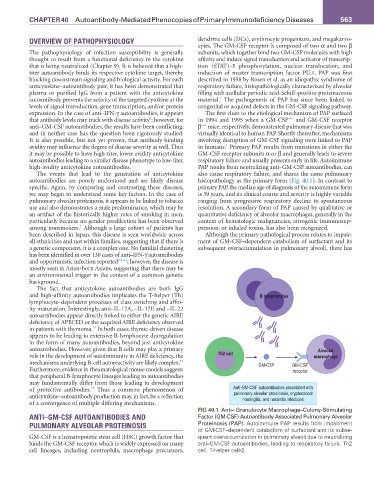
           autoantibodies are poorly understood and are likely disease   histopathology as the primary form (Fig. 40.1). In contrast to
           specific. Again, by comparing and contrasting these diseases,   primary PAP, the median age of diagnosis of the autoimmune form
           we may begin to understand some key factors. In the case of   is 39 years, and its clinical course and severity is highly variable
           pulmonary alveolar proteinosis, it appears to be linked to tobacco   ranging from progressive respiratory decline to spontaneous
           use and also demonstrates a male predominance, which may be   resolution. A secondary form of PAP caused by qualitative or
           an artifact of the historically higher rates of smoking in men,   quantitative deficiency of alveolar macrophages, generally in the
           particularly because no gender predilection has been observed   context of hematologic malignancies, iatrogenic immunosup-
                           1
           among nonsmokers.  Although a large cohort of patients has   pression, or inhaled toxins, has also been recognized.
           been described in Japan, this disease is seen worldwide across   Although the primary pathological process relates to impair-
           all ethnicities and not within families, suggesting that if there is   ment of GM-CSF–dependent catabolism of surfactant and its
           a genetic component, it is a complex one. No familial clustering   subsequent overaccumulation in pulmonary alveoli, there has
           has been identified in over 130 cases of anti–IFN-γ autoantibodies
           and opportunistic infection reported 2,9-12 ; however, the disease is
           mostly seen in Asian-born Asians, suggesting that there may be
           an environmental trigger in the context of a common genetic
           background.
             The  fact  that  anticytokine  autoantibodies  are  both  IgG
           and high-affinity autoantibodies implicates the T-helper (Th)              B lymphocytes
           lymphocyte–dependent processes of class switching and affin-
           ity maturation. Interestingly, anti–IL-17A, –IL-17F, and –IL-22
           autoantibodies appear directly linked to either the genetic AIRE
           deficiency of APECED or the acquired AIRE deficiency observed
                               13
           in patients with thymoma.  In both cases, thymic-driven disease
           appears to be leading to extensive B-lymphocyte dysregulation
           in the form of many autoantibodies, beyond just anticytokine
           autoantibodies. However, given that B cells may play a primary                                Alveolar
           role in the development of autoimmunity in AIRE deficiency, the   Th2 cell                   macrophage
                                                            13
           mechanisms underlying B-cell autoreactivity are likely complex.            GM-CSF     GM-CSF
           Furthermore, evidence in rheumatological mouse models suggests                        receptor
           that peripheral B-lymphocyte lineages leading to autoantibodies
           may fundamentally differ from those leading to development
                               14
           of  protective  antibodies.   Thus  a  common  phenomenon  of     Anti-GM-CSF autoantibodies associated with
           anticytokine–autoantibody production may, in fact, be a reflection   pulmonary alveolar proteinosis, cryptococcal
                                                                                meningitis, and nocardia infections
           of a convergence of multiple differing mechanisms.
                                                                  FIG 40.1  Anti– Granulocyte Macrophage–Colony-Stimulating
           ANTI–GM-CSF AUTOANTIBODIES AND                         Factor (GM-CSF) Autoantibody Associated Pulmonary Alveolar
           PULMONARY ALVEOLAR PROTEINOSIS                         Proteinosis (PAP). Autoimmune PAP results from impairment
                                                                  of GM-CSF–dependent catabolism of surfactant and its subse-
           GM-CSF is a hematopoietic stem cell (HSC) growth factor that   quent overaccumulation in pulmonary alveoli due to neutralizing
           binds the GM-CSF receptor, which is widely expressed on many   anti–GM-CSF autoantibodies, leading to respiratory failure. Th2
           cell lineages, including neutrophils, macrophage precursors,   cell, T-helper cell-2.

