


Page 581 - Clinical Immunology_ Principles and Practice ( PDFDrive )
P. 581
558          ParT fOur  Immunological Deficiencies


        secretions of infected partners and thereby reduce HIV transmis-  Association of certain major histocompatibility complex (MHC)
        sion to uninfected partners. The efficacy of the “Treatment as   molecules with HIV disease progression is clearly linked to the
        Prevention” model is demonstrated in the multinational HIV   cytotoxic T-cell responses. Unfortunately, the HIV vaccine-induced
        Prevention Trials Network (HPTN 052) clinical trial that examined   cytotoxic CD8 T-cell response is insufficient to halt the progression
        the effectiveness of ART to prevent the sexual transmission of   of acute or chronic HIV disease. This was clearly indicated in
        HIV in serodiscordant couples. Serodiscordant couples (1763   the STEP clinical trial, in which the CD8 T-cell effects were the
        in number) were randomly assigned to have the infected partner   same between HIV-infected vaccinees and sham HIV-infected
        either start ART immediately upon enrollment or to defer ART   vaccinee controls. Qualities of effector and central memory CD8
        until immunological or clinical criteria were met. Of 28 genetically   T cells that would be protective include (i) production of cytotoxic
        linked infections that occurred during the trial, only 1 infection   cytokines (e.g., IFN-γ and IL-2); (ii) rapidly replicating capacity;
        occurred in couples assigned to receive immediate treatment,   (iii) cytotoxic potential; (iv) high affinity for HIV antigens; (v)
        representing a 96% reduction in the risk of HIV transmission.   inhibition of HIV replication; (vi) recognition of specific HIV
        There were also fewer morbidity and mortality events in the   epitopes restricted by protective HLA-B antigens; (vii) central
        early-treatment group, suggesting a therapeutic benefit from   memory cells with long life spans; and (viii) rapid-attack memory
        early treatment as well.                               cells at mucosal HIV entry sites. A high-level collaboration of
           The fundamental paradigm for “Test and Treat” programs is   preeminent clinicians and scientists has proposed the modification
        the same as that for “Treatment as Prevention” programs. “Test   of the partially successful RV144 vaccine with the goal of produc-
        and Treat,” however, emphasizes the need for universal voluntary   ing a new HIV vaccine that will broadly neutralize HIV and
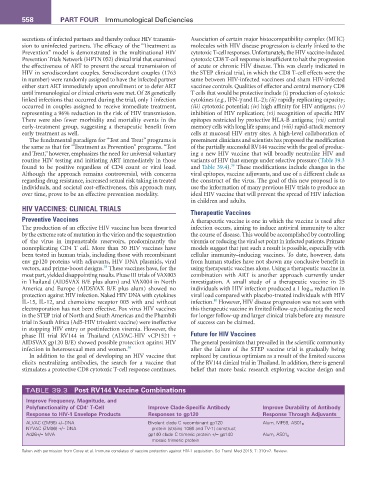
        routine HIV testing and initiating ART immediately in those   variants of HIV that emerge under selective pressure (Table 39.3
                                                                             39
        found to be positive regardless of CD4 count or viral load.   and Table 39.4).  These modifications include changes in the
        Although the approach remains controversial, with concerns   viral epitopes, vaccine adjuvants, and use of a different clade as
        regarding drug resistance, increased sexual risk taking in treated   the construct of the virus. The goal of this new proposal is to
        individuals, and societal cost-effectiveness, this approach may,   use the information of many previous HIV trials to produce an
        over time, prove to be an effective prevention modality.  ideal HIV vaccine that will prevent the spread of HIV infection
                                                               in children and adults.
        HIV VACCINES: CLINICAL TRIALS                          Therapeutic Vaccines
        Preventive Vaccines                                    A therapeutic vaccine is one in which the vaccine is used after
        The production of an effective HIV vaccine has been thwarted   infection occurs, aiming to induce antiviral immunity to alter
        by the extreme rate of mutation in the virion and the sequestration   the course of disease. This would be accomplished by controlling
        of the virus in impenetrable reservoirs, predominantly the   viremia or reducing the viral set point in infected patients. Primate
        nonreplicating CD4 T cell. More than 30 HIV vaccines have   models suggest that just such a result is possible, especially with
        been tested in human trials, including those with recombinant   cellular immunity–inducing vaccines. To date, however, data
        env gp120 proteins with adjuvants, HIV DNA plasmids, viral   from human studies have not shown any conclusive benefit in
                                   38
        vectors, and prime-boost designs.  These vaccines have, for the   using therapeutic vaccines alone. Using a therapeutic vaccine in
        most part, yielded disappointing results. Phase III trials of VAX003   combination with  ART is another approach currently under
        in Thailand (AIDSVAX B/E plus alum) and VAX004 in North   investigation.  A small study of a therapeutic  vaccine in 25
        America and Europe (AIDSVAX B/E plus alum) showed no   individuals with HIV infection produced a 1 log 10  reduction in
        protection against HIV infection. Naked HIV DNA with cytokines   viral load compared with placebo-treated individuals with HIV
                                                                       40
        IL-15, IL-12, and chemokine receptor 005 with and without   infection.  However, HIV disease progression was not seen with
        electroporation has not been effective. Pox virus HIV vaccines   this therapeutic vaccine in limited follow-up, indicating the need
        in the STEP trial of North and South Americas and the Phambili   for longer follow-up and larger clinical trials before any measure
        trial in South Africa (Ad5-HIV trivalent vaccine) were ineffective   of success can be claimed.
        in stopping HIV entry or postinfection viremia. However, the
        phase III trial RV144 in Thailand (ALVAC-HIV vCP1521  +   Future for HIV Vaccines
        AIDSVAX gp120 B/E) showed possible protection against HIV   The general pessimism that prevailed in the scientific community
        infection in heterosexual men and women. 38            after the failure of the STEP vaccine trial is gradually being
           In addition to the goal of developing an HIV vaccine that   replaced by cautious optimism as a result of the limited success
        elicits neutralizing antibodies, the search for a vaccine that   of the RV144 clinical trial in Thailand. In addition, there is general
        stimulates a protective CD8 cytotoxic T-cell response continues.   belief  that  more  basic  research  exploring  vaccine  design  and


         TABLE 39.3  Post rV144 Vaccine Combinations
          Improve frequency, Magnitude, and
                             +
          Polyfunctionality of CD4  T-Cell       Improve Clade-Specific antibody       Improve Durability of antibody
          response to HIV-1 Envelope Products    responses to gp120                    response Through adjuvants
          ALVAC (ZM96) +/−DNA                     Bivalent clade C recombinant gp120   Alum, MF59, AS01 B
          NYVAC (ZM96) +/− DNA                     protein (strains 1086 and TV-1) construct
          Ad26+/− MVA                            gp140 clade C trimeric protein +/− gp140   Alum, AS01 B
                                                   mosaic trimeric protein
        Taken with permission from Corey et al. Immune correlates of vaccine protection against HIV-1 acquisition. Sci Transl Med 2015; 7: 310rv7. Review.

