


Page 594 - Clinical Immunology_ Principles and Practice ( PDFDrive )
P. 594
572          ParT FIvE  Allergic Diseases


        malaise, loss of sense of smell (hyposmia), and cough. Of these,
        nasal obstruction is the most common (81–95%), followed by
        facial pain and pressure (70–85%), discolored nasal drainage
        (51–83%), and hyposmia (61–69%). In contrast, symptoms in
        children vary with age and require the parent or caregiver to
        recognize them. Young children often present with a chronic
        cough and irritability, rather than facial pain. Parents often also
        report the child has halitosis and purulent nasal discharge.
        Although it is more difficult to determine the prevalence of RS
        in children because of overlapping symptoms with AR and viral
        upper respiratory tract infections, its prevalence is inversely related
        to age. 2

        Diagnosis
        The diagnosis of AR is based on a history of typical symptoms
        and physical examination findings. Common symptoms include
        postnasal drainage, sneezing, itchy nose and eyes, and clear
        rhinorrhea. The frequency and effect of symptoms on sleep and
        productivity should be assessed to classify the AR as intermittent
        or persistent and mild or moderate–severe.
           Patients suffering from AR can present with an “allergic shiner,”
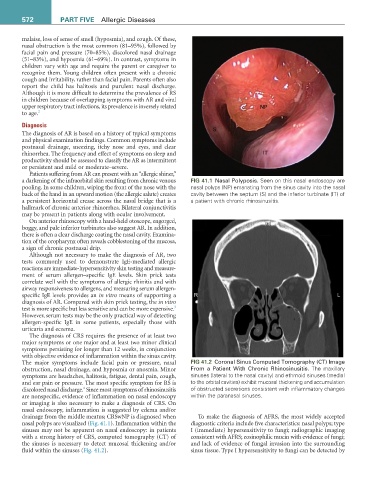
        a darkening of the infraorbital skin resulting from chronic venous   FIG 41.1  Nasal Polyposis. Seen on this nasal endoscopy are
        pooling. In some children, wiping the front of the nose with the   nasal polyps (NP) emanating from the sinus cavity into the nasal
        back of the hand in an upward motion (the allergic salute) creates   cavity between the septum (S) and the inferior turbinate (IT) of
        a persistent horizontal crease across the nasal bridge that is a   a patient with chronic rhinosinusitis.
        hallmark of chronic anterior rhinorrhea. Bilateral conjunctivitis
        may be present in patients along with ocular involvement.
           On anterior rhinoscopy with a hand-held otoscope, engorged,
        boggy, and pale inferior turbinates also suggest AR. In addition,
        there is often a clear discharge coating the nasal cavity. Examina-
        tion of the oropharynx often reveals cobblestoning of the mucosa,
        a sign of chronic postnasal drip.
           Although not necessary to make the diagnosis of AR, two
        tests commonly used to demonstrate IgE-mediated allergic
        reactions are immediate-hypersensitivity skin testing and measure-
        ment of serum allergen–specific IgE levels. Skin prick tests
        correlate well with the symptoms of allergic rhinitis and with
        airway responsiveness to allergens, and measuring serum allergen-
        specific IgE levels provides an in vitro means of supporting a
        diagnosis of AR. Compared with skin prick testing, the in vitro
                                                          3
        test is more specific but less sensitive and can be more expensive.
        However, serum tests may be the only practical way of detecting
        allergen-specific IgE in some patients, especially those with
        urticaria and eczema.
           The diagnosis of CRS requires the presence of at least two
        major symptoms or one major and at least two minor clinical
        symptoms persisting for longer than 12 weeks, in conjunction
        with objective evidence of inflammation within the sinus cavity.
        The major symptoms include facial pain or pressure, nasal   FIG 41.2  Coronal Sinus Computed Tomography (CT) Image
        obstruction, nasal drainage, and hyposmia or anosmia. Minor   From a Patient With Chronic Rhinosinusitis. The maxillary
        symptoms are headaches, halitosis, fatigue, dental pain, cough,   sinuses (lateral to the nasal cavity) and ethmoid sinuses (medial
        and ear pain or pressure. The most specific symptom for RS is   to the orbital cavities) exhibit mucosal thickening and accumulation
                            4
        discolored nasal discharge.  Since most symptoms of rhinosinusitis   of obstructed secretions consistent with inflammatory changes
        are nonspecific, evidence of inflammation on nasal endoscopy   within the paranasal sinuses.
        or imaging is also necessary to make a diagnosis of CRS. On
        nasal endoscopy, inflammation is suggested by edema and/or
        drainage from the middle meatus; CRSwNP is diagnosed when   To make the diagnosis of AFRS, the most widely accepted
        nasal polyps are visualized (Fig. 41.1). Inflammation within the   diagnostic criteria include five characteristics: nasal polyps; type
        sinuses may not be apparent on nasal endoscopy: in patients   I (immediate) hypersensitivity to fungi; radiographic imaging
        with a strong history of CRS, computed tomography (CT) of   consistent with AFRS; eosinophilic mucin with evidence of fungi;
        the sinuses is necessary to detect mucosal thickening and/or   and lack of evidence of fungal invasion into the surrounding
        fluid within the sinuses (Fig. 41.2).                  sinus tissue. Type I hypersensitivity to fungi can be detected by

