


Page 607 - Clinical Immunology_ Principles and Practice ( PDFDrive )
P. 607
CHaPTEr 41  Immunological Mechanisms of Airway Diseases and Pathways to Therapy                   584.e1


              MULTIPLE-CHOICE QUESTIONS

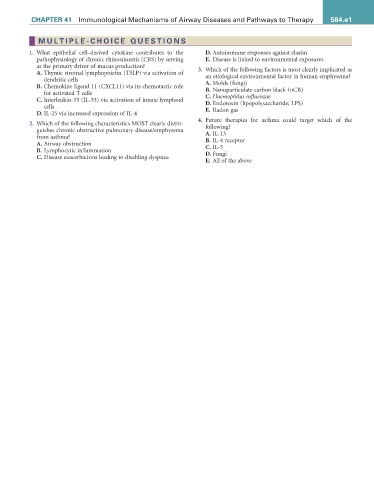
           1.  What epithelial cell–derived cytokine contributes to the    D. Autoimmune responses against elastin
             pathophysiology of chronic rhinosinusitis (CRS) by serving    E.  Disease is linked to environmental exposures
             as the primary driver of mucus production?           3.  Which of the following factors is most clearly implicated as
              A. Thymic stromal lymphopoietin (TSLP) via activation of   an etiological environmental factor in human emphysema?
               dendritic cells                                       A. Molds (fungi)
              B. Chemokine ligand 11 (CXCL11) via its chemotactic role    B. Nanoparticulate carbon black (nCB)
               for activated T cells                                 C. Haemophilus influenzae
              C. Interleukin-33 (IL-33) via activation of innate lymphoid    D. Endotoxin (lipopolysaccharide; LPS)
               cells                                                 E.  Radon gas
              D. IL-25 via increased expression of IL-4
                                                                  4.  Future therapies for asthma could target which of the
           2.  Which of the following characteristics MOST clearly distin-
             guishes chronic obstructive pulmonary disease/emphysema   following?
             from asthma?                                            A. IL-13
              A. Airway obstruction                                  B. IL-4 receptor
              B. Lymphocytic inflammation                            C. IL-5
              C. Disease exacerbations leading to disabling dyspnea   D. Fungi
                                                                     E.  All of the above

