


Page 681 - Clinical Immunology_ Principles and Practice ( PDFDrive )
P. 681
654          ParT FivE  Allergic diseases


                                                      Adverse drug reactions
                                      On-target                         Off-target
                                  (Type A; >80% ADRs)                (Type B; <20% ADRs)

                                   Dose-dependent
                                     phenotype is                       Pure T-cell  Antibody or non-
                           Mechanisms  predictable based on  Non-immunologic  (HLA risk allele present) (with or without T-cell help)
                                                                        mediated
                                                                                    antibody mediated
                                  pharmacologic action
                                                        activation of off-
                                                                                      (Type I-III)
                                                                        (Type IV)
                                   (ADME genes, drug
                                                         target receptor
                                  transporters, receptors)
                            Phenotype  Pharmacologically  Pharmacological  Immunologically
                                                              and
                                                           immunological
                                                           contributors
                                                                         mediated
                                    mediated
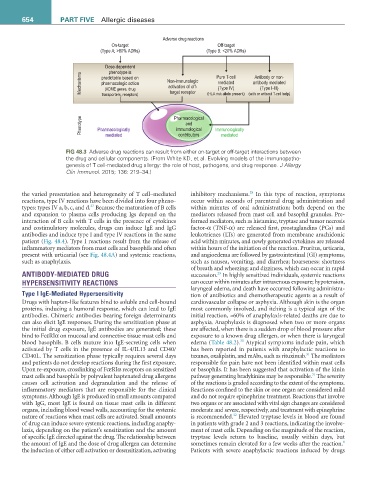
                       FiG 48.3  Adverse drug reactions can result from either on-target or off-target interactions between
                       the drug and cellular components. (From White KD, et al. Evolving models of the immunopatho-
                       genesis of T cell-mediated drug allergy: the role of host, pathogens, and drug response. J Allergy
                       Clin Immunol. 2015; 136: 219–34.)


                                                                                   28
        the varied presentation and heterogeneity of T cell–mediated   inhibitory mechanisms.  In this type of reaction, symptoms
        reactions, type IV reactions have been divided into four pheno-  occur within seconds of parenteral drug administration and
                               27
        types: types IV a, b, c, and d.  Because the maturation of B cells   within minutes of oral administration; both depend on the
        and expansion to plasma cells producing Igs depend on the   mediators released from mast cell and basophil granules. Pre-
        interaction of B cells with T cells in the presence of cytokines   formed mediators, such as histamine, tryptase and tumor necrosis
        and  costimulatory molecules,  drugs  can  induce IgE  and  IgG   factor-α (TNF-α) are released first, prostaglandins (PGs) and
        antibodies and induce type I and type IV reactions in the same   leukotrienes (LTs) are generated from membrane arachidonic
        patient (Fig. 48.4). Type I reactions result from the release of   acid within minutes, and newly generated cytokines are released
        inflammatory mediators from mast cells and basophils and often   within hours of the initiation of the reaction. Pruritus, urticaria,
        present with urticarial (see Fig. 48.4A) and systemic reactions,   and angioedema are followed by gastrointestinal (GI) symptoms,
        such as anaphylaxis.                                   such as nausea, vomiting, and diarrhea; hoarseness; shortness
                                                               of breath and wheezing; and dizziness, which can occur in rapid
        ANTIBODY-MEDIATED DRUG                                 succession.  In highly sensitized individuals, systemic reactions
                                                                        29
        HYPERSENSITIVITY REACTIONS                             can occur within minutes after intravenous exposure; hypotension,
                                                               laryngeal edema, and death have occurred following administra-
        Type I IgE-Mediated Hypersensitivity                   tion of antibiotics and chemotherapeutic agents as a result of
        Drugs with hapten-like features bind to soluble and cell-bound   cardiovascular collapse or asphyxia. Although skin is the organ
        proteins, inducing a humoral response, which can lead to IgE   most commonly involved, and itching is a typical sign of the
        antibodies. Chimeric antibodies bearing foreign determinants   initial reaction, ≈60% of anaphylaxis-related deaths are due to
        can also elicit IgE responses. During the sensitization phase at   asphyxia. Anaphylaxis is diagnosed when two or more organs
        the initial drug exposure, IgE antibodies are generated; these   are affected, when there is a sudden drop of blood pressure after
        bind to FcεRIα on mucosal and connective tissue mast cells and   exposure to a known drug allergen, or when there is laryngeal
                                                                                30
        blood basophils. B cells mature into IgE-secreting cells when   edema (Table 48.2).  Atypical symptoms include pain, which
        activated by T cells in the presence of IL-4/IL13 and CD40/  has been reported in patients with anaphylactic reactions to
                                                                                                     31
        CD40L. The sensitization phase typically requires several days   taxanes, oxaliplatin, and mAbs, such as rituximab.  The mediators
        and patients do not develop reactions during the first exposure.   responsible for pain have not been identified within mast cells
        Upon re-exposure, crosslinking of FcεRIα receptors on sensitized   or basophils. It has been suggested that activation of the kinin
                                                                                                       31
        mast cells and basophils by polyvalent haptenated drug allergens   pathway generating bradykinins may be responsible.  The severity
        causes cell activation and degranulation and the release of   of the reactions is graded according to the extent of the symptoms.
        inflammatory mediators that are responsible for the clinical   Reactions confined to the skin or one organ are considered mild
        symptoms. Although IgE is produced in small amounts compared   and do not require epinephrine treatment. Reactions that involve
        with IgG, most IgE is found on tissue mast cells in different   two organs or are associated with vital sign changes are considered
        organs, including blood vessel walls, accounting for the systemic   moderate and severe, respectively, and treatment with epinephrine
                                                                             32
        nature of reactions when mast cells are activated. Small amounts   is recommended.  Elevated tryptase levels in blood are found
        of drug can induce severe systemic reactions, including anaphy-  in patients with grade 2 and 3 reactions, indicating the involve-
        laxis, depending on the patient’s sensitization and the amount   ment of mast cells. Depending on the magnitude of the reaction,
        of specific IgE directed against the drug. The relationship between   tryptase levels return to baseline, usually within days, but
                                                                                                                 8
        the amount of IgE and the dose of drug allergen can determine   sometimes remain elevated for a few weeks after the reaction.
        the induction of either cell activation or desensitization, activating   Patients with severe anaphylactic reactions induced by drugs

