


Page 682 - Clinical Immunology_ Principles and Practice ( PDFDrive )
P. 682
CHaPTEr 48  Drug Hypersensitivity             655


            A                                                  B


            C                                                  D
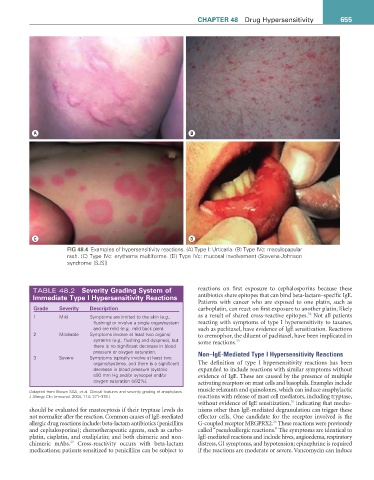
                       FiG 48.4  Examples of hypersensitivity reactions. (A) Type I: Urticaria. (B) Type IVc: maculopapular
                       rash. (C) Type IVc: erythema multiforme. (D) Type IVc: mucosal involvement (Stevens-Johnson
                       syndrome [SJS])


            TABLE 48.2  Severity Grading System of                reactions on first exposure to cephalosporins because these
            immediate Type i Hypersensitivity reactions           antibiotics share epitopes that can bind beta-lactam–specific IgE.
                                                                  Patients with cancer who are exposed to one platin, such as
            Grade   Severity  Description                         carboplatin, can react on first exposure to another platin, likely
                                                                                                      34
            1       Mild      Symptoms are limited to the skin (e.g.,   as a result of shared cross-reactive epitopes.  Not all patients
                                flushing) or involve a single organ/system   reacting with symptoms of type I hypersensitivity to taxanes,
                                and are mild (e.g., mild back pain).  such as paclitaxel, have evidence of IgE sensitization. Reactions
            2       Moderate  Symptoms involve at least two organs/  to cremophor, the diluent of paclitaxel, have been implicated in
                                systems (e.g., flushing and dyspnea), but   some reactions. 35
                                there is no significant decrease in blood
                                pressure or oxygen saturation.    Non–IgE-Mediated Type I Hypersensitivity Reactions
            3       Severe    Symptoms typically involve at least two
                                organs/systems, and there is a significant   The definition of type I hypersensitivity reactions has been
                                decrease in blood pressure (systolic   expanded to include reactions with similar symptoms without
                                ≤90 mm Hg and/or syncope) and/or   evidence of IgE. These are caused by the presence of multiple
                                oxygen saturation (≤92%).         activating receptors on mast cells and basophils. Examples include
           (Adapted from Brown SGA, et al. Clinical features and severity grading of anaphylaxis.   muscle relaxants and quinolones, which can induce anaphylactic
           J Allergy Clin Immunol. 2004; 114: 371–376.)           reactions with release of mast cell mediators, including tryptase,
                                                                                                36
                                                                  without evidence of IgE sensitization,  indicating that mecha-
           should be evaluated for mastocytosis if their tryptase levels do   nisms other than IgE-mediated degranulation can trigger these
           not normalize after the reaction. Common causes of IgE-mediated   effector cells. One candidate for the receptor involved is the
                                                                                          26
           allergic drug reactions include: beta-lactam antibiotics (penicillins   G-coupled receptor MRGPRX2.  These reactions were previously
           and cephalosporins); chemotherapeutic agents, such as carbo-  called “pseudoallergic reactions.” The symptoms are identical to
           platin, cisplatin, and oxaliplatin; and both chimeric and non-  IgE-mediated reactions and include hives, angioedema, respiratory
                        33
           chimeric mAbs.  Cross-reactivity occurs with beta-lactam   distress, GI symptoms, and hypotension; epinephrine is required
           medications; patients sensitized to penicillins can be subject to   if the reactions are moderate or severe. Vancomycin can induce

