


Page 689 - Clinical Immunology_ Principles and Practice ( PDFDrive )
P. 689
662          ParT FivE  Allergic diseases


        with exacerbation of chronic urticaria. Anaphylaxis can occur   such as with rituximab. Infusion-related reactions to mAbs
        to a single NSAID with tolerance to all others, but usually     present as cytokine storm-like reactions, with such symptoms
        there is complete cross-reactivity. Desensitization protocols are    as nausea, chills, fever, and malaise. These are thought to be
        available for AERD to ameliorate nasal polyps and increase the   caused by release of proinflammatory cytokines (e.g., IL-1, IL-6,
        sense of smell. Desensitization has also been tried for urticarial     and TNF-α) and respond to NSAIDs and steroids. Hypersensitivity
        reactions.                                             reactions to cetuximab on first exposure have been attributed
                                                               to sensitization to the galactose-α-1,3-galactose epitope caused
        Biological Agents and Monoclonal Antibodies            by exposure to the lone star tick (Amblyomma americanum).
        The use of mAbs to target cancer and chronic inflammatory   The carbohydrate galactose-α-1,3-galactose is expressed on
        diseases has become widespread over the past decade. Inevitably   nonprimate mammalian  proteins and also  on the cetuximab
        this has led to adverse reactions, which sometimes prevent the   heavy chain.
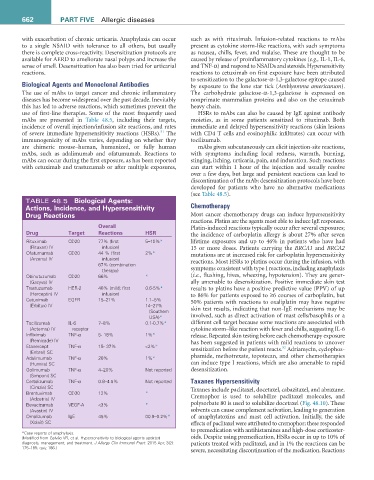
        use of first-line therapies. Some of the  most frequently  used   HSRs to mAbs can also be caused by IgE against antibody
        mAbs are presented in  Table 48.5, including their targets,     moieties, as in some patients sensitized to rituximab. Both
        incidence of overall injection/infusion site reactions, and rates   immediate and delayed hypersensitivity reactions (skin lesions
                                                      51
        of severe immediate hypersensitivity reactions (HSRs).  The   with CD4 T cells and eosinophilic infiltrates) can occur with
        immunogenicity of mAbs varies, depending on whether they   tocilizumab.
        are chimeric mouse–human, humanized, or fully human       mAbs given subcutaneously can elicit injection-site reactions,
        mAbs, such as adalimumab and ofatumumab. Reactions to    with symptoms including local redness, warmth, burning,
        mAbs can occur during the first exposure, as has been reported   stinging, itching, urticaria, pain, and induration. Such reactions
        with cetuximab and trastuzumab or after multiple exposures,   can start within 1 hour of the injection and usually resolve
                                                               over a few days, but large and persistent reactions can lead to
                                                               discontinuation of the mAb; desensitization protocols have been
                                                               developed  for  patients  who  have  no  alternative  medications
                                                               (see Table 48.5).
         TABLE 48.5  Biological agents:
         actions, incidence, and Hypersensitivity              Chemotherapy
         Drug reactions                                        Most cancer chemotherapy drugs can induce hypersensitivity
                                                               reactions. Platins are the agents most able to induce IgE responses.
                                 Overall                       Platin-induced reactions typically occur after several exposures;
          Drug         Target    reactions       HSr           the incidence of carboplatin allergy is about 27% after seven
          Rituximab    CD20      77% (first      5–10%*        lifetime exposures and up to 46% in patients who have had
           (Rituxan) IV           infusion)                    15 or more doses. Patients carrying the  BRCA1 and  BRCA2
          Ofatumumab   CD20      44 % (first     2%*           mutations are at increased risk for carboplatin hypersensitivity
           (Arzerra) IV           infusion)                    reactions. Most HSRs to platins occur during the infusion, with
                                 67% (combination
                                  therapy)                     symptoms consistent with type I reactions, including anaphylaxis
          Obinutuzumab   CD20    66%             *             (i.e., flushing, hives, wheezing, hypotension). They are gener-
           (Gazyva) IV                                         ally amenable to desensitization. Positive immediate skin test
          Trastuzumab   HER-2    40% (mild; first   0.6-5%*    results to platins have a positive predictive value (PPV) of up
           (Herceptin) IV         infusion)                    to 86% for patients exposed to ≥6 courses of carboplatin, but
          Cetuximab    EGFR      15–21%          1.1–5%        50% patients with reactions to oxaliplatin may have negative
           (Erbitux) IV                          14–27%
                                                  (Southern    skin test results, indicating that non-IgE mechanisms may be
                                                  USA)*        involved, such as direct activation of mast cells/basophils or a
          Tocilizumab   IL-6     7–8%            0.1-0.7%*     different cell target because some reactions are associated with
           (Actemra) IV  receptor                              cytokine storm–like reaction with fever and chills, suggesting IL-6
          Infliximab   TNF-α     5- 18%          1%*           release. Repeated skin testing before each chemotherapy exposure
           (Remicade) IV                                       has been suggested in patients with mild reactions to uncover
          Etanercept   TNF-α     15- 37%         <2%*          sensitization before the patient reacts.  Adriamycin, cyclophos-
                                                                                             52
           (Enbrel) SC
          Adalimumab   TNF-α     20%             1%*           phamide, methotrexate, topotecan, and other chemotherapies
           (Humira) SC                                         can induce type I reactions, which are also amenable to rapid
          Golimumab    TNF-α     4–20%           Not reported  desensitization.
           (Simponi) SC
          Certolizumab   TNF-α   0.8–4.5%        Not reported  Taxanes Hypersensitivity
           (Cimzia) SC                                         Taxanes include paclitaxel, docetaxel, cabazitaxel, and abraxane.
          Brentuximab   CD30     12%             *
           (Adcetris) IV                                       Cremophor is used to solubilize paclitaxel molecules, and
          Bevacizumab   VEGF-A   <3%             *             polysorbate 80 is used to solubilize docetaxel (Fig. 48.10). These
           (Avastin) IV                                        solvents can cause complement activation, leading to generation
          Omalizumab   IgE       45%             00.9–0.2%*    of anaphylatoxins and mast cell activation. Initially, the side
           (Xolair) SC                                         effects of paclitaxel were attributed to cremophor; these responded
                                                               to premedication with antihistamines and high-dose corticoster-
        *Case reports of anaphylaxis.
        (Modified from Galvão VR, et al. Hypersensitivity to biological agents-updated   oids. Despite using premedication, HSRs occur in up to 10% of
        diagnosis, management, and treatment. J Allergy Clin Immunol Pract. 2015 Apr; 3(2):   patients treated with paclitaxel, and in 1% the reactions can be
        175–185; quiz 186.)
                                                               severe, necessitating discontinuation of the medication. Reactions

