


Page 776 - Clinical Immunology_ Principles and Practice ( PDFDrive )
P. 776
CHaPtEr 55  Scleroderma–Systemic Sclerosis                747


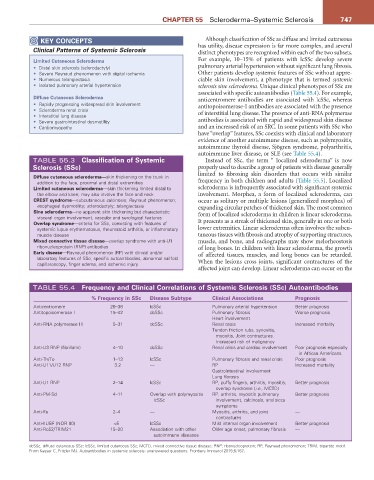
               KEY CONCEPtS                                         Although classification of SSc as diffuse and limited cutaneous
            Clinical Patterns of Systemic Sclerosis               has utility, disease expression is far more complex, and several
                                                                  distinct phenotypes are recognized within each of the two subsets.
            Limited Cutaneous Scleroderma                         For  example,  10–15%  of  patients  with  lcSSc  develop  severe
            •  Distal skin sclerosis (sclerodactyly)              pulmonary arterial hypertension without significant lung fibrosis.
            •  Severe Raynaud phenomenon with digital ischemia    Other patients develop systemic features of SSc without appre-
            •  Numerous telangiectasia                            ciable  skin  involvement,  a phenotype that  is  termed  systemic
            •  Isolated pulmonary arterial hypertension           sclerosis sine scleroderma. Unique clinical phenotypes of SSc are
                                                                  associated with specific autoantibodies (Table 55.4). For example,
            Diffuse Cutaneous Scleroderma                         anticentromere antibodies are associated with lcSSc, whereas
            •  Rapidly progressing widespread skin involvement    antitopoisomerase-I antibodies are associated with the presence
            •  Scleroderma renal crisis                           of interstitial lung disease. The presence of anti-RNA polymerase
            •  Interstitial lung disease
            •  Severe gastrointestinal dysmotility                antibodies is associated with rapid and widespread skin disease
            •  Cardiomyopathy                                     and an increased risk of an SRC. In some patients with SSc who
                                                                  have “overlap” features, SSc coexists with clinical and laboratory
                                                                  evidence of another autoimmune disease, such as polymyositis,
                                                                  autoimmune thyroid disease, Sjögren syndrome, polyarthritis,
                                                                  autoimmune liver disease, or SLE (see Table 55.4).
            TABLE 55.3  Classification of Systemic                  Instead  of  SSc,  the  term  “  localized  scleroderma”  is  now
            Sclerosis (SSc)                                       properly used to describe a group of patients with disease generally
                                                                  limited to fibrosing skin disorders that occurs with similar
            Diffuse cutaneous scleroderma—skin thickening on the trunk in
             addition to the face, proximal and distal extremities  frequency in both children and adults (Table 55.5). Localized
            Limited cutaneous scleroderma—skin thickening limited distal to   scleroderma is infrequently associated with significant systemic
             the elbow and knee; may also involve the face and neck  involvement. Morphea, a form of localized scleroderma, can
            CrESt syndrome—subcutaneous calcinosis; Raynaud phenomenon;   occur as solitary or multiple lesions (generalized morphea) of
             esophageal dysmotility; sclerodactyly; telangiectasia  expanding circular patches of thickened skin. The most common
            Sine scleroderma—no apparent skin thickening but characteristic   form of localized scleroderma in children is linear scleroderma.
             visceral organ involvement, vascular and serological features
            Overlap syndrome—criteria for SSc, coexisting with features of   It presents as a streak of thickened skin, generally in one or both
             systemic lupus erythematosus, rheumatoid arthritis, or inflammatory   lower extremities. Linear scleroderma often involves the subcu-
             muscle disease                                       taneous tissues with fibrosis and atrophy of supporting structures,
            Mixed connective tissue disease—overlap syndrome with anti-U1   muscle, and bone, and radiographs may show melorheostosis
             ribonucleoprotein (RNP) antibodies                   of long bones. In children with linear scleroderma, the growth
            Early disease—Raynaud phenomenon (RP) with clinical and/or   of  affected  tissues,  muscles,  and  long  bones  can  be  retarded.
             laboratory features of SSc; specific autoantibodies, abnormal nailfold
             capillaroscopy, finger edema, and ischemic injury    When the lesions cross joints, significant contractures of the
                                                                  affected joint can develop. Linear scleroderma can occur on the


            TABLE 55.4  Frequency and Clinical Correlations of Systemic Sclerosis (SSc) autoantibodies
                               % Frequency in SSc  Disease Subtype    Clinical associations       Prognosis
            Anticentromere           20–38        lcSSc               Pulmonary arterial hypertension  Better prognosis
            Antitopoisomerase I      15–42        dcSSc               Pulmonary fibrosis          Worse prognosis
                                                                      Heart involvement
            Anti-RNA polymerase III   5–31        dcSSc               Renal crisis                Increased mortality
                                                                      Tendon friction rubs, synovitis,
                                                                        myositis, Joint contractures.
                                                                        Increased risk of malignancy
            Anti-U3 RNP (fibrillarin)  4–10       dcSSc               Renal crisis and cardiac involvement  Poor prognosis especially
                                                                                                   in African Americans
            Anti-Th/To                1–13        lcSSc               Pulmonary fibrosis and renal crisis  Poor prognosis
            Anti-U11/U12 RNP           3.2        —                   RP                          Increased mortality
                                                                      Gastrointestinal involvement
                                                                      Lung fibrosis
            Anti-U1 RNP               2–14        lcSSc               RP, puffy fingers, arthritis, myositis,   Better prognosis
                                                                        overlap syndrome (i.e., MCTD)
            Anti-PM-Scl               4–11        Overlap with polymyositis   RP, arthritis, myositis pulmonary   Better prognosis
                                                   lcSSc                involvement, calcinosis, and sicca
                                                                        symptoms
            Anti-Ku                   2–4         —                   Myositis, arthritis, and joint   —
                                                                        contractures
            Anti-hUBF (NOR 90)        <5          lcSSc               Mild internal organ involvement  Better prognosis
            Anti-Ro52/TRIM21         15–20        Association with other   Older age onset, pulmonary fibrosis  —
                                                   autoimmune diseases
           dcSSc, diffuse cutaneous SSc; lcSSc, limited cutaneous SSc; MCTD, mixed connective tissue disease; RNP; ribonucleoprotein; RP, Raynaud phenomenon; TRIM, tripartite motif.
           From Kayser C, Fritzler MJ. Autoantibodies in systemic sclerosis: unanswered questions. Frontiers Immunol 2015;6:167.

