


Page 778 - Clinical Immunology_ Principles and Practice ( PDFDrive )
P. 778
CHaPtEr 55  Scleroderma–Systemic Sclerosis                749


           with loss of body hair, reduced production of skin oils, and a   disease, severe GI dysfunction, SRC, progressive heart disease,
           decline in sweating capacity as these cutaneous structures atrophy.   and recurrent digital ulcers during the initial active inflammatory
           Gradually, the subcutaneous tissue becomes affected, with atrophy   and fibrotic phases of the skin disease. In practical terms, this
           of subcutaneous fat and fibrosis extending to the underlying   means that in dcSSc, the initial 3–4 years is the period that the
           fascia, muscle, and other soft tissue structures. During the fibrotic   systemic process is most active; if organ failure does not occur
           phase, patients note pain, progressive loss of flexibility, distressing   during this period, the systemic process may stabilize without
           disfigurement, and profound weight loss. Progressive flexion   further progression.
           contractures of the finger joints ensue. Other joints, including
           wrist, elbow, shoulder, hip girdle, knees, and ankle, can also be   Limited Cutaneous SSc
           affected as a result of fibrosis of the supporting joint structures   The disease course in the limited cutaneous variant of SSc is
           (see Fig. 55.3). Thick ridges at the neck caused by firm adherence   more indolent and often relatively benign. After the onset of
           of skin to the underlying platysma muscle interfere with neck   Raynaud phenomenon, several years may pass before additional
           extension. Tendon friction rub is a prominent crepitation that   symptoms or signs are recognized. The most common non-
           can be felt or even heard over tendons of the lower and upper   Raynaud symptoms in patients with lcSSc are those of upper
           extremities. Tendon friction rubs are caused by fibrosis in the   GI disease with dysphagia and gastroesophageal reflux. Dilated
           tissues surrounding the affected joints; they are associated with   capillaries form visible erythematous vascular lesions (telangi-
           rapidly progressive skin disease and are linked to an overall poor   ectasia), seen most commonly on the fingertips, nailfold areas
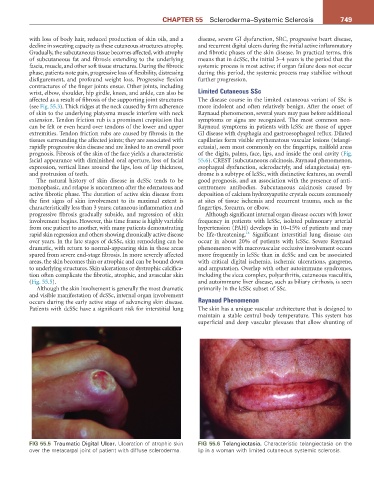
           prognosis. Fibrosis of the skin of the face yields a characteristic   of the digits, palms, face, lips, and inside the oral cavity (Fig.
           facial appearance with diminished oral aperture, loss of facial   55.6). CREST (subcutaneous calcinosis, Raynaud phenomenon,
           expression, vertical lines around the lips, loss of lip thickness,   esophageal dysfunction, sclerodactyly, and telangiectasia) syn-
           and protrusion of teeth.                               drome is a subtype of lcSSc, with distinctive features, an overall
             The natural history of skin disease in dcSSc tends to be   good prognosis, and an association with the presence of anti-
           monophasic, and relapse is uncommon after the edematous and   centromere antibodies. Subcutaneous calcinosis caused by
           active fibrotic phase. The duration of active skin disease from   deposition of calcium hydroxyapatite crystals occurs commonly
           the first signs of skin involvement to its maximal extent is   at  sites  of  tissue  ischemia  and  recurrent  trauma,  such  as  the
           characteristically less than 3 years; cutaneous inflammation and   fingertips, forearm, or elbow.
           progressive fibrosis gradually subside, and regression of skin   Although significant internal organ disease occurs with lower
           involvement begins. However, this time frame is highly variable   frequency  in  patients  with  lcSSc,  isolated  pulmonary  arterial
           from one patient to another, with many patients demonstrating   hypertension (PAH) develops in 10–15% of patients and may
                                                                                  14
           rapid skin regression and others showing chronically active disease   be life-threatening.  Significant interstitial lung disease can
           over years. In the late stages of dcSSc, skin remodeling can be   occur in about 20% of patients with lcSSc. Severe Raynaud
           dramatic, with return to normal-appearing skin in those areas   phenomenon with macrovascular occlusive involvement occurs
           spared from severe end-stage fibrosis. In more severely affected   more frequently in lcSSc than in dcSSc and can be associated
           areas, the skin becomes thin or atrophic and can be bound down   with critical digital ischemia, ischemic ulcerations, gangrene,
           to underlying structures. Skin ulcerations or dystrophic calcifica-  and amputation. Overlap with other autoimmune syndromes,
           tion often complicate the fibrotic, atrophic, and avascular skin   including the sicca complex, polyarthritis, cutaneous vasculitis,
           (Fig. 55.5).                                           and autoimmune liver disease, such as biliary cirrhosis, is seen
             Although the skin involvement is generally the most dramatic   primarily in the lcSSc subset of SSc.
           and visible manifestation of dcSSc, internal organ involvement
           occurs during the early active stage of advancing skin disease.   Raynaud Phenomenon
           Patients with dcSSc have a significant risk for interstitial lung   The skin has a unique vascular architecture that is designed to
                                                                  maintain a stable central body temperature. This system has
                                                                  superficial and deep vascular plexuses that allow shunting of


           FIG 55.5  Traumatic Digital Ulcer. Ulceration of atrophic skin   FIG 55.6  Telangiectasia. Characteristic telangiectasia on the
           over the metacarpal joint of patient with diffuse scleroderma.   lip in a woman with limited cutaneous systemic sclerosis.

