


Page 781 - Clinical Immunology_ Principles and Practice ( PDFDrive )
P. 781
752          Part SIX  Systemic Immune Diseases


        of detection. Clinical criteria are insensitive, but modern sensitive   process, which leads to glomerular hypoperfusion and a high
        tools, such as echocardiography, tissue Doppler imaging, speckle-  renin state.
        tracking echocardiography, cardiac magnetic resonance imaging,   Patients with SRC who present with a creatinine >3 mg/dL have
        or thallium scanning, can detect disease early and suggest that   a poor outcome, with increased likelihood of permanent hemo-
        40–60% of patients have heart disease. When heart disease is   dialysis, need for renal transplantation, and/or high mortality.
        symptomatic, the prognosis is poor. SSc can affect virtually any   Prompt and aggressive intervention with angiotensin-converting
        cardiac structure, including the myocardium with fibrosis or   enzyme (ACE) inhibitors to achieve blood pressure control before
        inflammatory myocarditis, the myocardial microvasculature, or   evidence of renal dysfunction is seen significantly improves the
        the pericardium with asymptomatic small effusions or large   prognosis. Introduction of ACE inhibitors dramatically improved
        effusions leading to cardiac tamponade. As a consequence of   survival from a 1-year survival rate of 10% to a 5-year survival
        cardiac tissue injury, left ventricular (LV) systolic dysfunction   rate of 60%. All patients with SRC should be treated with an
        and/or LV diastolic dysfunction and/or right ventricular (RV)   ACE inhibitor, but other vasodilators, including calcium channel
        failure and/or conduction abnormalities with complex arrhyth-  blockers, endothelin receptor inhibitors, and prostaglandins,
        mias can occur, but valvular heart disease is unusual. Cardiac   can be helpful. About 45% of patients whose blood pressure is
        dysfunction can be primary to the disease process or secondary   normalized do not require dialysis. Reasonable kidney function
        to other organ diseases, including PAH, ILD, or SRC. Cardiac   can resume months after renal failure and the need for dialysis
        disease occurs in both the limited and the diffuse subtypes but   support. Despite ideal therapy, approximately 40% of patients
        is more common in the patients with rapidly progressive diffuse   still  need long-term kidney support or  have a poor  survival.
        skin disease, in those with anti-U3 RNP antibodies, and in   Overall survival on chronic dialysis is worse in patients with SSc
                                            28
        association with peripheral muscle disease.  Heart disease is   compared with those without SSc, but renal transplantation is
        reported to be a cause of death in 20–30% of patients and is an   still an option with a long-term outcome similar to that of other
        independent risk factor for death. Optimal screening for heart   causes of renal failure.
        disease is not well defined, but periodic clinical assessment coupled
        with echocardiography and blood levels of BNP is recommended.
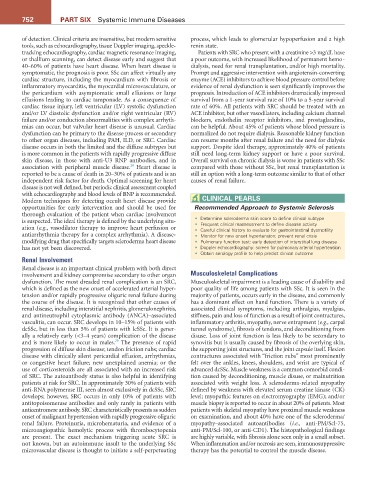
        Modern techniques for detecting occult heart disease provide    CLINICaL PEarLS
        opportunities for early intervention and should be used for   Recommended Approach to Systemic Sclerosis
        thorough evaluation of the patient when cardiac involvement
        is suspected. The ideal therapy is defined by the underlying situ-  •  Determine scleroderma skin score to define clinical subtype
                                                                 •  Frequent clinical reassessment to define disease activity
        ation (e.g., vasodilator therapy to improve heart perfusion or   •  Careful clinical history to evaluate for gastrointestinal dysmotility
        antiarrhythmia therapy for a complex arrhythmia). A disease-  •  Monitor for new onset hypertension: prevent renal crisis
        modifying drug that specifically targets scleroderma heart disease   •  Pulmonary function test: early detection of interstitial lung disease
        has not yet been discovered.                             •  Doppler echocardiography: screen for pulmonary arterial hypertension
                                                                 •  Obtain serology profile to help predict clinical outcome
        Renal Involvement
        Renal disease is an important clinical problem with both direct
        involvement and kidney compromise secondary to other organ   Musculoskeletal Complications
        dysfunction. The most dreaded renal complication is an SRC,   Musculoskeletal impairment is a leading cause of disability and
        which is defined as the new onset of accelerated arterial hyper-  poor quality of life among patients with SSc. It is seen in the
        tension and/or rapidly progressive oliguric renal failure during   majority of patients, occurs early in the disease, and commonly
        the course of the disease. It is recognized that other causes of   has a dominant effect on hand function. There is a variety of
        renal disease, including interstitial nephritis, glomerulonephritis,   associated clinical symptoms, including arthralgias, myalgias,
        and antineutrophil cytoplasmic antibody (ANCA)–associated   stiffness, pain and loss of function as a result of joint contractures,
        vasculitis, can occur. SRC develops in 10–15% of patients with   inflammatory arthritis, myopathy, nerve entrapment (e.g., carpal
        dcSSc, but in less than 5% of patients with lcSSc. It is gener-  tunnel syndrome), fibrosis of tendons, and deconditioning from
        ally a relatively early (<3–4 years) complication of the disease   disuse. Loss of joint function is less likely to be secondary to
                                       29
        and is more likely to occur in males.  The presence of rapid   synovitis but is usually caused by fibrosis of the overlying skin,
        progression of diffuse skin disease; tendon friction rubs; cardiac   the supporting joint structures, and the joint capsule itself. Flexion
        disease with clinically silent pericardial effusion, arrhythmias,   contractures associated with “friction rubs” most prominently
        or congestive heart failure; new unexplained anemia; or the   felt over the ankles, knees, shoulders, and wrist are typical of
        use of corticosteroids are all associated with an increased risk   advanced dcSSc. Muscle weakness is a common comorbid condi-
        of SRC. The autoantibody status is also helpful in identifying   tion caused by deconditioning, muscle disuse, or malnutrition
        patients at risk for SRC. In approximately 30% of patients with   associated with weight loss.  A scleroderma-related myopathy
        anti-RNA polymerase III, seen almost exclusively in dcSSc, SRC   defined by weakness with elevated serum creatine kinase (CK)
        develops;  however,  SRC  occurs  in  only  10%  of  patients  with   level; myopathic features on electromyography (EMG); and/or
        antitopoisomerase antibodies and only rarely in patients with   muscle biopsy is reported to occur in about 20% of patients. Most
        anticentromere antibody. SRC characteristically presents as sudden   patients with skeletal myopathy have proximal muscle weakness
        onset of malignant hypertension with rapidly progressive oliguric   on examination, and about 40% have one of the scleroderma/
        renal  failure.  Proteinuria,  microhematuria,  and  evidence  of  a   myopathy–associated  autoantibodies  (i.e.,  anti-PM/Scl-75,
        microangiopathic hemolytic process  with thrombocytopenia   anti-PM/Scl-100, or anti-CD1). The histopathological findings
        are present. The exact mechanism triggering acute SRC is   are highly variable, with fibrosis alone seen only in a small subset.
        not known, but an autoimmune insult to the underlying SSc   When inflammation and/or necrosis are seen, immunosuppressive
        microvascular disease is thought to initiate a self-perpetuating   therapy has the potential to control the muscle disease.

