


Page 782 - Clinical Immunology_ Principles and Practice ( PDFDrive )
P. 782
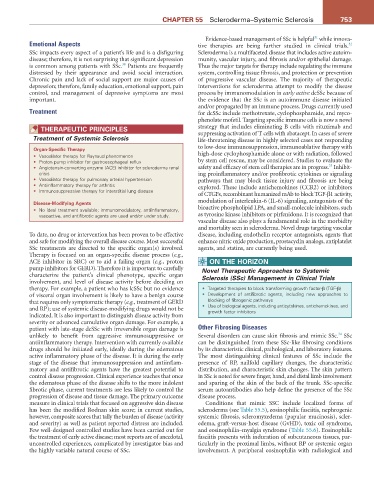
CHaPtEr 55  Scleroderma–Systemic Sclerosis                753


                                                                                                        31
                                                                    Evidence-based management of SSc is helpful  while innova-
           Emotional Aspects                                      tive therapies are being further studied in clinical trials.
                                                                                                                   32
           SSc impacts every aspect of a patient’s life and is a disfiguring   Scleroderma is a multifaceted disease that includes active autoim-
           disease; therefore, it is not surprising that significant depression   munity, vascular injury, and fibrosis and/or epithelial damage.
                                         30
           is common among patients with SSc.  Patients are frequently   Thus the major targets for therapy include regulating the immune
           distressed by their appearance and avoid social interaction.   system, controlling tissue fibrosis, and protection or prevention
           Chronic pain and lack of social support are major causes of   of progressive vascular  disease. The majority of therapeutic
           depression; therefore, family education, emotional support, pain   interventions  for scleroderma attempt to modify  the disease
           control, and management of depressive symptoms are most   process by immunomodulation in early active dcSSc because of
           important.                                             the evidence that the SSc is an autoimmune disease initiated
                                                                  and/or propagated by an immune process. Drugs currently used
           Treatment                                              for dcSSc include methotrexate, cyclophosphamide, and myco-
                                                                  phenolate mofetil. Targeting specific immune cells is now a novel
               tHEraPEUtIC PrINCIPLES                             strategy that includes eliminating B cells with rituximab and
            Treatment of Systemic Sclerosis                       suppressing activation of T cells with abatacept. In cases of severe
                                                                  life-threatening disease in highly selected cases not responding
            Organ-Specific therapy                                to low-dose immunosuppression, immunoablative therapy with
            •  Vasodilator therapy for Raynaud phenomenon         high-dose cyclophosphamide alone or with radiation, followed
            •  Proton pump inhibitor for gastroesophageal reflux  by stem cell rescue, may be considered. Studies to evaluate the
                                                                                                             33
            •  Angiotensin-converting enzyme (ACE) inhibitor for scleroderma renal   safety and efficacy of stem cell therapies are in progress.  Inhibit-
              crisis                                              ing proinflammatory and/or profibrotic cytokines or signaling
            •  Vasodilator therapy for pulmonary arterial hypertension  pathways  that may block tissue injury and fibrosis  are being
            •  Antiinflammatory therapy for arthritis             explored. These include antichemokines (CCR2) or inhibitors
            •  Immunosuppressive therapy for interstitial lung disease
                                                                  of CTGFs, recombinant humanized mAb to block TGF-β1 activity,
            Disease-Modifying agents                              modulation of interleukin-6 (IL-6) signaling, antagonists of the
            •  No ideal treatment available; immunomodulatory, antiinflammatory,   bioactive phospholipid LPA, and small-molecule inhibitors, such
              vasoactive, and antifibrotic agents are used and/or under study.  as tyrosine kinase inhibitors or pirfenidone. It is recognized that
                                                                  vascular disease also plays a fundamental role in the morbidity
                                                                  and mortality seen in scleroderma. Novel drugs targeting vascular
           To date, no drug or intervention has been proven to be effective   disease, including endothelin receptor antagonists, agents that
           and safe for modifying the overall disease course. Most successful   enhance nitric oxide production, prostacyclin analogs, antiplatelet
           SSc treatments  are  directed  to the  specific  organ(s)  involved.   agents, and statins, are currently being used.
           Therapy is focused on an organ-specific disease process (e.g.,
           ACE inhibitor in SRC) or to aid a failing organ (e.g., proton    ON tHE HOrIZON
           pump inhibitors for GERD). Therefore it is important to carefully   Novel Therapeutic Approaches to Systemic
           characterize the patient’s clinical phenotype, specific organ   Sclerosis (SSc) Management in Clinical Trials
           involvement, and level of disease activity before deciding  on
           therapy. For example, a patient who has lcSSc but no evidence   •  Targeted therapies to block transforming growth factor-β (TGF-β)
           of visceral organ involvement is likely to have a benign course   •  Development of antifibrotic agents, including new approaches to
           that requires only symptomatic therapy (e.g., treatment of GERD   blocking of fibrogenic pathways
           and RP); use of systemic disease-modifying drugs would not be   •  Use of biological agents, including anticytokines, antichemokines, and
                                                                     growth factor inhibitors
           indicated. It is also important to distinguish disease activity from
           severity or advanced cumulative organ damage. For example, a
           patient with late-stage dcSSc with irreversible organ damage is   Other Fibrosing Diseases
                                                                                                                34
           unlikely to benefit from aggressive immunosuppressive or   Several disorders can cause skin fibrosis and mimic SSc.  SSc
           antiinflammatory therapy. Intervention with currently available   can be distinguished from these SSc-like fibrosing conditions
           drugs should be initiated early, ideally during the edematous   by its characteristic clinical, pathological, and laboratory features.
           active inflammatory phase of the disease. It is during the early   The most distinguishing clinical features of SSc include the
           stage of the disease that immunosuppression and antiinflam-  presence of RP, nailfold capillary changes, the characteristic
           matory and antifibrotic agents have the greatest potential to   distribution, and characteristic skin changes. The skin pattern
           control disease progression. Clinical experience teaches that once   in SSc is noted for severe finger, hand, and distal limb involvement
           the edematous phase of the disease shifts to the more indolent   and sparing of the skin of the back of the trunk. SSc-specific
           fibrotic phase, current treatments are less likely to control the   serum autoantibodies also help define the presence of the SSc
           progression of disease and tissue damage. The primary outcome   disease process.
           measure in clinical trials that focused on aggressive skin disease   Conditions  that  mimic  SSC  include  localized  forms  of
           has been the modified Rodnan skin score; in current studies,   scleroderma (see Table 55.5), eosinophilic fasciitis, nephrogenic
           however, composite scores that tally the burden of disease (activity   systemic fibrosis, scleromyxedema (papular mucinosis), scler-
           and severity) as well as patient reported distress are included.   edema, graft-versus-host disease (GvHD), toxic oil syndrome,
           Few well-designed controlled studies have been carried out for   and eosinophilia–myalgia syndrome (Table 55.6). Eosinophilic
           the treatment of early active disease; most reports are of anecdotal,   fasciitis presents with induration of subcutaneous tissues, par-
           uncontrolled experiences, complicated by investigator bias and   ticularly in the proximal limbs, without RP or systemic organ
           the highly variable natural course of SSc.             involvement. A peripheral eosinophilia with radiological and

