


Page 787 - Clinical Immunology_ Principles and Practice ( PDFDrive )
P. 787
758          Part SIX  Systemic Immune Diseases


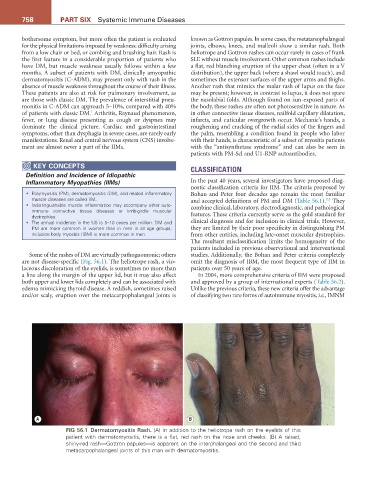
        bothersome symptom, but more often the patient is evaluated   known as Gottron papules. In some cases, the metatarsophalangeal
        for the physical limitations imposed by weakness: difficulty arising   joints, elbows, knees, and malleoli show a similar rash. Both
        from a low chair or bed, or combing and brushing hair. Rash is   heliotrope and Gottron rashes can occur rarely in cases of frank
        the first feature in a considerable proportion of patients who   SLE without muscle involvement. Other common rashes include
        have  DM,  but  muscle  weakness  usually  follows  within  a  few   a flat, red blanching eruption of the upper chest (often in a V
        months. A subset of patients with DM, clinically amyopathic   distribution), the upper back (where a shawl would touch), and
        dermatomyositis (C-ADM), may present only with rash in the   sometimes the extensor surfaces of the upper arms and thighs.
        absence of muscle weakness throughout the course of their illness.   Another rash that mimics the malar rash of lupus on the face
        These patients are also at risk for pulmonary involvement, as   may be present; however, in contrast to lupus, it does not spare
        are those with classic DM. The prevalence of interstitial pneu-  the nasolabial folds. Although found on sun-exposed parts of
        monitis in C-ADM can approach 5–10%, compared with 40%   the body, these rashes are often not photosensitive in nature. As
                               1
        of patients with classic DM.  Arthritis, Raynaud phenomenon,   in other connective tissue diseases, nailfold capillary dilatation,
        fever, or lung disease presenting as cough or dyspnea may   infarcts, and cuticular overgrowth occur. Mechanic’s hands, a
        dominate the clinical picture. Cardiac and gastrointestinal   roughening and cracking of the radial sides of the fingers and
        symptoms, other than dysphagia in severe cases, are rarely early   the palm, resembling a condition found in people who labor
        manifestations. Renal and central nervous system (CNS) involve-  with their hands, is characteristic of a subset of myositis patients
        ment are almost never a part of the IIMs.              with the “antisynthetase syndrome” and can also be seen in
                                                               patients with PM-Scl and U1-RNP autoantibodies.
            KEY CONCEPtS                                       CLASSIFICATION
         Definition and Incidence of Idiopathic
         Inflammatory Myopathies (IIMs)                        In the past 40 years, several investigators have proposed diag-
                                                               nostic classification criteria for IIM. The criteria proposed by
          •  Polymyositis (PM), dermatomyositis (DM), and related inflammatory   Bohan  and  Peter  four  decades  ago  remain  the  most  familiar
           muscle diseases are called IIM.                     and accepted definitions of PM and DM (Table 56.1).  They
                                                                                                            2,3
          •  Indistinguishable muscle inflammation may accompany other auto-  combine clinical, laboratory, electrodiagnostic, and pathological
           immune connective tissue diseases or limb-girdle muscular
           dystrophies.                                        features. These criteria currently serve as the gold standard for
          •  The annual incidence in the US is 5–10 cases per million. DM and   clinical diagnosis and for inclusion in clinical trials. However,
           PM are more common in women than in men in all age groups;   they are limited by their poor specificity in distinguishing PM
           inclusion body myositis (IBM) is more common in men.  from other entities, including late-onset muscular dystrophies.
                                                               The resultant misclassification limits the homogeneity of the
                                                               patients included in previous observational and interventional
           Some of the rashes of DM are virtually pathognomonic; others   studies. Additionally, the Bohan and Peter criteria completely
        are not disease-specific (Fig. 56.1). The heliotrope rash, a vio-  omit the diagnosis of IBM, the most frequent type of IIM in
        laceous discoloration of the eyelids, is sometimes no more than   patients over 50 years of age.
        a line along the margin of the upper lid, but it may also affect   In 2004, more comprehensive criteria of IIM were proposed
        both upper and lower lids completely and can be associated with   and approved by a group of international experts (Table 56.2).
        edema mimicking thyroid disease. A reddish, sometimes raised   Unlike the previous criteria, these new criteria offer the advantage
        and/or scaly, eruption over the metacarpophalangeal joints is   of classifying two rare forms of autoimmune myositis, i.e., IMNM


             A                                                 B
                       FIG 56.1  Dermatomyositis Rash. (A) In addition to the heliotrope rash on the eyelids of this
                       patient with dermatomyositis, there is a flat, red rash on the nose and cheeks. (B) A raised,
                       shiny-red rash—Gottron papules—is apparent on the interphalangeal and the second and third
                       metacarpophalangeal joints of this man with dermatomyositis.

