


Page 788 - Clinical Immunology_ Principles and Practice ( PDFDrive )
P. 788
CHaPtEr 56  Inflammatory Muscle Diseases                759


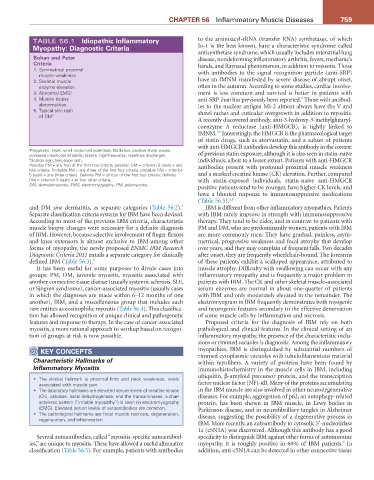
            TABLE 56.1  Idiopathic Inflammatory                   to the aminoacyl-tRNA (transfer RNA) synthetases, of which
            Myopathy: Diagnostic Criteria                         Jo-1 is the best known, have a characteristic syndrome called
                                                                  antisynthetase syndrome, which usually includes interstitial lung
            Bohan and Peter                                       disease, nondeforming inflammatory arthritis, fevers, mechanic’s
            Criteria                                              hands, and Raynaud phenomenon, in addition to myositis. Those
            1. Symmetrical proximal                               with antibodies to the signal recognition particle (anti-SRP)
              muscle weakness
            2. Skeletal muscle                                    have an IMNM manifested by severe disease of abrupt onset,
              enzyme elevation                                    often in the autumn. According to some studies, cardiac involve-
            3. Abnormal EMG a                                     ment is less common and survival is better in patients with
            4. Muscle biopsy                                      anti-SRP than has previously been reported.  Those with antibod-
                                                                                                    6
              abnormalities                                       ies to the nuclear antigen Mi-2 almost always have the V and
            5. Typical skin rash                                  shawl rashes and cuticular overgrowth in addition to myositis.
              of DM b
                                                                  A recently discovered antibody, anti-3-hydroxy-3-methylglutaryl-
                                                                  coenzyme  A reductase  (anti-HMGCR), is tightly linked to
                                                                        7,8
                                                                  IMNM.  Interestingly, the HMGCR is the pharmacological target
                                                                  of statin drugs, such as atorvastatin, and a subset of patients
                                                                  with anti-HMGCR antibodies develop this antibody in the context
           a Polyphasic, short, small motor-unit potentials; fibrillation, positive sharp waves,
           increased insertional irritability; bizarre, high-frequency, repetitive discharges.  of previous statin exposure, although it is also seen in statin-naïve
           b Gottron sign, heliotrope rash.                       individuals, albeit to a lesser extent. Patients with anti-HMGCR
           Possible PM = any two of the first four criteria; possible DM = criterion 5 (rash) + any   antibodies present with profound proximal muscle weakness
           two criteria. Probable PM = any three of the first four criteria; probable DM = criterion
           5 (rash) + any three criteria. Definite PM = all four of the first four criteria; definite   and a marked creatine kinase (CK) elevation. Further, compared
           DM = criterion 5 (rash) + all four other criteria.     with statin-exposed individuals, statin-naïve anti-HMGCR
           DM, dermatomyositis; EMG, electromyography; PM, polymyositis.
                                                                  positive patients tend to be younger, have higher CK levels, and
                                                                  have a blunted response to immunosuppressive medications
                                                                  (Table 56.5). 2,8
                                                            4
           and DM  sine dermatitis, as separate categories (Table 56.2).    IBM is different from other inflammatory myopathies. Patients
           Separate classification criteria systems for IBM have been devised.   with IBM rarely improve in strength with immunosuppressive
           According to most of the previous IBM criteria, characteristic   therapy. They tend to be older, and in contrast to patients with
           muscle biopsy changes were necessary for a definite diagnosis   PM and DM, who are predominantly women, patients with IBM
           of IBM. However, because selective involvement of finger flexors   are more commonly men. They have gradual, painless, asym-
           and knee extensors is almost exclusive to IBM among other   metrical, progressive weakness and focal atrophy that develop
           forms of myopathy, the newly proposed ENMC IBM Research   over years, and they may complain of frequent falls. Two decades
           Diagnostic Criteria 2011 entails a separate category for clinically   after onset, they are frequently wheelchair-bound. The forearms
           defined IBM (Table 56.3). 5                            of these patients exhibit a scalloped appearance, attributed to
             It has been useful for some purposes to divide cases into   muscle atrophy. Difficulty with swallowing can occur with any
           groups: PM, DM, juvenile myositis, myositis associated with   inflammatory myopathy and is frequently a major problem in
           another connective tissue disease (usually systemic sclerosis, SLE,   patients with IBM. The CK and other skeletal muscle–associated
           or Sjögren syndrome), cancer-associated myositis (usually cases   serum enzymes are normal in about one-quarter of patients
           in which the diagnoses are made within 6–12 months of one   with IBM and only moderately elevated in the remainder. The
           another), IBM, and a miscellaneous group that includes such   electromyogram in IBM frequently demonstrates both myogenic
           rare entities as eosinophilic myositis (Table 56.4). This classifica-  and neurogenic features secondary to the effective denervation
           tion has allowed recognition of unique clinical and pathogenetic   of some muscle cells by inflammation and necrosis.
           features and response to therapy. In the case of cancer-associated   Proposed criteria for the diagnosis of IBM rely on both
           myositis, a more rational approach to workup based on recogni-  pathological and clinical features. In the clinical setting of an
           tion of groups at risk is now possible.                inflammatory myopathy, the presence of the characteristic inclu-
                                                                  sions or rimmed vacuoles is diagnostic. Among the inflammatory
               KEY CONCEPtS                                       myopathies, IBM is distinguished by substantial numbers of
            Characteristic Hallmarks of                           rimmed cytoplasmic vacuoles with tubulofilamentous material
                                                                  within  myofibers.  A  variety of proteins have been found  by
            Inflammatory Myositis                                 immunohistochemistry in the muscle cells in IBM, including
                                                                  ubiquitin, β-amyloid precursor protein, and the transcription
            •  The clinical hallmark is proximal limb and neck weakness, rarely
              associated with muscle pain.                        factor nuclear factor (NF)-κB. Many of the proteins accumulating
            •  The laboratory hallmarks are elevated serum levels of creatine kinase   in the IBM muscle are also involved in other neurodegenerative
              (CK), aldolase, lactic dehydrogenase, and the transaminases; a char-  diseases. For example, aggregation of p62, an autophagy-related
              acteristic pattern (“irritable myopathy”) is seen on electromyography   protein, has been shown in IBM muscle, in Lewy bodies in
              (EMG). Elevated serum levels of autoantibodies are common.  Parkinson disease, and in neurofibrillary tangles in Alzheimer
            •  The pathological hallmarks are focal muscle necrosis, degeneration,   disease, suggesting the possibility of a degenerative process in
              regeneration, and inflammation.
                                                                  IBM. More recently, an autoantibody to cytosolic 5′-nucleotidase
                                                                  1a (c5N1A) was discovered. Although this antibody has a good
             Several autoantibodies, called “myositis-specific autoantibod-  specificity to distinguish IBM against other forms of autoimmune
                                                                                                                 9
           ies,” are unique to myositis. These have allowed a useful alternative   myopathy, it  is  roughly  positive  in  60%  of  IBM  patients.   In
           classification (Table 56.5). For example, patients with antibodies   addition, anti-c5N1A can be detected in other connective tissue

