


Page 793 - Clinical Immunology_ Principles and Practice ( PDFDrive )
P. 793
764          Part SIX  Systemic Immune Diseases


                                                               with immunosuppressive agents. 34,35  Patients with limb-girdle
        Corticosteroids                                        muscular dystrophies may mimic PM clinically. They may have
        Corticosteroids are the main immunosuppressive agents used   inflammation on muscle biopsy and may occasionally have
        in myositis treatment. An initial course of pulses of methyl-  associated autoantibodies. Thus patients with a suspected IIM
        prednisolone  may  be  helpful,  particularly  in disease  of  acute   who do not respond to immunosuppressive therapy should
        onset, and may also be helpful in managing disease flares. If   undergo further evaluation, including genetic testing, to search
        active muscle inflammation persists or the side effects of   for a limb-girdle muscular dystrophy.
        corticosteroids are severe, other immunosuppressive treatments
        are employed.                                          Nonskeletal Muscle Involvement
                                                               Other organs frequently involved in myositis include the skin,
        Second-Line and Third-Line                             lungs, and joints. Such organ involvement and the systemic
        Immunosuppressive Therapies                            features of myositis (fever and weight loss) usually improve with
        The most frequently used second-line agents in the treatment   immunosuppressive therapy that controls inflammation in the
        of myositis are azathioprine and methotrexate.  Azathioprine   skeletal muscle. Hydroxychloroquine and other antimalarials are
        reduces long-term disability. Methotrexate is useful in patients   useful in controlling the rashes associated with myositis.
        with little or no response to corticosteroid therapy. Combination
        therapies, such as methotrexate with azathioprine, are useful   DIAGNOSTIC TOOLS, EVALUATION, AND
        even if patients have failed to respond to one of the agents alone.   DIFFERENTIAL DIAGNOSIS
        High-dose intravenous immunoglobulin (IVIG) is of proven
                    25
        benefit in DM.  Whereas patients with statin-associated anti-
                                                         26
        HMGCR myopathy may be particularly responsive to IVIG,     CLINICaL PEarLS
        its usefulness in PM is less predictable. Apheresis proved ineffective
                               27
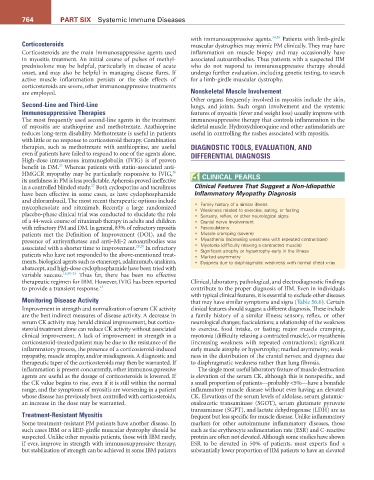
        in a controlled blinded study.  Both cyclosporine and tacrolimus   Clinical Features That Suggest a Non-Idiopathic
        have been effective in some cases, as have cyclophosphamide   Inflammatory Myopathy Diagnosis
        and chlorambucil. The most recent therapeutic options include
        mycophenolate and rituximab. Recently a large randomized   •  Family history of a similar illness
                                                                 •  Weakness related to exercise, eating, or fasting
        placebo-phase clinical trial was conducted to elucidate the role   •  Sensory, reflex, or other neurological signs
        of a 44-week course of rituximab therapy in adults and children   •  Cranial nerve involvement
        with refractory PM and DM. In general, 83% of refractory myositis   •  Fasciculations
        patients met the Definition of Improvement (DOI), and the   •  Muscle cramping (severe)
        presence of antisynthetase and anti–Mi-2 autoantibodies was   •  Myasthenia (increasing weakness with repeated contractions)
        associated with a shorter time to improvement. 28,29  In refractory   •  Myotonia (difficulty relaxing a contracted muscle)
                                                                 •  Significant atrophy or hypertrophy early in the illness
        patients who have not responded to the above-mentioned treat-  •  Marked asymmetry
        ments, biological agents such as etanercept, adalimumab, anakinra,   •  Dyspnea due to diaphragmatic weakness with normal chest x-ray
        abatacept, and high-dose cyclophosphamide have been tried with
        variable success. 16,30–33  Thus far, there has been no effective
        therapeutic regimen for IBM. However, IVIG has been reported   Clinical, laboratory, pathological, and electrodiagnostic findings
        to provide a transient response. 13                    contribute to the proper diagnosis of IIM. Even in individuals
                                                               with typical clinical features, it is essential to exclude other diseases
        Monitoring Disease Activity                            that may have similar symptoms and signs (Table 56.6). Certain
        Improvement in strength and normalization of serum CK activity   clinical features should suggest a different diagnosis. These include
        are the best indirect measures of disease activity. A decrease in   a family history of a similar illness; sensory, reflex, or other
        serum CK activity may herald clinical improvement, but cortico-  neurological changes; fasciculations; a relationship of the weakness
        steroid treatment alone can reduce CK activity without associated   to exercise, food intake, or fasting; major muscle cramping,
        clinical improvement. A lack of improvement in strength in a   myotonia (difficulty relaxing a contracted muscle), or myasthenia
        corticosteroid-treated patient may be due to the resistance of the   (increasing  weakness  with  repeated  contractions);  significant
        inflammatory process, the presence of a corticosteroid-induced   early muscle atrophy or hypertrophy; marked asymmetry; weak-
        myopathy, muscle atrophy, and/or misdiagnosis. A diagnostic and   ness in the distribution of the cranial nerves; and dyspnea due
        therapeutic taper of the corticosteroids may then be warranted. If   to diaphragmatic weakness rather than lung fibrosis.
        inflammation is present concurrently, other immunosuppressive   The single most useful laboratory feature of muscle destruction
        agents are useful as the dosage of corticosteroids is lowered. If   is elevation of the serum CK, although this is nonspecific, and
        the CK value begins to rise, even if it is still within the normal   a small proportion of patients—probably <5%—have a bonafide
        range, and the symptoms of myositis are worsening in a patient   inflammatory muscle disease without ever having an elevated
        whose disease has previously been controlled with corticosteroids,   CK. Elevations of the serum levels of aldolase, serum glutamic-
        an increase in the dose may be warranted.              oxaloacetic transaminase (SGOT), serum glutamate pyruvate
                                                               transaminase (SGPT), and lactate dehydrogenase (LDH) are as
        Treatment-Resistant Myositis                           frequent but less specific for muscle disease. Unlike inflammatory
        Some treatment-resistant PM patients have another disease. In   markers for other autoimmune inflammatory diseases, those
        such cases IBM or a liED-girdle muscular dystrophy should be   such as the erythrocyte sedimentation rate (ESR) and C-reactive
        suspected. Unlike other myositis patients, those with IBM rarely,   protein are often not elevated. Although some studies have shown
        if ever, improve in strength with immunosuppressive therapy,   ESR to be elevated in 50% of patients, most experts find a
        but stabilization of strength can be achieved in some IBM patients   substantially lower proportion of IIM patients to have an elevated

