


Page 800 - Clinical Immunology_ Principles and Practice ( PDFDrive )
P. 800
CHaPtEr 57  Spondyloarthritis             771


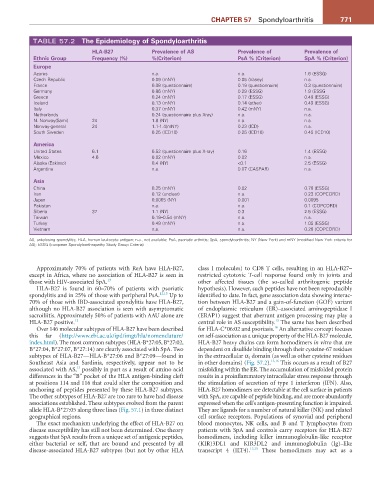
            TABLE 57.2  the Epidemiology of spondyloarthritis
                               HLa-B27             Prevalence of as            Prevalence of         Prevalence of
            Ethnic Group       Frequency (%)       %(Criterion)                Psa % (Criterion)     spa % (Criterion)
            Europe
            Azores                                 n.a.                        n.a.                  1.6 (ESSG)
            Czech Republic                         0.09 (mNY)                  0.05 (Vasey)          n.a.
            France                                 0.08 (questionnaire)        0.19 (questionnaire)  0.3 (questionnaire)
            Germany                                0.86 (mNY)                  0.29 (ESSG)           1.9 (ESSG
            Greece                                 0.24 (mNY)                  0.17 (ESSG)           0.49 (ESSG)
            Iceland                                0.13 (mNY)                  0.14 (other)          0.49 (ESSG)
            Italy                                  0.37 (mNY)                  0.42 (mNY)            n.a.
            Netherlands                            0.24 (questionnaire plus Xray)  n.a.              n.a.
            N. Norway(Sami)    24                  1.8 (NY)                    n.a.                  n.a.
            Norway-general     24                  1.1-1.4(mNY)                0.23 (ICD)            n.a.
            South Sweden                           0.25 (ICD10)                0.25 (ICD10)          0.45 (ICD10)

            america
            United States      6.1                 0.52 (questionnaire plus X-ray)  0.16             1.4 (ESSG)
            Mexico             4.6                 0.02 (mNY)                  0.02                  n.a.
            Alaska (Eskimo)                        0.4 (NY)                    <0.1                  2.5 (ESSG)
            Argentina                              n.a.                        0.07 (CASPAR)         n.a.
            asia
            China                                  0.25 (mNY)                  0.02                  0.78 (ESSG)
            Iran                                   0.12 (unclear)              n.a.                  0.23 (COPCORD)
            Japan                                  0.0065 (NY)                 0.001                 0.0095
            Pakistan                               n.a.                        n.a.                  0.1 (COPCORD)
            Siberia            37                  1.1 (NY)                    0.3                   2.5 (ESSG)
            Taiwan                                 0.19–0.54 (mNY)             n.a.                  n.a.
            Turkey                                 0.49 (mNY)                  n.a.                  1.05 (ESSG)
            Vietnam                                n.a.                        n.a.                  0.28 (COPCORD)
           AS, ankylosing spondylitis; HLA, human leukocyte antigen; n.a., not available; PsA, psoriatic arthritis; SpA, spondyloarthritis; NY (New York) and mNY (modified New York criteria for
           AS); ESSG (European Spondyloarthropathy Study Group Criteria)


             Approximately  70%  of  patients  with  ReA  have  HLA-B27,   class I molecules) to CD8 T cells, resulting in an HLA-B27–
           except in Africa, where no association of HLA-B27 is seen in   restricted cytotoxic T-cell response found only in joints and
           those with HIV-associated SpA. 13                      other affected tissues (the so-called arthritogenic peptide
             HLA-B27 is found in 60–70% of patients with psoriatic   hypothesis). However, such peptides have not been reproducibly
           spondylitis and in 25% of those with peripheral PsA. 12,13  Up to   identified to date. In fact, gene association data showing interac-
           70% of those with IBD-associated spondylitis have HLA-B27,   tion between HLA-B27 and a gain-of-function (GOF) variant
           although no HLA-B27 association is seen with asymptomatic   of endoplasmic reticulum (ER)–associated aminopeptidase I
           sacroiliitis. Approximately 50% of patients with AAU alone are   (ERAP1) suggest that aberrant antigen processing may play a
                                                                                           15
           HLA-B27 positive. 12                                   central role in AS susceptibility.  The same has been described
                                                                                           16
             Over 146 molecular subtypes of HLA-B27 have been described   for HLA-C*06:02 and psoriasis.  An alternative concept focuses
           this far (http://www.ebi.ac.uk/ipd/imgt/hla/nomenclature/  on self-association as a unique property of the HLA-B27 molecule.
           index.html). The most common subtypes (HLA-B*27:05, B*27:02,   HLA-B27 heavy chains can form homodimers in vitro that are
           B*27:04, B*27:07, B*27:14) are clearly associated with SpA. Two   dependent on disulfide binding through their cysteine-67 residues
           subtypes of HLA-B27—HLA-B*27:06 and B*27:09—found in   in the extracellular α 1  domain (as well as other cysteine residues
           Southeast  Asia and Sardinia, respectively, appear not to be   in other domains) (Fig. 57.2). 13,16  This occurs as a result of B27
                          13
           associated with AS,  possibly in part as a result of amino acid   misfolding within the ER. The accumulation of misfolded protein
           differences in the “B” pocket of the HLA antigen-binding cleft   results in a proinflammatory intracellular stress response through
           at positions 114 and 116 that could alter the composition and   the stimulation of secretion of type 1 interferon (IFN). Also,
           anchoring of peptides presented by these HLA-B27 subtypes.   HLA-B27 homodimers are detectable at the cell surface in patients
           The other subtypes of HLA-B27 are too rare to have had disease   with SpA, are capable of peptide binding, and are more abundantly
           associations established. These subtypes evolved from the parent   expressed when the cell’s antigen-presenting function is impaired.
           allele HLA-B*27:05 along three lines (Fig. 57.1) in three distinct   They are ligands for a number of natural killer (NK) and related
           geographical regions.                                  cell surface receptors. Populations of synovial and peripheral
             The exact mechanism underlying the effect of HLA-B27 on   blood monocytes, NK cells, and B and T lymphocytes from
           disease susceptibility has still not been determined. One theory   patients with SpA and controls carry receptors for HLA-B27
           suggests that SpA results from a unique set of antigenic peptides,   homodimers, including  killer  immunoglobulin-like receptor
           either bacterial or self, that are bound and presented by all   (KIR)3DL1 and KIR3DL2 and immunoglobulin (Ig)–like
           disease-associated HLA-B27 subtypes (but not by other HLA   transcript 4 (ILT4). 13,15  These homodimers may act as a

