


Page 937 - Clinical Immunology_ Principles and Practice ( PDFDrive )
P. 937
904          Part Seven  Organ-Specific Inflammatory Disease


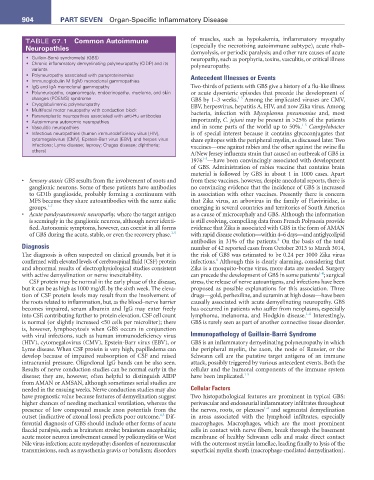
         TABLE 67.1  Common autoimmune                         of muscles, such as hypokalemia, inflammatory myopathy
         neuropathies                                          (especially the necrotizing autoimmune subtype), acute rhab-
                                                               domyolysis, or periodic paralysis; and other rare causes of acute
          •  Guillain-Barré syndrome(s) (GBS)                  neuropathy, such as porphyria, toxins, vasculitis, or critical illness
          •  Chronic inflammatory demyelinating polyneuropathy (CIDP) and its   polyneuropathy.
           variants
          •  Polyneuropathy associated with paraproteinemias   Antecedent Illnesses or Events
          •  Immunoglobulin M (IgM) monoclonal gammopathies
          •  IgG and IgA monoclonal gammopathy                 Two-thirds of patients with GBS give a history of a flu-like illness
          •  Polyneuropathy, organomegaly, endocrinopathy, myeloma, and skin   or acute dysenteric episodes that precede the development of
           changes (POEMS) syndrome                            GBS by 1–3 weeks.  Among the implicated viruses are CMV,
                                                                               1-5
          •  Cryoglobulinemic polyneuropathy                   EBV, herpesvirus, hepatitis A, HIV, and now Zika virus. Among
          •  Multifocal motor neuropathy with conduction block
          •  Paraneoplastic neuropathies associated with anti-Hu antibodies  bacteria, infection with  Mycoplasma pneumoniae and, most
          •  Autoimmune autonomic neuropathies                 importantly, C. jejuni may be present in >25% of the patients
                                                                                                    1-5
          •  Vasculitic neuropathies                           and in some parts of the world up to 50%.  Campylobacter
          •  Infectious neuropathies (human immunodeficiency virus [HIV],   is of special interest because it contains glycoconjugates that
           cytomegalovirus [CMV], Epstein-Barr virus [EBV], and herpes virus   share epitopes with the peripheral myelin, as discussed later. Two
           infections; Lyme disease; leprosy; Chagas disease; diphtheria;   vaccines—one against rabies and the other against the swine flu
           others)
                                                               A/New Jersey influenza strain that caused an outbreak of GBS in
                                                                   1-5
                                                               1976 —have been convincingly associated with development
                                                               of GBS. Administration of rabies vaccine that contains brain
                                                               material is followed by GBS in about 1 in 1000 cases. Apart
        •  Sensory ataxic GBS results from the involvement of roots and   from these vaccines, however, despite anecdotal reports, there is
           ganglionic neurons. Some of these patients have antibodies   no convincing evidence that the incidence of GBS is increased
           to GD1b ganglioside, probably forming a continuum with   in association with other vaccines. Presently there is concern
           MFS because they share autoantibodies with the same sialic   that Zika virus, an arbovirus in the family of Flaviviridae, is
           groups. 1-7                                         emerging in several countries and territories of South America
        •  Acute pandysautonomic neuropathy, where the target antigen   as a cause of microcephaly and GBS. Although the information
           is seemingly in the ganglionic neurons, although never identi-  is still evolving, compelling data from French Polynesia provide
           fied. Autonomic symptoms, however, can coexist in all forms   evidence that Zika is associated with GBS in the form of AMAN
           of GBS during the acute, stable, or even the recovery phase. 1-5  with rapid disease evolution—within 4–6 days—and antiglycolipid
                                                                                            8
                                                               antibodies in 31% of the patients.  On the basis of the total
        Diagnosis                                              number of 42 reported cases from October 2013 to March 3014,
        The diagnosis is often suspected on clinical grounds, but it is   the risk of GBS was estimated to be 0.24 per 1000 Zika virus
                                                                        8
        confirmed with elevated levels of cerebrospinal fluid (CSF) protein   infections.  Although this is clearly alarming, considering that
        and abnormal results of electrophysiological studies consistent   Zika is a mosquito-borne virus, more data are needed. Surgery
                                                                                                         1-4
        with active demyelination or nerve inexcitability.     can precede the development of GBS in some patients ; surgical
           CSF protein may be normal in the early phase of the disease,   stress, the release of nerve autoantigens, and infections have been
        but it can be as high as 1000 mg/dL by the sixth week. The eleva-  proposed as possible explanations for this association. Three
        tion of CSF protein levels may result from the involvement of   drugs—gold, perhexiline, and suramin at high doses—have been
        the roots related to inflammation, but, as the blood–nerve barrier   causally associated with acute demyelinating neuropathy. GBS
        becomes impaired, serum albumin and IgG may enter freely   has occurred in patients who suffer from neoplasms, especially
                                                                                                     1-4
        into CSF, contributing further to protein elevation. CSF cell count   lymphoma, melanoma, and Hodgkin disease.  Interestingly,
        is normal (or slightly increased <50 cells per microliter); there   GBS is rarely seen as part of another connective tissue disorder.
        is, however, lymphocytosis when GBS occurs in conjunction
        with viral infections, such as human immunodeficiency virus   Immunopathology of Guillain-Barré Syndrome
        (HIV), cytomegalovirus (CMV), Epstein-Barr virus (EBV), or   GBS is an inflammatory demyelinating polyneuropathy in which
        Lyme disease. When CSF protein is very high, papilledema can   the peripheral myelin, the axon, the node of Ranvier, or the
        develop because of impaired reabsorption of CSF and raised   Schwann cell are the putative target antigens of an immune
        intracranial pressure. Oligoclonal IgG bands can be also seen.   attack, possibly triggered by various antecedent events. Both the
        Results of nerve conduction studies can be normal early in the   cellular and the humoral components of the immune system
        disease; they are, however, often helpful to distinguish AIDP   have been implicated. 1-5
        from AMAN or AMSAN, although sometimes serial studies are
        needed in the ensuing weeks. Nerve conduction studies may also   Cellular Factors
        have prognostic value because features of demyelination suggest   Two histopathological features are prominent in typical GBS:
        higher chances of needing mechanical ventilation, whereas the   perivascular and endoneurial inflammatory infiltrates throughout
                                                                                       1-4
        presence of low compound muscle axon potentials from the   the nerves, roots, or plexuses  and segmental demyelination
                                                     4,5
        outset (indicative of axonal loss) predicts poor outcome.  Dif-  in areas associated with the lymphoid infiltrates, especially
        ferential diagnosis of GBS should include other forms of acute   macrophages. Macrophages, which are the most prominent
        flaccid paralysis, such as brainstem stroke; brainstem encephalitis;   cells in contact with nerve fibers, break through the basement
        acute motor neuron involvement caused by poliomyelitis or West   membrane of healthy Schwann cells and make direct contact
        Nile virus infection; acute myelopathy; disorders of neuromuscular   with the outermost myelin lamellae, leading finally to lysis of the
        transmissions, such as myasthenia gravis or botulism; disorders   superficial myelin sheath (macrophage-mediated demyelination).

