


Page 939 - Clinical Immunology_ Principles and Practice ( PDFDrive )
P. 939
906          Part Seven  Organ-Specific Inflammatory Disease


                          Cytokines         Barrier  (Blood–brain)
                          (INF-γ, IL-1, IL-2, IL-6   (Blood–nerve)
                              TNF)                                     APC
                                          Integrins  ICAM-1  IL-2 MHC            B cell
                                       MAC-1      MHC
                                                            TCR MHC-II
                                       LFA-1
                              T cell              MHC-I, II  T cell                Anti-MAG
                                                           INF-γ         Autoantigen  Anti-GQ1b
                                                                                   Anti-glycolipids
                                                      IL-2  IL-1(fever)
                                                                      TNF-1
                                                           CR 1
                                                  ICAM-1                          Fc
                                  Viruses                    Mφ
                                                  MHC
                                                               MHC               Mφ
                                                           CR 3
                              Mφ                Mφ
                                       TNF                    O 2
                                                                                  Schwann cell
                                      IL-1                   OH
                                             Igs
                                                                                   MHC
                                                                           CR 3  AG
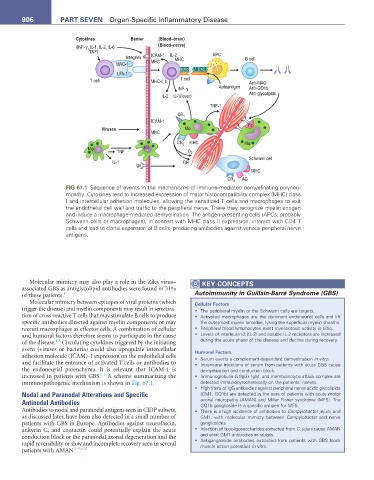
                       FIG 67.1  Sequence of events in the mechanisms of immune-mediated demyelinating polyneu-
                       ropathy. Cytokines lead to increased expression of major histocompatibility complex (MHC) class
                       I and intercellular adhesion molecules, allowing the sensitized T cells and macrophages to exit
                       the endothelial cell wall and traffic to the peripheral nerve. There they recognize myelin antigen
                       and induce a macrophage-mediated demyelination. The antigen-presenting cells (APCs; probably
                       Schwann cells or macrophages), in concert with MHC class II expression, interact with CD4 T
                       cells and lead to clonal expansion of B cells, producing antibodies against various peripheral nerve
                       antigens.


           Molecular mimicry may also play a role in the Zika virus–   KeY COnCePtS
        associated GBS as antiglycolipid antibodies were found in 31%
        of these patients. 8                                     Autoimmunity in Guillain-Barré Syndrome (GBS)
           Molecular mimicry between epitopes of viral proteins (which   Cellular Factors
        trigger the disease) and myelin components may result in sensitiza-  •  The peripheral myelin or the Schwann cells are targets.
        tion of cross-reactive T cells that may stimulate B cells to produce   •  Activated macrophages are the dominant endoneurial cells and lift
        specific antibodies directed against myelin components or may   the outermost myelin lamellae, lysing the superficial myelin sheaths.
        recruit macrophages as effector cells. A combination of cellular   •  Peripheral blood lymphocytes exert myelinotoxic activity in vitro.
        and humoral factors therefore seems to participate in the cause   •  Levels of interleukin-2 (IL-2) and soluble IL-2 receptors are increased
                   1-8
        of the disease.  Circulating cytokines triggered by the initiating   during the acute phase of the disease and decline during recovery.
        event (viruses or bacteria) could also upregulate intercellular   Humoral Factors
        adhesion molecule (ICAM)-1 expression on the endothelial cells   •  Serum exerts a complement-dependent demyelination in vitro.
        and facilitate the entrance of activated T cells or antibodies to   •  Intraneural injections of serum from patients with acute GBS cause
        the endoneurial parenchyma. It is relevant that ICAM-1 is   demyelination and conduction block.
                                  1-5
        increased in patients with GBS.  A scheme summarizing the   •  Immunoglobulin G (IgG), IgM, and membranolytic attack complex are
        immunopathogenic mechanism is shown in Fig. 67.1.          detected immunocytochemically on the patients’ nerves.
                                                                 •  High titers of IgG antibodies against peripheral nerve acidic glycolipids
        Nodal and Paranodal Alterations and Specific               (GM1, GQ1b) are detected in the sera of patients with acute motor
        Antinodal Antibodies                                       axonal neuropathy (AMAN) and Miller Fisher syndrome (MFS). The
                                                                   GQ1b ganglioside is a specific antigen for MFS.
        Antibodies to nodal and paranodal antigens seen in CIDP subsets,   •  There is a high incidence of antibodies to Campylobacter jejuni, and
        as discussed later, have been also detected in a small number of   GM1, with molecular mimicry between  Campylobacter and nerve
        patients with GBS in Europe. Antibodies against neurofascin,   gangliosides.
        ankyrin G, and  contactin  could  potentially  explain  the  acute   •  Injection of lipooligosaccharides extracted from C. jejuni cause AMAN
        conduction block or the paranodal axonal degeneration and the   and elicit GM1 antibodies in rabbits.
        rapid reversibility or slow and incomplete recovery seen in several   •  Antiganglioside antibodies extracted from patients with GBS block
                                                                   muscle action potentials in vitro.
        patients with AMAN  1-5,9,10

