


Page 994 - Clinical Immunology_ Principles and Practice ( PDFDrive )
P. 994
CHaPter 71  Type 1 Diabetes             959


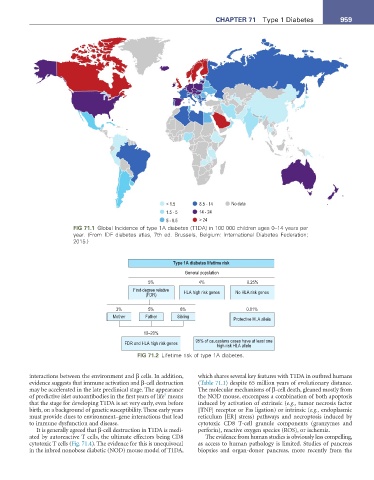
                                                       < 1.5      8.5 - 14   No data
                                                       1.5 - 5    14 - 24
                                                       5 - 8.5    > 24
                         FIG 71.1  Global Incidence of type 1A diabetes (T1DA) in 100 000 children ages 0–14 years per
                         year.  (From IDF  diabetes  atlas,  7th ed.  Brussels,  Belgium:  International  Diabetes  Federation;
                         2015.)


                                                          Type 1A diabetes lifetime risk
                                                             General population
                                                  5%              4%              0.25%
                                             First-degree relative  HLA high risk genes  No HLA risk genes
                                                 (FDR)
                                       3%         5%        8%                    0.01%
                                      Mother     Father    Sibling
                                                                             Protective HLA allele
                                                10–20%
                                          FDR and HLA high risk genes  95% of caucasians cases have at least one
                                                                        high risk HLA allele
                                              FIG 71.2  Lifetime risk of type 1A diabetes.


           interactions between the environment and β cells. In addition,   which shares several key features with T1DA in outbred humans
           evidence suggests that immune activation and β-cell destruction   (Table 71.1) despite 65 million years of evolutionary distance.
           may be accelerated in the late preclinical stage. The appearance   The molecular mechanisms of β-cell death, gleaned mostly from
                                                       5
           of predictive islet autoantibodies in the first years of life  means   the NOD mouse, encompass a combination of both apoptosis
           that the stage for developing T1DA is set very early, even before   induced by activation of extrinsic (e.g., tumor necrosis factor
           birth, on a background of genetic susceptibility. These early years   [TNF] receptor or Fas ligation) or intrinsic (e.g., endoplasmic
           must provide clues to environment–gene interactions that lead   reticulum  [ER] stress) pathways and necroptosis induced by
           to immune dysfunction and disease.                     cytotoxic CD8 T-cell granule components (granzymes and
             It is generally agreed that β-cell destruction in T1DA is medi-  perforin), reactive oxygen species (ROS), or ischemia.
           ated by autoreactive T cells, the ultimate effectors being CD8   The evidence from human studies is obviously less compelling,
           cytotoxic T cells (Fig. 71.4). The evidence for this is unequivocal   as access to human pathology is limited. Studies of pancreas
           in the inbred nonobese diabetic (NOD) mouse model of T1DA,   biopsies and organ-donor pancreas, more recently from the

