


Page 997 - Clinical Immunology_ Principles and Practice ( PDFDrive )
P. 997
962          Part seven  Organ-Specific Inflammatory Disease


                   7.0


                   6.5


                   6.0


                  Odds ratio  5.5
                   2.5


                   2.0


                   1.5


                   1.0
                        HLA  *INS  PTPN22  IL2RA  C10orf59  *SH2B3  *ERBB3  *COBL  *PTPN2  *CTRB1/2  *CLEC16A  CTLA4  IL18RAP  PTPN2  IL10  CCR5  *C6orf173  *C14orf181  *PRKD2  *IFIH1  *CTSH  CD226  IL27  GAB3     IL2RA  *SKAP2  *GLIS3  *ORMDL3  *PRKCQ  IL2  BACH2  UBASH3A  *RGS1  IL7R  CIQTNF6  SIRPG  *TNFAIP3  4p15  CD69  14q22  TAGAP  *SMARCE1


                                                              Locus
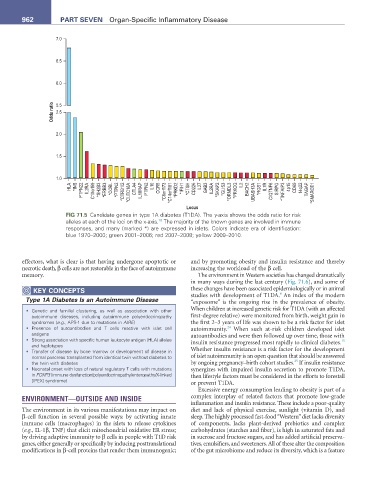
                       FIG 71.5  Candidate genes in type 1A diabetes (T1DA). The y-axis shows the odds ratio for risk
                       alleles at each of the loci on the x-axis.  The majority of the known genes are involved in immune
                                                     18
                       responses, and many (marked *) are expressed in islets. Colors indicate era of identification:
                       blue 1970–2000; green 2001–2006; red 2007–2008; yellow 2009–2010.


        effectors, what is clear is that having undergone apoptotic or   and by promoting obesity and insulin resistance and thereby
        necrotic death, β cells are not restorable in the face of autoimmune   increasing the workload of the β cell.
        memory.                                                   The environment in Western societies has changed dramatically
                                                               in many ways during the last century (Fig. 71.6), and some of
            KeY COnCePts                                       these changes have been associated epidemiologically or in animal
                                                                                             6
         Type 1A Diabetes Is an Autoimmune Disease             studies with development of T1DA.  An index of the modern
                                                               “exposome” is the ongoing rise in the prevalence of obesity.
          •  Genetic and familial clustering, as well as association with other   When children at increased genetic risk for T1DA (with an affected
           autoimmune diseases, including autoimmune polyendocrinopathy   first-degree relative) were monitored from birth, weight gain in
           syndromes (e.g., APS-1 due to mutations in AIRE)    the first 2–3 years of life was shown to be a risk factor for islet
          •  Presence of autoantibodies and T cells reactive with islet cell   autoimmunity.   When such at-risk children developed islet
                                                                           24
           antigens                                            autoantibodies and were then followed up over time, those with
          •  Strong association with specific human leukocyte antigen (HLA) alleles   insulin resistance progressed most rapidly to clinical diabetes.
                                                                                                                 15
           and haplotypes
          •  Transfer of disease by bone marrow or development of disease in   Whether insulin resistance is a risk factor for the development
           normal pancreas transplanted from identical twin without diabetes to   of islet autoimmunity is an open question that should be answered
                                                                                                 25
           the twin with diabetes                              by ongoing pregnancy–birth cohort studies.  If insulin resistance
          •  Neonatal onset with loss of natural regulatory T cells with mutations   synergizes with impaired insulin secretion to promote T1DA,
           in FOXP3 (immune dysfunction/polyendocrinopathy/enteropathy/X-linked   then lifestyle factors must be considered in the efforts to forestall
           [IPEX] syndrome)                                    or prevent T1DA.
                                                                  Excessive energy consumption leading to obesity is part of a
        ENVIRONMENT—OUTSIDE AND INSIDE                         complex interplay of related factors that promote low-grade
                                                               inflammation and insulin resistance. These include a poor-quality
        The environment in its various manifestations may impact on   diet and lack of physical  exercise, sunlight  (vitamin  D), and
        β-cell function in several possible ways: by activating innate   sleep. The highly processed fast-food “Western” diet lacks diversity
        immune cells (macrophages) in the islets to release cytokines   of components, lacks plant-derived prebiotics and complex
        (e.g., IL-1β, TNF) that elicit mitochondrial oxidative ER stress;   carbohydrates (starches and fiber), is high in saturated fats and
        by driving adaptive immunity to β cells in people with T1D risk   in sucrose and fructose sugars, and has added artificial preserva-
        genes, either generally or specifically by inducing posttranslational   tives, emulsifiers, and sweeteners. All of these alter the composition
        modifications in β-cell proteins that render them immunogenic;   of the gut microbiome and reduce its diversity, which is a feature

