


Page 998 - Clinical Immunology_ Principles and Practice ( PDFDrive )
P. 998
CHaPter 71  Type 1 Diabetes             963


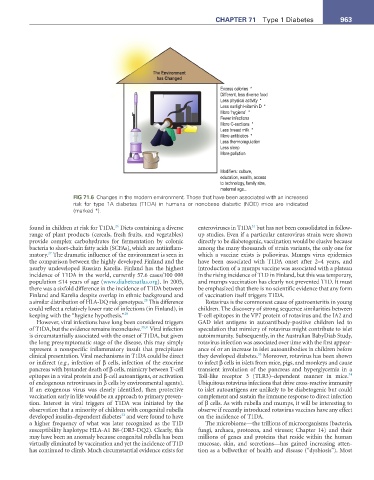
                                                   The Environment
                                                   Th he e e  E
                                                   T T T Th
                                                    h h has
                                                    has Changed
                                                                         Excess calories  *
                                                                         Different, less diverse food
                                                                         Less physical activity  *
                                                                         Less sunlight-vitamin D  *
                                                                         More ‘hygiene’  *
                                                                         Fewer infections
                                                                         More C-sections  *
                                                                         Less breast milk  *
                                                                         More antibiotics  *
                                                                         Less thermoregulation
                                                                         Less sleep
                                                                         More pollution

                                                                         Modifiers: culture,
                                                                         education, wealth, access
                                                                         to technology, family size,
                                                                         maternal age...
                         FIG 71.6  Changes in the modern environment. Those that have been associated with an increased
                         risk  for type 1A  diabetes  (T1DA) in  humans or  nonobese diabetic  (NOD)  mice are  indicated
                         (marked *).


                                                                                   31
                                       26
           found in children at risk for T1DA.  Diets containing a diverse   enteroviruses in T1DA  but has not been consolidated in follow-
           range of plant products (cereals, fresh fruits, and vegetables)   up studies. Even if a particular enterovirus strain were shown
           provide complex carbohydrates for fermentation by colonic   directly to be diabetogenic, vaccination would be elusive because
           bacteria to short-chain fatty acids (SCFAs), which are antiinflam-  among the many thousands of strain variants, the only one for
                 27
           matory.  The dramatic influence of the environment is seen in   which  a  vaccine  exists  is  poliovirus. Mumps  virus epidemics
           the comparison between the highly developed Finland and the   have been associated with T1DA onset after 2–4 years, and
           nearby undeveloped Russian Karelia. Finland has the highest   introduction of a mumps vaccine was associated with a plateau
           incidence of T1DA in the world, currently 57.6 cases/100 000   in the rising incidence of T1D in Finland, but this was temporary,
           population ≤14 years of age (www.diabetesatlas.org). In 2005,   and mumps vaccination has clearly not prevented T1D. It must
           there was a sixfold difference in the incidence of T1DA between   be emphasized that there is no scientific evidence that any form
           Finland and Karelia despite overlap in ethnic background and   of vaccination itself triggers T1DA.
                                                28
           a similar distribution of HLA-DQ risk genotypes.  This difference   Rotavirus is the commonest cause of gastroenteritis in young
           could reflect a relatively lower rate of infections (in Finland), in   children. The discovery of strong sequence similarities between
           keeping with the “hygiene hypothesis.” 29              T-cell epitopes in the VP7 protein of rotavirus and the IA2 and
             However, viral infections have long been considered triggers   GAD islet antigens in autoantibody-positive children led to
           of T1DA, but the evidence remains inconclusive. 30,31  Viral infection   speculation that mimicry of rotavirus might contribute to islet
           is circumstantially associated with the onset of T1DA, but given   autoimmunity. Subsequently, in the Australian BabyDiab Study,
           the long presymptomatic stage of the disease, this may simply   rotavirus infection was associated over time with the first appear-
           represent a nonspecific inflammatory insult that precipitates   ance of or an increase in islet autoantibodies in children before
                                                                                     33
           clinical presentation. Viral mechanisms in T1DA could be direct   they developed diabetes.  Moreover, rotavirus has been shown
           or indirect (e.g., infection of β cells, infection of the exocrine   to infect β cells in islets from mice, pigs, and monkeys and cause
           pancreas with bystander death of β cells, mimicry between T-cell   transient involution of the pancreas and hyperglycemia in a
                                                                                                                   34
           epitopes in a viral protein and β-cell autoantigens, or activation   Toll-like receptor 3 (TLR3)–dependent manner in mice.
           of endogenous retroviruses in β cells by environmental agents).   Ubiquitous rotavirus infections that drive cross-reactive immunity
           If an exogenous virus was clearly identified, then protective   to islet autoantigens are unlikely to be diabetogenic but could
           vaccination early in life would be an approach to primary preven-  complement and sustain the immune response to direct infection
           tion. Interest in viral triggers of T1DA was initiated by the   of β cells. As with rubella and mumps, it will be interesting to
           observation that a minority of children with congenital rubella   observe if recently introduced rotavirus vaccines have any effect
                                         32
           developed insulin-dependent diabetes  and were found to have   on the incidence of T1DA.
           a higher frequency of what was later recognized as the T1D   The microbiome—the trillions of microorganisms (bacteria,
           susceptibility haplotype HLA-A1 B8-(DR3-DQ2). Clearly, this   fungi, archaea, protozoa, and viruses; Chapter 14) and their
           may have been an anomaly because congenital rubella has been   millions of genes and proteins that reside within the human
           virtually eliminated by vaccination and yet the incidence of T1D   mucosae, skin, and secretions—has gained increasing atten-
           has continued to climb. Much circumstantial evidence exists for   tion as a bellwether of health and disease (“dysbiosis”). Most

