


Page 1169 - Hall et al (2015) Principles of Critical Care-McGraw-Hill
P. 1169
808     PART 6: Neurologic Disorders


                 platelet levels (using platelet transfusion if <50,000 per µL). The correc-    indicated as the primary treatment for intracranial hypertension due to
                 tion of platelet and coagulation profiles is more urgent in the presence of     hydrocephalus. In addition, placement of a ventricular drain allows for
                 an intracranial monitoring device or recent brain surgery.  easy CSF sampling for cultures and administration of either antibiot-
                   Hyperthermia in patients with brain injury increases cerebral   ics in the setting of a meningitis or ventriculitis as well as intrathecal
                   metabolic demand and the potential for ischemia in those with elevated   thrombolytic agents (t-PA) in the setting of an obstructive intraven-
                 ICP. Therefore, a targeted core temperature of ~36.5°C (goal <37°C) is   tricular hemorrhage. The use of an EVD in TBI patients is a common
                 utilized in most patients. Most commonly, hypothermia is achieved with   and routine practice to provide monitoring of ICP as well as continu-
                 noninvasive surface cooling devices. Shivering may limit the benefits of   ous drainage of CSF to reduce global elevation in ICP.  CSF drainage
                                                                                                               79
                 cooling, since it increases metabolic demand.         through lumbar puncture should generally be avoided in patients with
                   Nutrition is important to optimize outcome in the setting of brain   intracranial hypertension.
                 injury.  Enteral  nutrition should  ideally  be started within  24  hours.   Simultaneous CSF drainage and ICP monitoring (“leaving the EVD
                 Gastroparesis, which is common in neurologically injured patients, may   open”) may misrepresent the actual ICP as the monitored ICP can be
                 impede efforts to achieve adequate nutrition.         markedly different from intraparenchymal ICP. Defective CSF cycling
                   Endotracheal intubation with suspected or verified ICP elevation   within the cranium in patients with intracranial mass lesions may lead
                 should follow distinct guidelines (Table 86-10). Short-acting medica-  to additional ICP gradients between the parenchyma and ventricles.
                                                                                                                          80
                 tions (eg, propofol) at minimal doses should be used. Medications that   Closure of the drainage port during measurements allows ICP gradients
                 potentially elevate ICP (eg, succinylcholine alone, nitroglycerin)  or   to  equilibrate  throughout  the  cranial  vault  and  this  timepoint is  best
                 that produce sustained paralysis should be avoided. Succinylcholine in   estimated when both a stable ICP value and waveform are visible. The
                 patients with chronic muscular disease or spasticity should be avoided   extent of CSF drainage should be guided by the achieved control of
                 due to the potential for severe hyperkalemia. A physician with experi-  target ICP and often, an hourly rate of 10 to 15 mL will be an effective
                 ence in rapid sequence intubations should be assigned as prolonged   approach. Removal of a ventricular drain can be indicated when ICP has
                 supine positioning can increase ICP; immediate head elevation after   been normal for 2 to 3 days and no elevation in ICP is seen when the
                 the airway is secured is essential. Patients with acute herniation requir-  drain is continuously clamped. If a patient fails a clamp trial, that is, the
                 ing intubation may be pretreated with a mannitol bolus to reduce ICP   ICP increases and/or the patient becomes symptomatic, a permanent
                 during the procedure. Once the airway is secured, the tube should be   ventriculoperitoneal shunt is indicated.
                 stabilized without tight wrapping around the neck, skull fractures, or
                 craniectomy defects. Brain oxygen tension around the brain injury area   Hyperosmolar Therapy:  With the use of hypertonic solutions, moderate
                 is generally lower than expected from simultaneously measured arte-  hypernatremia should be expected and tolerated. Mannitol, hypertonic
                      , and it seems prudent to allow for an extra oxygenation “safety   saline solutions (HTS), and hypertonic sodium lactate (HTSL) are all
                 rial P O 2                                            effective in reducing elevated ICP in brain trauma patients as delineated

                 margin” to avoid borderline systemic hypoxemia, that is, keeping P O 2  in observational studies but unfortunately, there are no large random-
                           75                    is titrated to 35 to 40 mm Hg
                 >100 mm Hg.  Following intubation, P CO 2             ized studies to compare equiosmolar doses of different hyperosmolar
                 to prevent cerebral arterial dilation or constriction and the respective
                 risks of brain hyper- or hypoperfusion. Positive end-expiratory pressure   treatments.
                 (PEEP) up to 12 cm H O can be used safely. 76,77      Mannitol:  Osmotherapy is directed at increasing plasma osmolality
                                 2
                   The initial management of raised ICP in head trauma focuses on both   and establishing an osmotic gradient across the normally imperme-
                 normalizing the ICP and stabilizing CPP (Table 86-12). Early emphasis   able  blood-brain  barrier.   Mannitol,  the  most  widely  used  osmotic
                                                                                          163
                 in brain injured patients with cardiorespiratory compromise targets   agent, can improve cerebral perfusion through transient hypervolemia
                                       >60 mm Hg, systolic BP >90 mm Hg, and   and hemodilution, leading to autoregulatory cerebral vasoconstriction,
                   2
                 O  saturation >90% or Pa O 2
                 euvolemia. The CPP goal is 50 to 70 mm Hg, as CPP  <50 mm Hg  is   decreased cerebral blood volume, and lower ICP. 81-85  Mannitol can also
                 associated with increased mortality 5,33,74  and CPP >70 mm Hg has not   increase CSF absorption.  Most brain injury, however, results in disrup-
                                                                                         86
                 been shown to improve outcome.  A general approach to control ICP is   tion of the blood-brain barrier and loss of normal autoregulation. As a
                                         78
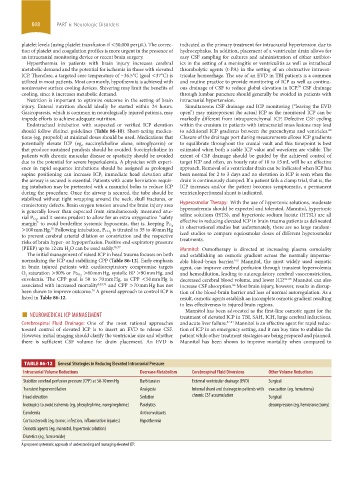
                 listed in Table 86-12.                                result, osmotic agents establish an incomplete osmotic gradient resulting
                                                                       in less effectiveness in injured brain regions.
                     ■  NEUROMEDICAL ICP MANAGEMENT                    treatment of elevated ICP in TBI, SAH, ICH, large cerebral infarctions,
                                                                         Mannitol has been advocated as the first-line osmotic agent for the
                 Cerebrospinal  Fluid  Drainage:  One of the most rational approaches   and acute liver failure. 87-91  Mannitol is an effective agent for rapid reduc-
                 toward control of elevated ICP is to insert an EVD to release CSF.   tion of ICP in an emergency setting, and it can buy time to stabilize the
                 However, initial imaging should clarify the ventricular size and whether   patient while other treatment strategies are being prepared and planned.
                 there is sufficient CSF volume for drain placement. An EVD is   Mannitol has  been shown  to improve mortality when  compared  to
                   TABLE 86-12    General Strategies in Reducing Elevated Intracranial Pressure
                  Intracranial Volume Reductions          Decrease Metabolism  Cerebrospinal Fluid Diversions  Other Volume Reductions
                  Stabilize cerebral perfusion pressure (CPP) at 50-70 mm Hg  Barbiturates  External ventricular drainage (EVD)  Surgical
                  Transient hyperventilation              Analgesia        Internal shunt and drainage in patients with  evacuation (eg, hematoma)
                  Head elevation                          Sedation         chronic CSF accumulation  Surgical
                  Inotropics to avoid ischemia (eg, phenylephrine,  norepinephrine)  Paralytics      decompression (eg, hemicraniectomy)
                  Euvolemia                               Anticonvulsants
                  Corticosteroids (eg, tumor, infection, inflammation injuries)  Hypothermia
                  Osmotic agents (eg, mannitol, hypertonic solution)
                  Diuretics (eg, furosemide)
                 A proposed systematic approach of understanding and managing elevated ICP.


            section06.indd   808                                                                                       1/23/2015   12:56:06 PM

