


Page 1180 - Hall et al (2015) Principles of Critical Care-McGraw-Hill
P. 1180
CHAPTER 86: Intracranial Pressure: Monitoring and Management  817


                                                                                            P 1       P 2
                                        P 1       P 2            P 1       P 2


                                              P = P 2                  P > P 2                 P >> P 2
                                                                        1
                                                                                                1
                                               1
                                                                    Brain tissue shift


                                                                   Clinical worsening
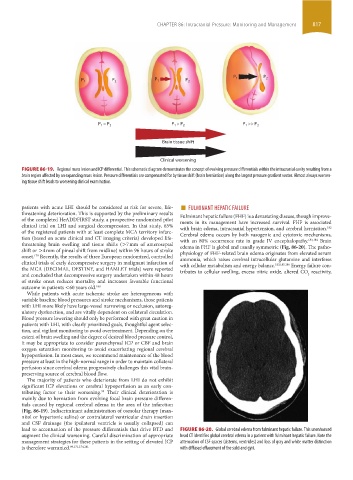
                    FIGURE 86-19.  Regional mass lesion and ICP differential. This schematic diagram demonstrates the concept of evolving pressure differentials within the intracranial cavity resulting from a
                    brain region affected by an expanding mass lesion. Pressure differentials are compensated for by tissue shift (brain herniation) along the largest pressure gradient vector. Almost always worsen-
                    ing tissue shift leads to worsening clinical examination.


                                                                              ■
                    patients with acute LHI should be considered at risk for severe, life-  FULMINANT HEPATIC FAILURE
                    threatening deterioration. This is supported by the preliminary results   Fulminant hepatic failure (FHF) is a devastating disease, though improve-
                    of the completed HeADDFIRST study, a prospective randomized pilot   ments in its management have increased survival. FHF is associated
                    clinical trial on LHI and surgical decompression. In that study, 65%   with brain edema, intracranial hypertension, and cerebral herniation.
                                                                                                                            182
                    of the registered patients with at least complete MCA territory infarc-  Cerebral edema occurs by both vasogenic and cytotoxic mechanisms,
                    tion (based on acute clinical and CT imaging criteria) developed life-  with an 80% occurrence rate in grade IV encephalopathy. 183,184  Brain
                    threatening brain swelling and tissue shifts (>7 mm of anteroseptal   edema in FHF is global and usually symmetric (Fig. 86-20). The patho-
                    shift or >4 mm of pineal shift from midline) within 96 hours of stroke   physiology of FHF-related brain edema originates from elevated serum
                    onset.  Recently, the results of three European randomized, controlled   ammonia, which raises cerebral intracellular glutamine  and interferes
                        179
                    clinical trials of early decompressive surgery in malignant infarction of   with cellular metabolism and energy balance. 183,185,186  Energy failure con-
                    the MCA (DECIMAL, DESTINY, and HAMLET trials) were reported   tributes to cellular swelling, excess nitric oxide, altered CO  reactivity,
                    and concluded that decompressive surgery undertaken within 48 hours                              2
                    of stroke onset reduces mortality and increases favorable functional
                    outcome in patients <60 years old. 180
                     While patients with acute ischemic stroke are heterogeneous with
                    variable baseline blood pressures and stroke mechanisms, those patients
                    with LHI more likely have large-vessel narrowing or occlusion, autoreg-
                    ulatory dysfunction, and are vitally dependent on collateral circulation.
                    Blood pressure lowering should only be performed with great caution in
                    patients with LHI, with clearly prioritized goals, thoughtful agent selec-
                    tion, and vigilant monitoring to avoid overtreatment. Depending on the
                    extent of brain swelling and the degree of desired blood pressure control,
                    it may be appropriate to consider parenchymal ICP or CBF and brain
                    oxygen  saturation  monitoring  to  avoid  exacerbating  regional  cerebral
                    hypoperfusion. In most cases, we recommend maintenance of the blood
                    pressure at least in the high-normal range in order to maintain collateral
                    perfusion since cerebral edema progressively challenges this vital brain-
                    preserving source of cerebral blood flow.
                     The majority of patients who deteriorate from LHI do not exhibit
                    significant ICP elevations or cerebral hypoperfusion as an early con-
                    tributing factor to their worsening.  Their clinical deterioration is
                                               99
                    mainly due to herniation from evolving focal brain pressure differen-
                    tials caused by regional cerebral edema in the area of the infarction
                    (Fig. 86-19). Indiscriminant administration of osmolar therapy (man-
                    nitol or hypertonic saline) or contralateral ventricular drain insertion
                    and CSF drainage (the ipsilateral ventricle is usually collapsed) can
                    lead to accentuation of the pressure differentials that drive BTD and   FIGURE 86-20.  Global cerebral edema from fulminant hepatic failure. This unenhanced
                    augment the clinical worsening. Careful discrimination of appropriate   head CT identifies global cerebral edema in a patient with fulminant hepatic failure. Note the
                    management strategies for these patients in the setting of elevated ICP   attenuation of CSF spaces (cisterns, ventricles) and loss of gray and white matter distinction
                    is therefore warranted. 99,171,174,181                with diffused effacement of the sulci and gyri.


            section06.indd   817                                                                                       1/23/2015   12:56:14 PM

