


Page 1192 - Hall et al (2015) Principles of Critical Care-McGraw-Hill
P. 1192
CHAPTER 88: Coma, Persistent Vegetative State, and Brain Death  829


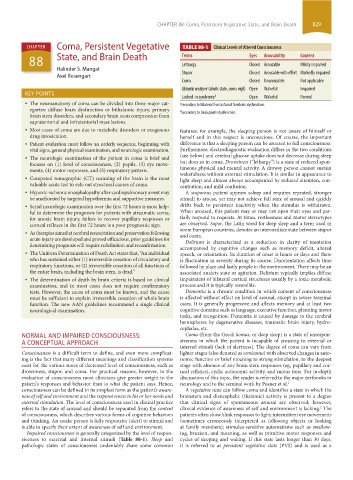
                     CHAPTER    Coma, Persistent Vegetative                 TABLE 88-1    Clinical levels of Altered Consciousness
                      88        State, and Brain Death                    Terms                  Eyes  Arousability  Content
                                                                                                                   Mildly impaired
                                                                          Lethargy
                                                                                                 Closed Arousable
                                Halinder S. Mangat
                                Axel Rosengart                            Stupor                 Closed Arousable with effort Markedly impaired
                                                                          Coma                   Closed Unarousable  Not applicable
                                                                          Akinetic mutism  (abulic state, coma vigil) Open  Wakeful  Impaired
                                                                                   a
                     KEY POINTS
                                                                          Locked-in syndrome b   Open  Wakeful     Normal
                        • The neuroanatomy of coma can be divided into three major cat-  a Secondary to bilateral frontal/basal forebrain dysfunction.
                      egories:  diffuse brain  dysfunction or  bithalamic  injury, primary   b
                      brain stem  disorders, and secondary brain stem compression from   Secondary to basis pontis dysfunction.
                      supratentorial and infratentorial mass lesions.
                        • Most cases of coma are due to metabolic disorders or exogenous   features;  for  example,  the  sleeping  person  is  not aware  of himself or
                      drug intoxication.                                  herself and in this respect is unconscious. Of course, the important
                       • Patient evaluation must follow an orderly sequence, beginning with     difference is that a sleeping person can be aroused to full consciousness.
                      vital signs, general physical examination, and neurologic examination.  Furthermore, electrodiagnostic evaluation differs in the two conditions
                        • The neurologic examination of the patient in coma is brief and   (see below) and cerebral glucose uptake does not decrease during sleep
                      focuses on (1) level of consciousness, (2) pupils, (3) eye move-  but does so in coma. Drowsiness (“lethargy”) is a state of reduced spon-
                      ments, (4) motor responses, and (5) respiratory pattern.  taneous physical and mental activity. A drowsy person cannot sustain
                                                                          wakefulness without external stimulation. It is similar in appearance to
                        • Computed tomographic (CT) scanning of the brain is the most   light sleep and almost always accompanied by reduced attention, con-
                        valuable acute test to rule out structural causes of coma.  centration, and mild confusion.
                       • Hypoxic-ischemic encephalopathy after cardiopulmonary arrest may   A  stuporous patient appears asleep and requires repeated, stronger
                      be ameliorated by targeted hypothermia and supportive measures.  stimuli to arouse, yet may not achieve full state of arousal and quickly
                        • Serial neurologic examination over the first 72 hours is most help-  drifts back to persistent inactivity when the stimulus is withdrawn.
                      ful to determine the prognosis for patients with atraumatic coma;   When aroused, this patient may or may not open their eyes and par-
                      for anoxic brain injury, failure to recover pupillary responses or   tially respond to requests. At times, restlessness and motor stereotypes
                      corneal reflexes in the first 72 hours is a poor prognostic sign.  are observed. Sopor, the Latin word for deep sleep and a term used in
                       • As therapies aimed at cerebral resuscitation and preservation following   some European countries, denotes an intermediate state between stupor
                                                                          and coma.
                      acute injury are developed and proved efficacious, prior guidelines for   Delirium is characterized as a reduction in clarity of mentation
                      determining prognosis will require redefinition and reconfirmation.  accompanied by cognitive changes such as memory deficit, altered
                       • The Uniform Determination of Death Act states that, “An individual   speech, or orientation. Its duration of onset is hours or days and there
                      who has sustained either (1) irreversible cessation of circulatory and   is fluctuation in severity during its course. Disorientation affects time
                      respiratory functions, or (2) irreversible cessation of all functions of     followed by place and lastly people in the environment. There may be an
                      the entire brain, including the brain stem, is dead.”  associated anxiety state or agitation. Delirium typically implies diffuse
                        • The determination of death by brain criteria is based on clinical   impairment of bilateral cortical structures usually by a toxic-metabolic
                      examination, and in most cases does not require confirmatory   process and it is typically reversible.
                      tests. However, the cause of coma must be known, and the cause   Dementia is a chronic condition in which content of consciousness
                      must be sufficient to explain irreversible cessation of whole brain   is affected without effect on level of arousal, except in severe terminal
                      function. The new AAN guidelines recommend a single clinical   cases. It is generally progressive and affects memory and at least two
                      neurological examination.                           cognitive domains such as language, executive function, planning motor
                                                                          tasks, and recognition. Dementia is caused by damage to the cerebral
                                                                          hemispheres by degenerative diseases, traumatic brain injury, hydro-
                                                                          cephalus, etc.
                    NORMAL AND IMPAIRED CONSCIOUSNESS:                     Coma (from the Greek komas, or deep sleep) is a state of unrespon-
                    A CONCEPTUAL APPROACH                                 siveness in which the patient is incapable of arousing to external or
                                                                          internal stimuli (lack of alertness). The degree of coma can vary from
                    Consciousness is a difficult term to define, and even more complicat-  lighter stages (also denoted as semicoma) with observed changes in auto-
                    ing is the fact that many different meanings and classification systems   nomic function or brief moaning to strong stimulation, to the deepest
                    exist for the various states of decreased level of consciousness, such as   stage with absence of any brain stem responses (eg, pupillary and cor-
                    drowsiness, stupor, and coma. For practical reasons, however, in the   neal reflexes), cyclic autonomic activity, and motor tone. For in-depth
                    evaluation of consciousness most clinicians give greater weight to the   discussions of this topic, the reader is referred to the major textbooks in
                    patient’s responses and behavior than to what the patient says. Hence,   neurology and to the seminal work by Posner et al. 1
                    consciousness can be defined in its simplest form as the patient’s aware-  A vegetative state can follow coma and identifies a state in which the
                    ness of self and environment and the responsiveness to his or her needs and   brainstem  and  diencephalic  (thalamic)  activity  is  present  to  a  degree
                    external stimulation. The level of consciousness used in clinical practice   that clinical signs of spontaneous arousal are observed; however,
                    refers to the state of arousal and should be separated from the content   clinical evidence of awareness of self and environment is lacking.  The
                                                                                                                         2
                    of consciousness, which describes various forms of cognitive behaviors   patients often show blink responses to light; intermittent eye movements
                    and thinking. An awake person is fully responsive (alert) to stimuli and   (sometimes erroneously interpreted as following objects or looking
                    is able to specify their extent of awareness of self and environment.  at family members); stimulus-sensitive automatisms such as swallow-
                     Impaired consciousness is generally categorized by the level of respon-  ing, bruxism, and moaning, as well as primitive motor responses and
                    siveness  to external and  internal  stimuli (Table 88-1).  Sleep and   cycles of sleeping and waking. If this state lasts longer than 30 days,
                      pathologic states of consciousness undeniably share some common   it is referred to as  persistent vegetative  state (PVS) and is used as a


            section06.indd   829                                                                                       1/23/2015   12:56:20 PM

