


Page 1197 - Hall et al (2015) Principles of Critical Care-McGraw-Hill
P. 1197
834     PART 6: Neurologic Disorders


                 contralateral side by stimulating the contralateral pontine paramedian   horizontal nystagmus, with the slow phase toward and the fast phase
                 reticular formation (PPRF) at the pontomedullary junction. Lesions of   away from the stimulated side and with minimal eye movement from
                 the frontal eye fields or the PPRFs lead to conjugate eye deviation, pro-  the midline. With diminishing consciousness in patients without struc-
                 vided that the MLF is intact. Therefore, a lesion of the right frontal eye   tural brain stem damage, the fast phase of the nystagmus disappears,
                 field or left PPRF impairs leftward gaze, and thus the eyes conjugately   and the eyes tend to deviate conjugately toward the stimulated side.
                 deviate to the right. In short, the eyes turn toward the lesion with frontal   Structural brain stem disease eliminates the caloric response, as does
                 eye field dysfunction and away from the lesion with PPRF dysfunction.   inner ear disease, deep drug coma, and anticonvulsant drug overdose.
                 In contrast, MLF lesions are manifested as poor adduction of the eye   In order to ensure proper interpretation of cold water caloric testing,
                 ipsilateral to the MLF lesion. Spontaneous “roving” eye movements in   the opposite side should not be stimulated until 5 minutes after the
                 all directions in the comatose patient imply bilateral frontal eye field   initial side.
                 dysfunction due to a diffuse cerebral process. If no spontaneous eye   Corneal Reflex  The corneal reflex is an important protective mechanism
                 movements are observed, the intactness of the interconnections respon-  for the cornea. It is a blinking reflex triggered when the cornea is pre-
                 sible for eye control is in question. Since comatose patients are unable to   sented with any tactile stimulus. The afferent limb is via the trigeminal
                 follow commands, maneuvers that take advantage of vestibular input   nerve (CN V), and the efferent limb is via the facial nerve (CN VII).
                 to ocular control must be utilized.                   Although corneal reflexes assess brain stem function, they have limited
                   An oculocephalic reflex (doll’s eye maneuver) is performed by rap-  localizing value.
                 idly rotating the head from side to side, and observing the patient’s eye
                 positional changes (Figure 88-3). The normal response in the coma-  Motor Function  The corticospinal tract predominantly originates from the
                 tose patient with intact brain stem is for the eyes to remain fixed on   frontal cortex and descends ipsilaterally through the corona radiata,
                 the same point in space. Thus, when the head is turned rightward, the   the posterior limb of the internal capsule, and the cerebral peduncle of
                 eyes move to the left. When the head is turned leftward, the eyes move   the midbrain and consolidates in the pyramids, and the ventral swell-
                 conjugately to the right. If a comatose patient does not have normal   ings of the medulla. The pyramidal fibers decussate to the contralateral
                 doll’s eyes, a disruption of brain stem ocular and vestibular connections   side at the junction of the medulla and spinal cord to form the lateral
                 may be present. Of course, in the setting of trauma, the head should not   corticospinal tract.
                 be rotated due to the possibility of cervical spine injury. In this situa-  Observation is the key to the motor examination in the comatose
                 tion or when doll’s eye maneuvers are inconclusive, cold water calorics   patient. The patient is observed for spontaneous movements or main-
                 are helpful.                                          tenance of particular postures. Lesions involving the corticospinal
                   Oculovestibular reflexes (cold water caloric testing) depend on   tract  generally  lead  to  diminished  contralateral  spontaneous  activ-
                 vestibular system stimulation by altering endolymphatic flow in the   ity. Upper midbrain or more rostral lesions may lead to decorticate
                 semicircular canals. The change in endolymphatic flow is achieved by   posturing characterized by flexion of the contralateral arm at the
                 instilling ice-cold water in the external auditory canal, thereby cooling   elbow and hyperextension of the leg. Central midbrain and high
                 the middle and inner ear, and in turn the semicircular canal. Prior to   pontine lesions, with a relatively intact brain stem inferiorly, may
                 performing this test, the external auditory canal should be examined   lead to decerebrate   posturing  characterized by contralateral  arm
                 to confirm intactness of the tympanic membrane and remove any   and leg extension. Structural lesions or metabolic insults may also
                 impacted cerumen. The head should then be elevated 30°. A functional   cause such posturing and it is often mistaken for seizure activity. The
                 apparatus for instilling the water is a butterfly catheter (with the needle   patient  should  be  observed  for  the   presence  of  tremor,  myoclonus,
                 removed) connected to a syringe containing approximately 15 to 20 mL   or  asterixis,  because these  may  be  associated  with  toxic-metabolic
                 of cold water.                                        encephalopathies.
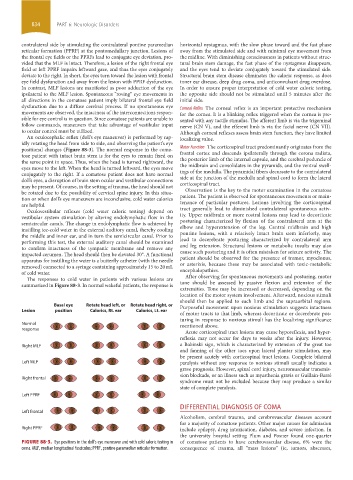
                   The responses to cold water in patients with various lesions are     After observing for spontaneous movements and posturing, motor
                 summarized in Figure 88-3. In normal wakeful patients, the response is    tone should be assessed by passive flexion and extension of the
                                                                       extremities. Tone may be increased or decreased, depending on the
                                                                       location of the motor system involvement. Afterward, noxious stimuli
                                                                       should then be applied to each limb and the supraorbital regions.
                            Basal eye  Rotate head left, or  Rotate head right, or  Purposeful movement upon noxious stimulation suggests intactness
                 Lesion      position    Calorics, Rt. ear  Calorics, Lt. ear
                                                                       of motor tracts to that limb, whereas decorticate or decerebrate pos-
                                                                       turing in response to noxious stimuli has the localizing significance
                 Normal                                                mentioned above.
                 response
                                                                         Acute corticospinal tract lesions may cause hyporeflexia, and hyper-
                                                                       reflexia may not occur for days to weeks after the injury. However,
                                                                       a Babinski sign, which is characterized by extension of the great toe
                 Right MLF
                                                                       and fanning of the other toes upon lateral plantar stimulation, may
                                                                       be   present acutely with corticospinal tract lesions. Complete bilateral
                 Left MLF                                              paralysis without any response to noxious stimuli usually indicates a
                                                                       grave prognosis. However, spinal cord injury, neuromuscular transmis-
                                                                       sion blockade, or an illness such as myasthenia gravis or Guillain-Barré
                 Right frontal
                                                                       syndrome must not be excluded because they may produce a similar
                                                                       state of complete paralysis.
                 Left PPRF
                                                                       DIFFERENTIAL DIAGNOSIS OF COMA
                 Left frontal
                                                                       Alcoholism, cerebral trauma, and cerebrovascular diseases account
                                                                       for a majority of comatose patients. Other major causes for admission
                 Right PPRF                                            include epilepsy, drug intoxication, diabetes, and severe infection. In
                                                                       the university hospital setting Plum and Posner found one-quarter
                 FIGURE 88-3.  Eye positions in the doll’s eye maneuver and with cold caloric testing in   of comatose patients to have cerebrovascular disease, 6% were the
                 coma. MLF, median longitudinal fasciculus; PPRF, pontine paramedian reticular formation.  consequence  of  trauma,  all  “mass  lesions”  (ie,  tumors,  abscesses,


            section06.indd   834                                                                                       1/23/2015   12:56:23 PM

