


Page 1195 - Hall et al (2015) Principles of Critical Care-McGraw-Hill
P. 1195
832     PART 6: Neurologic Disorders


                   consciousness, (2) respiratory pattern, (3) pupillary size and reactivity,     TABLE 88-6    Pupillary Changes in Coma
                 (4) eye position and movements, (5) corneal reflexes, and (6) motor
                 function.                                              Size          Reactivity  Comments
                 Assessment of Consciousness  The determination of the level of consciousness   Bilateral
                 depends on analyzing arousal and content (see  Table 88-1). Initially,     Normal or small  Normal  Toxic-metabolic disturbance
                 one should observe whether the patient appears asleep or wakeful with
                 spontaneous eye opening. In a sleeping patient, one should quantify how      Midposition   Poor  Midbrain dysfunction; drugs (glutethimide
                 much stimulation (verbal, tactile, or noxious) is required to arouse the   (3-5 mm)  [Doriden])
                 patient. Attempts should be made to elicit a behavioral response by verbal     Small (pinpoint)  Poor  Pontine dysfunction; drugs (narcotics)
                 command alone. If no response is obtained, then physical stimulation     Large  Poor  Toxic-metabolic disturbance (anoxia); drugs
                 should be used, first by shaking the patient. Then noxious stimulation       ( anticholinergics)
                 can be applied by digital pressure to the supraorbital nerves or nail beds of   Unilateral
                 the fingers or toes. Care should always be taken not to use stimuli severe
                 enough to cause bruising. Purposeful attempts by the patient to remove     Large  Unreactive  Ipsilateral midbrain pathology or compression
                 the offending stimulus indicate preservation of brain stem function          of  ipsilateral CN III: uncal herniation, posterior
                 and intact connections to the cerebral hemispheres. Eye opening, either        communicating artery aneurysm
                 spontaneous or in response to stimulation, indicates preserved function     Small  Minimal  Ipsilateral sympathetic dysfunction
                 of the RAS in the upper brain stem and hypothalamus. Once aroused, the
                 patient’s ability to remain wakeful and respond coherently is determined.
                   Lethargy (or drowsiness), stupor, and coma represent different points on   continuous  pattern;  by  parabrachial  nucleus  in  the  pons,  which  inte-
                 a continuum of decreasing levels of consciousness. Patients in these states   grates respiratory movements  with reflexes such as  coughing and
                 appear to be sleeping with eyes closed. In contrast, patients with akinetic   swallowing; and by the hypothalamus, which modulates respiration
                 mutism and locked-in syndrome appear to be awake with eyes opened.  in relation to behavioral state. The cerebral cortex and forebrain are
                   The Glasgow Coma Scale (Table 88-5) is used to assign a  numerical   important in  the control  of  regular respiration.  Patients  with isolated
                 description of consciousness. The scale was devised to evaluate patients   brain injury uncomplicated by other critical medical illnesses may have
                 with head injury and is most reliable and reproducible in trauma   characteristic breathing patterns that aid in neuroanatomical localiza-
                 patients. 17,18  Its application in nontraumatic conditions is less reliable, but it   tion (Fig. 88-1). However, these patterns are not reliable in patients with
                 is still the most widely used clinical scale to evaluate the level of conscious-  multiple organ system failure who are receiving mechanical ventilation.
                 ness. Furthermore, it provides a reproducible tool to monitor progression.   Nevertheless, a discussion is warranted.
                 Another scale has recently been adopted by neurointensive care units   Cheyne-Stokes respiration is a periodic breathing pattern in which
                 across the country. The FOUR score includes more neurological details   periods  of hyperpnea regularly  alternate  with  apnea in  a smooth
                 and has higher predictability for in-hospital mortality (Table 88-6). 19  crescendo-decrescendo pattern. This neurogenic respiratory alteration
                 Respiratory Control  The ventral respiratory group of neurons in the medulla   occurs with damage to the cortex and forebrain bilaterally, or secondary
                                                                       to cardiac or respiratory failure. It is the result of the loss of frontal lobe
                 generates  the  intrinsic  respiratory  rhythm with the dorsal group  of   control over respiratory patterns with excessive dependence on blood
                 neurons controlling the airway and respiratory reflexes. The respiratory   CO /pH levels to trigger brain stem respiratory centers.
                 motor control is also influenced by prefrontal cortex, which modulates    Midbrain and upper pontine lesions may cause a central neurogenic
                                                                          2
                                                                       hyperventilation syndrome with persistent deep hyperventilation. It can
                                                                       only be diagnosed with arterial blood gas measurements, since hyper-
                   TABLE 88-5    The Glasgow Coma Scale a              ventilation also occurs secondary to hypoxemia and acidemia. Likewise,
                  Response                                      Points  metabolic disorders, especially the early stages of hepatic coma, cause
                                                                       central neurogenic hyperventilation.
                  Eye opening
                                                                         Lesions of the middle or lower pons are characterized by deep pro-
                    Spontaneously                                 4    longed inspiration followed by a long pause referred to as  apneustic
                    To speech                                     3    breathing. Most patients with this respiratory pattern require early intu-
                                                                       bation and mechanical ventilation.
                    To pain                                       2
                                                                         Ataxic and irregular periodic breathing occurs with lesions in the dorso-
                    Never                                         1    medial medulla and may be accompanied by hypersensitivity to respiratory
                  Best verbal response                                 depressants. These patterns are not compatible with sustained life.
                                                                         When assessing a comatose patient, the rate and pattern of respiration
                    Oriented                                      5
                                                                       should be observed. In addition, vomiting and hiccups should be noted
                    Confused                                      4    because they may result from intrinsic brain stem pathology or transmit-
                    Inappropriate                                 3    ted pressure on the brain stem. Furthermore, spontaneous yawning may
                    Garbled                                       2    occur in comatose patients. The neurogenic networks for this complex
                                                                       respiratory response are integrated in the lower brain stem.
                    None                                          1
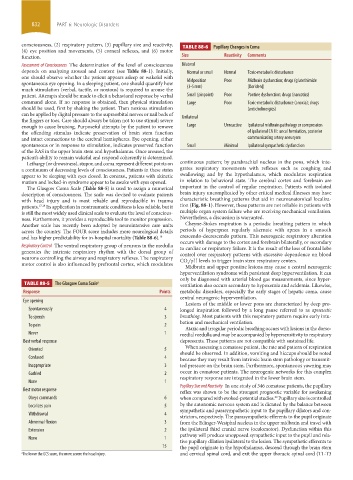
                                                                       Pupillary Size and Reactivity  In one study of 346 comatose patients, the pupillary
                  Best motor response                                  reflex was shown to be the strongest prognostic variable for awakening
                    Obeys commands                                6    when compared with evoked-potential studies.  Pupillary size is controlled
                                                                                                       20
                    Localizes pain                                5    by the autonomic nervous system and is dictated by the balance between
                                                                       sympathetic and parasympathetic input to the pupillary dilators and con-
                    Withdrawal                                    4
                                                                       strictors, respectively. The parasympathetic efferents to the pupil originate
                    Abnormal flexion                              3    from the Edinger-Westphal nucleus in the upper midbrain and travel with
                    Extension                                     2    the ipsilateral third cranial nerve (oculomotor). Dysfunction within this
                                                                       pathway will produce unopposed sympathetic input to the pupil and rela-
                    None                                          1
                                                                       tive pupillary dilation ipsilateral to the lesion. The  sympathetic efferents to
                                                                 15    the pupil originate in the hypothalamus, descend through the brain stem
                 a The lower the GCS score, the more severe the head injury.  and cervical spinal cord, and exit the upper  thoracic spinal cord (T1-T3


            section06.indd   832                                                                                       1/23/2015   12:56:21 PM

