


Page 1196 - Hall et al (2015) Principles of Critical Care-McGraw-Hill
P. 1196
CHAPTER 88: Coma, Persistent Vegetative State, and Brain Death  833


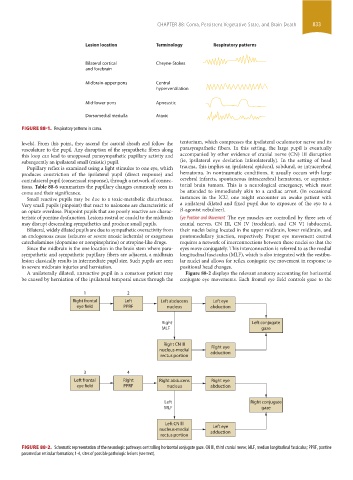
                                         Lesion location         Terminology         Respiratory patterns


                                         Bilateral cortical      Cheyne-Stokes
                                         and forebrain

                                         Midbrain-upper pons     Central
                                                                 hyperventilation

                                         Mid-lower pons          Apneustic

                                         Dorsomedial medulla     Ataxic
                    FIGURE 88-1.  Respiratory patterns in coma.

                    levels). From this point, they ascend the carotid sheath and follow the   tentorium, which compresses the ipsilateral oculomotor nerve and its
                    vasculature to the pupil. Any disruption of the sympathetic fibers along   parasympathetic fibers. In this setting, the large pupil is eventually
                    this loop can lead to unopposed parasympathetic pupillary activity and   accompanied by other evidence of cranial nerve (CN) III disruption
                    subsequently an ipsilateral small (miotic) pupil.     (ie, ipsilateral eye deviation inferolaterally). In the setting of head
                     Pupillary reflex is examined using a light stimulus to one eye, which   trauma, this implies an ipsilateral epidural, subdural, or intracerebral
                    produces constriction of the ipsilateral pupil (direct response) and   hematoma.  In nontraumatic  conditions,  it  usually  occurs  with  large
                    contralateral pupil (consensual response), through a network of connec-  cerebral infarcts, spontaneous intracerebral hematoma, or supraten-
                    tions. Table 88-6 summarizes the pupillary changes commonly seen in   torial brain tumors. This  is a neurological emergency,  which must
                    coma and their significance.                          be attended to immediately akin to a cardiac arrest. (In occasional
                     Small reactive pupils may be due to a toxic-metabolic disturbance.   instances in the ICU, one might encounter an awake patient with
                    Very small pupils (pinpoint) that react to naloxone are characteristic of   a unilateral dilated and fixed pupil due to exposure of the eye to a
                    an opiate overdose. Pinpoint pupils that are poorly reactive are charac-  β-agonist nebulizer).
                    teristic of pontine dysfunction. Lesions rostral or caudal to the midbrain   Eye Position and Movement  The eye muscles are controlled by three sets of
                    may disrupt descending sympathetics and produce small pupils.  cranial nerves, CN III, CN IV (trochlear), and CN VI (abducens),
                     Bilateral, widely dilated pupils are due to sympathetic overactivity from   their nuclei being located in the upper midbrain, lower midbrain, and
                    an endogenous cause (seizures or severe anoxic ischemia) or exogenous   pontomedullary junction, respectively. Proper eye movement control
                    catecholamines (dopamine or norepinephrine) or atropine-like drugs.  requires a network of interconnections between these nuclei so that the
                     Since the midbrain is the one location in the brain stem where para-  eyes move conjugately. This interconnection is referred to as the medial
                    sympathetic and sympathetic pupillary fibers are adjacent, a midbrain   longitudinal fasciculus (MLF), which is also integrated with the vestibu-
                    lesion classically results in intermediate pupil size. Such pupils are seen   lar nuclei and allows for reflex conjugate eye movement in response to
                    in severe midbrain injuries and herniation.           positional head changes.
                     A unilaterally dilated, unreactive pupil in a comatose patient may   Figure 88-2 displays the relevant anatomy accounting for horizontal
                    be caused by herniation of the ipsilateral temporal uncus through the   conjugate  eye  movements.  Each  frontal  eye  field  controls  gaze  to  the

                                         1              2
                                     Right frontal     Left        Left abducens     Left eye
                                      eye field       PPRF           nucleus        abduction


                                                                   Right                          Left conjugate
                                                                   MLF                               gaze

                                                                    Right CN lll
                                                                                    Right eye
                                                                   nucleus-medial   adduction
                                                                   rectus portion

                                         3              4
                                      Left frontal    Right       Right abducens    Right eye
                                      eye field       PPRF           nucleus        abduction


                                                                    Left                          Right conjugate
                                                                    MLF                              gaze

                                                                     Left CN lll
                                                                                     Left eye
                                                                   nucleus-medial   adduction
                                                                   rectus portion
                    FIGURE 88-2.  Schematic representation of the neurologic pathways controlling horizontal conjugate gaze. CN III, third cranial nerve; MLF, median longitudinal fasciculus; PPRF, pontine
                    paramedian reticular formation; 1-4, sites of possible pathologic lesions (see text).


            section06.indd   833                                                                                       1/23/2015   12:56:22 PM

