


Page 1194 - Hall et al (2015) Principles of Critical Care-McGraw-Hill
P. 1194
CHAPTER 88: Coma, Persistent Vegetative State, and Brain Death  831


                    in injuries to the midbrain or medial thalami, which lead to significant     TABLE 88-3    Useful Physical Examination Findings in Comatose Patients
                    impairment of consciousness but none or only minimal focal neurologic
                    findings. Traumatic brain injury with diffuse axonal injury can lead to   Exam Focus  Specific Features  Suggested Condition
                    petechial  hemorrhages  and  ischemia  or  inflammatory  to  necrotizing   Skin  Petechiae, splinter hemorrhage  Coagulopathy; SBE
                    lesions of the midbrain, resulting in impaired consciousness.
                     Cerebral masses can produce either direct or indirect (uncal or tento-  Icteric      Hepatic encephalopathy
                    rial herniation) displacement and torsions of the midbrain and reduced   Needle tracks  Drug overdose or withdrawal
                    alertness. Sudden injury to either or both cerebral hemispheres may   Cyanotic        Hypoxemia
                    produce impaired consciousness, indicating that wakefulness has no
                    hemispheric dominance and requires some cerebral function. Bilateral,   Lymph nodes  Adenopathy  Infectious etiologies;
                                                                                                            immunocompromised hosts
                    extensive acute or subacute damage to the cortex and white matter, for
                    example, due to trauma, hypoxia, or infection, impairs activation of the   Head  Contusion; postauricular ecchymosis  Trauma
                    upper  RAS,  leading  to  impaired  consciousness.  However,  focal  large   (Battle sign)
                    cortical (lobar) areas can be injured and initially not affect consciousness   VP shunt  Hydrocephalus; shunt malfunction
                    at all until secondary injury from swelling and bleeding occurs, as evi-  Eyes  Periorbital ecchymosis (raccoon eyes) Trauma
                    denced by patients with penetrating wounds of the cerebral hemispheres
                    who remain fully awake. Similarly, degenerative disorders such as   Papilledema       Increased intracranial pressure
                    Alzheimer disease generally do not or only minimally affect the RAS and   Ears  Hemotympanum  Trauma
                    these patients remain fully awake. Hypersomnia refers to a condition of   Nose  Excessive discharge  Trauma
                    excessive drowsiness and sleep. It may occur in the setting of narcolepsy,
                    hypothalamic disorders, sleep disorders, or psychiatric illness.  Neck  Stiff         Subarachnoid hemorrhage, infection
                     Several categories of consciousness-impairing mechanisms and   Enlarged thyroid      Dysthyroidism
                    lesions can be defined. First, one cause is an easily identifiable mass   Cardiovascular Arrhythmia, etc  Hypoxic/ischemic encephalopathy
                    lesion compressing the upper RAS either directly or indirectly (such as
                    tumor, abscess, meningitis, or hemorrhage); second, discrete lesions of   Abdomen  Small hard liver  Hepatic encephalopathy
                    the upper brain stem (examples are outlined above) may be the cause;   Miscellaneous  Acetone, alcohol breath  Ketoacidosis; alcohol intoxication
                    and third, a larger group of patients includes those in whom suppres-  Fever          Infection
                    sion of the RAS is induced by metabolic derangements, toxic states, or   Tongue laceration; incontinence  Postictal state
                    seizures. Such functional causes of coma may be reversible by correcting
                    the underlying metabolic derangement or removing the offending drug.   SBE, subacute bacterial endocarditis; VP, ventriculoperitoneal.
                    “Metabolic” coma is likely the most common etiologic category resulting
                    in impaired consciousness in medical critical care units.  Frequently the etiology of acute depression in consciousness in the
                                                                          hospitalized patient includes sepsis, acid-base, fluid, and electrolyte
                    EXAMINATION OF THE COMATOSE PATIENT:                  disorders, or hepatic, renal, or cardiac failure or seizures. Therefore,
                    A CLINICAL APPROACH                                   laboratory studies should be obtained to exclude metabolic and endo-
                                                                          crine causes.
                    Acute depression in level of consciousness is a critical, life-threatening
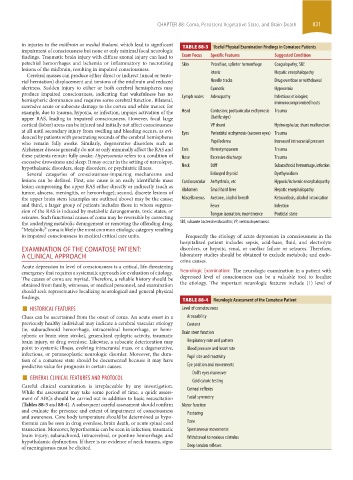
                    emergency that requires a systematic approach for evaluation of etiology.   Neurologic Examination:  The neurologic examination in a patient with
                    The causes of coma are myriad. Therefore, a reliable history should be   depressed level of consciousness can be a valuable tool to localize
                    obtained from family, witnesses, or medical personnel, and examination   the etiology. The important neurologic features include (1) level of
                    should seek representative localizing neurological and general physical
                    findings.                                               TABLE 88-4    Neurologic Assessment of the Comatose Patient
                        ■  HISTORICAL FEATURES                            Level of consciousness

                    Clues can be ascertained from the onset of coma. An acute onset in a     Arousability
                    previously healthy individual may indicate a cerebral vascular etiology     Content
                    (ie, subarachnoid hemorrhage, intracerebral hemorrhage, or hemi-
                    spheric or brain stem stroke), generalized epileptic activity, traumatic   Brain stem function
                    brain injury, or drug overdose. Likewise, a subacute deterioration may     Respiratory rate and pattern
                    point to systemic illness, evolving intracranial mass, or a degenerative,     Blood pressure and heart rate
                    infectious, or paraneoplastic neurologic disorder. Moreover, the dura-    Pupil size and reactivity
                    tion of a comatose state should be documented because it may have
                    predictive value for prognosis in certain causes.       Eye position and movements
                        ■  GENERAL CLINICAL FEATURES AND PROTOCOL             Doll’s eyes maneuver

                    Careful clinical examination is irreplaceable by any investigation.       Cold caloric testing
                                                                            Corneal reflexes
                    While  the  assessment  may  take  some  period  of  time,  a  quick  assess-
                    ment of ABCs should be carried out in addition to basic resuscitation     Facial symmetry
                    (Tables 88-3 and 88-4). A subsequent careful assessment should  confirm   Motor function
                    and evaluate the presence and extent of impairment of  consciousness     Posturing
                    and awareness. Core body temperature should be determined as hypo-
                    thermia can be seen in drug overdose, brain death, or acute spinal cord     Tone
                    transection. Moreover, hyperthermia can be seen in infection; traumatic     Spontaneous movements
                    brain injury; subarachnoid, intracerebral, or pontine hemorrhage; and     Withdrawal to noxious stimulus
                    hypothalamic dysfunction. If there is no evidence of neck trauma, signs
                    of meningismus must be elicited.                        Deep tendon reflexes


            section06.indd   831                                                                                       1/23/2015   12:56:20 PM

