


Page 1246 - Hall et al (2015) Principles of Critical Care-McGraw-Hill
P. 1246
CHAPTER 90: Bleeding Disorders  853


                    ranges from mild to severe requiring renal replacement therapy. Long-  DISORDERS OF SOLUBLE COAGULATION FACTORS
                    term consequences in children and young adults who develop diarrhea-
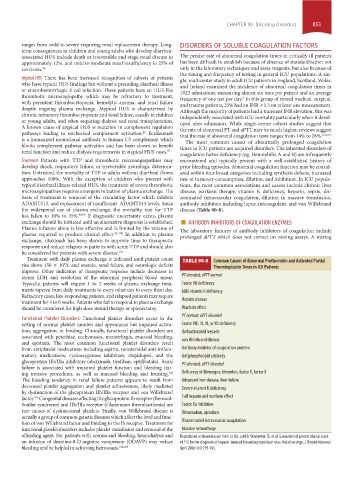
                    associated HUS include death or irreversible end-stage renal disease in   The precise rate of abnormal coagulation times in critically ill patients
                    approximately 12%, and mild to moderate renal insufficiency in 25% of   has been difficult to establish because of absence of standardization not
                    survivors. 96                                         only in the laboratory techniques and assay reagents, but also because of
                                                                          the timing and frequency of testing in general ICU populations. A sin-
                    Atypical HUS  There has been increased recognition of subsets of patients   gle, multicenter study in adult ICU patients in England, Scotland, Wales,
                    who have typical HUS findings but without a preceding diarrheal illness   and Ireland examined the incidence of abnormal coagulation times in
                    or enterohemorrhagic E coli infection. These patients have an HUS-like   1923 admissions, measuring almost six tests per patient and an average
                    thrombotic microangiopathy which may be refractory to treatment,   frequency of one test per day.  In this group of mixed medical, surgical,
                                                                                               2
                    with persistent thrombocytopenia, hemolytic anemia, and renal failure    and trauma patients, 25% had an INR >1.5 on at least one measurement.
                    despite ongoing plasma exchange. Atypical HUS is characterized by   Although the majority of patients had a transient INR elevation, this was
                    chronic refractory thrombocytopenia and renal failure, usually in children   independently associated with ICU mortality particularly when it devel-
                    or young adults, and often requiring dialysis and renal transplantation.   oped after admission. While single-center cohort studies suggest that
                    A known cause of atypical HUS is mutation in complement regulation   the rate of abnormal PT and aPTT may be much higher, reviews suggest
                    pathways leading to unchecked complement activation.  Eculizumab   that the rate of abnormal coagulation tests ranges from 14% to 28%. 106,107
                                                             86
                    is a humanized monoclonal antibody to human C5 complement which   The most common causes of abnormally prolonged coagulation
                    blocks complement pathway activation and has been shown to benefit   times in ICU patients are acquired disorders. The inherited disorders of
                    renal function and reduce dialysis requirements in atypical HUS cases. 97  coagulation factor deficiency (eg, Hemophilia A and B) are infrequently
                    Treatment  Patients with TTP and thrombotic microangiopathies may   encountered and typically present with a well-established history of
                    develop shock, respiratory failure, or irreversible neurologic deteriora-  prior bleeding episodes. Abnormal coagulation function may be consid-
                    tion. Untreated, the mortality of TTP in adults without diarrheal illness   ered within four broad categories including synthesis defects, increased
                    approaches 100%. With the exception of children who present with   rate of turnover-consumption, dilution, and inhibition. In ICU popula-
                    typical diarrheal illness-related HUS, the treatment of severe thrombotic   tions, the most common associations and causes include chronic liver
                    microangiopathies requires emergent initiation of plasma exchange. The   disease, warfarin therapy, vitamin K deficiency, heparin, sepsis, dis-
                    basis of treatment is removal of the circulating factor which inhibits     seminated intravascular coagulation, dilution in massive transfusion,
                    ADAMTS13, and replacement of insufficient  ADAMTS13 levels. Since   antibody inhibitors including lupus anticoagulant, and von Willebrand
                    the widespread use of plasma exchange, the mortality rate for TTP   disease (Table 90-8).
                    has  fallen  to  10%  to  35%. 98,99   If  diagnostic  uncertainty  exists,  plasma
                    exchange should be initiated until an alternative diagnosis is established.     ■  ANTIBODY INHIBITORS OF COAGULATION ENZYMES
                    Plasma infusion alone is less effective and is limited by the volume of   The laboratory features of antibody inhibitors of coagulation include
                    plasma  required  to  produce  clinical  effect. 98-100   In  addition  to  plasma   prolonged aPTT which does not correct on mixing assays. A mixing
                    exchange, rituximab has been shown to improve time to therapeutic
                    response and reduce relapses in patients with acute TTP and should also
                    be considered for patients with severe disease. 101
                     Treatment with daily plasma exchange is indicated until platelet count     TABLE 90-8     Common Causes of Abnormal Prothrombin and Activated Partial
                    rise above 150 × 10 /L and anemia, renal failure, and neurologic deficits   Thromboplastin Times in ICU Patients
                                  9
                    improve. Other indicators of therapeutic response include decreases in
                    serum  LDH  and  resolution  of  the  abnormal  peripheral  blood  smear.   PT elevated; aPTT normal
                    Typically, patients will require 1 to 2 weeks of plasma exchange treat-  Factor VII deficiency
                    ments tapered from daily treatments to every other day to every third day.   Mild vitamin K deficiency
                    Refractory cases, late-responding patients, and relapsed patients may require
                    treatment for 4 to 6 weeks. Patients who fail to respond to plasma exchange   Hepatic disease
                    should be considered for high-dose steroid therapy or splenectomy.  Warfarin effect

                    Functional Platelet Disorders:  Functional  platelet  disorders  occur  in  the   PT normal; aPTT elevated
                    setting of normal platelet number and appearance but impaired activa-  Factor VIII, IX, XI, or XII deficiency
                    tion, aggregation, or binding. Clinically, functional platelet disorders are   Unfractionated heparin
                    associated with petechiae, ecchymoses, menorrhagia, mucosal bleeding,
                    and epistaxis. The most common functional platelet disorders result   von Willebrand disease
                    from antiplatelet medications including aspirin, nonsteroidal anti-inflam-  Antibody inhibitor of coagulation proteins
                    matory medications, cyclooxygenase inhibitors, clopidogrel, and the   Antiphospholipid antibody
                    glycoprotein IIb/IIIa inhibitors (abciximab, tirofiban, eptifibatide). Renal   PT elevated; aPTT elevated
                    failure is associated with impaired platelet function and bleeding dur-
                    ing invasive procedures, as well as mucosal bleeding and bruising.      Deficiency of fibrinogen, thrombin, factor V, factor X
                                                                      102
                    The bleeding tendency in renal failure patients appears to result from   Advanced liver disease, liver failure
                    decreased platelet aggregation and platelet adhesiveness, likely mediated   Severe vitamin K deficiency
                    by dysfunction of the glycoprotein IIb/IIIa receptor and von Willebrand
                    factor.  Congenital diseases affecting the glycoprotein Ib receptor (Bernard-  Full heparin and warfarin effect
                        103
                    Soulier syndrome) and IIb/IIIa receptor (Glanzmann thrombasthenia) are   Factor Xa inhibition
                    rare causes of dysfunctional platelets. Finally, von Willebrand disease is   Rivaroxaban, apixaban
                    actually a group of common genetic diseases which affect the level and func-
                    tion of von Willebrand factor and binding to the Ib receptor. Treatment for   Disseminated intravascular coagulation
                    functional platelet disorders includes platelet transfusion and removal of the   Massive hemorrhage
                    offending agent. For patients with uremia and bleeding, hemodialysis and   Reproduced with permission from Lo GK, Juhl D, Warkentin TE, et al. Evaluation of pretest clinical score
                    an infusion of deamino-8-D-arginine vasopressin (DDAVP) may reduce   (4 T’s) for the diagnosis of heparin-induced thrombocytopenia in two clinical settings. J Thromb Haemost.
                    bleeding and be helpful in achieving hemostasis. 104,105  April 2006;4(4):759-765.


            section07.indd   853                                                                                       1/21/2015   7:42:44 AM

