


Page 1249 - Hall et al (2015) Principles of Critical Care-McGraw-Hill
P. 1249
856     PART 7: Hematologic and Oncologic Disorders

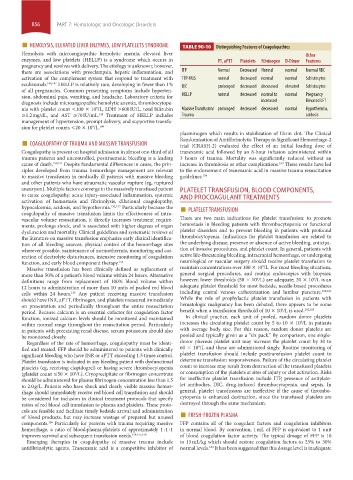
                     ■  HEMOLYSIS, ELEVATED LIVER ENZYMES, LOW PLATELETS SYNDROME    TABLE 90-10    Distinguishing Features of Coagulopathies

                 Hemolysis  with  microangiopathic  hemolytic  anemia,  elevated  liver                           Other
                 enzymes,  and low  platelets  (HELLP)  is  a  syndrome  which  occurs  in   PT, aPTT  Platelets  Fibrinogen D-Dimer  Features
                 pregnancy and resolves with delivery. The etiology is unknown; however,
                 there are associations with preeclampsia, hepatic inflammation, and   ITP  Normal  Decreased Normal  normal  Normal RBC
                 activation of the complement system that respond to treatment with   TTP-HUS  normal  decreased normal  normal  Schistocytes
                 eculizumab. 146,147  HELLP is relatively rare, developing in fewer than 1%   DIC  prolonged  decreased decreased  elevated  Schistocytes
                 of all pregnancies. Common presenting symptoms include hyperten-
                 sion, abdominal pain, vomiting, and headache. Laboratory criteria for   HELLP  normal  decreased normal to   normal   Pregnancy
                 diagnosis include microangiopathic hemolytic anemia, thrombocytope-               increased      Elevated LFT
                 nia with platelet count <100 × 10 /L, LDH >600 IU/L, total bilirubin   Massive Transfusion/ prolonged  decreased decreased  normal  Hypothermia,
                                           9
                 ≥1.2 mg/dL, and AST  ≥70 IU/mL.  Treatment of HELLP includes   Trauma                            acidosis
                                            148
                 management of hypertension, prompt delivery, and supportive transfu-
                 sion for platelet counts <20 × 10 /L. 149             plasminogen which results in stabilization of fibrin clot. The Clinical
                                         9
                     ■  COAGULOPATHY OF TRAUMA AND MASSIVE TRANSFUSION  Randomization of Antifibrinolytic Therapy in Significant Hemorrhage-2
                                                                       trial (CRASH-2)  evaluated  the  effect  of  an  initial  loading  dose  of
                 Coagulopathy is present on hospital admission in almost one-third of all   tranexamic  acid  followed  by  an  8-hour  infusion  administered  within
                 trauma patients and uncontrolled, posttraumatic bleeding is a leading   3 hours of trauma. Mortality was significantly reduced without an
                 cause of death. 150,151  Despite fundamental differences in cause, the prin-  increase in thrombosis or other complications.  These results have led
                                                                                                         159
                 ciples developed from trauma hemorrhage management are relevant   to the endorsement of tranexamic acid in massive trauma resuscitation
                 to massive transfusion in medically ill patients with massive bleeding   guidelines. 154
                 and other patients who have atraumatic vascular rupture (eg, ruptured
                 aneurysm). Multiple factors converge in the massively transfused patient   PLATELET TRANSFUSION, BLOOD COMPONENTS,
                 to cause coagulopathy: acute injury-associated inflammation, systemic   AND PROCOAGULANT TREATMENTS
                 activation of hemostasis and fibrinolysis, dilutional coagulopathy,
                 hypocalcemia, acidosis, and hypothermia. 152,153  Particularly because the     ■  PLATELET TRANSFUSION
                 coagulopathy of massive transfusion limits the effectiveness of intra-
                 vascular volume resuscitation, it directly increases treatment require-  There are two main indications for platelet transfusion: to promote
                 ments, prolongs shock, and is associated with higher degrees of organ   hemostasis  in bleeding  patients with thrombocytopenia or functional
                   dysfunction and mortality. Clinical guidelines and systematic reviews of   platelet disorders and to prevent bleeding in patients with profound
                 the literature on massive transfusion emphasize early clinical identifica-  thrombocytopenia. Indications for platelet transfusion are related to
                 tion of all bleeding sources, physical control of the hemorrhage sites   the underlying disease, presence or absence of active bleeding, anticipa-
                 wherever possible, maintenance of normothermia, monitoring and cor-  tion of invasive procedures, and platelet count. In general, patients with
                 rection of electrolyte disturbances, intensive monitoring of coagulation   active life-threatening bleeding, intracranial hemorrhage, or undergoing
                 function, and early blood component therapy. 154      neurological or vascular surgery should receive platelet transfusion to
                                                                                                   9
                   Massive  transfusion  has been  clinically  defined  as  replacement  of   maintain concentrations over 100 × 10 /L. For most bleeding situations,
                 more than 50% of a patient’s blood volume within 24 hours. Alternative   general surgical procedures, and routine endoscopies with biopsies;
                                                                                                 9
                                                                                                                     9
                 definitions range from replacement of 100% blood volume within     however, lower thresholds (50 × 10 /L) are adequate; 20 × 10 /L is an
                 12 hours to administration of more than 10 units of packed red blood   adequate platelet threshold for most bedside, needle-based procedures
                 cells within 24 hours.  Any patient receiving massive transfusion   including central venous catheterization and lumbar puncture. 160,161
                                  155
                 should have INR, aPTT, fibrinogen, and platelets measured immediately   While the role of prophylactic platelet transfusion in patients with
                 on presentation and periodically throughout the entire resuscitation   hematologic malignancy has been debated, there appears to be some
                                                                                                          9
                 period. Because calcium is an essential cofactor for coagulation factor   benefit when a transfusion threshold of 10 × 10 /L is used. 162,163
                 function, ionized calcium levels should be monitored and maintained   In  clinical  practice,  each  unit  of  pooled,  random  donor  platelets
                                                                                                                9
                 within normal range throughout the resuscitation period. Particularly   increases the circulating platelet count by 5 to 10 × 10 /L in patients
                 in patients with preexisting renal disease, serum potassium should also   with average body size. For this reason, random donor platelets are
                 be monitored closely.                                 pooled and typically given as a “six pack.” By comparison, one single-
                   Regardless of the rate of hemorrhage, coagulopathy must be identi-  donor  pheresis  platelet  unit  may  increase  the  platelet  count  by  30  to
                                                                             9
                 fied and treated. FFP should be administered to patients with clinically   60 × 10 /L and these are administered singly. Routine monitoring of
                 significant bleeding who have INR or aPTT exceeding 1.5 times control.   platelet  transfusion should include  posttransfusion platelet  count to
                 Platelet transfusion is indicated in any bleeding patient with  dysfunctional   determine transfusion responsiveness. Failure of the circulating platelet
                 platelets (eg, receiving clopidogrel) or having severe thrombocytopenia   count to increase may result from destruction of the transfused platelets
                 (platelet count ≤50 × 10 /L). Cryoprecipitate or fibrinogen concentrate   or consumption of the platelets at sites of injury or clot activation. Risks
                                   9
                 should be administered for plasma fibrinogen concentration less than 1.5   for  ineffective  platelet  transfusion  include  ITP,  presence  of antiplate-
                 to 2.0 g/L. Patients who have shock and clearly visible massive hemor-  let antibodies, DIC, drug-induced thrombocytopenia, and sepsis. In
                 rhage should immediately receive red blood cell transfusion and should   general, platelet transfusions are ineffective if the cause of thrombo-
                 be considered for inclusion in clinical treatment protocols that specify   cytopenia is enhanced destruction, since the transfused platelets are
                 ratios of red blood cell transfusion to plasma and platelets. These proto-  destroyed through the same mechanism.
                 of blood products, but may increase wastage of prepared but unused   ■  FRESH-FROZEN PLASMA
                 cols are feasible and facilitate timely bedside arrival and administration
                 components.  Particularly for patients with trauma requiring massive   FFP contains all of the coagulant factors and coagulation inhibitors
                          156
                 hemorrhage, a ratio of blood:plasma:platelets of approximately 1 : 1 : 1   in normal blood. By convention, 1 mL of FFP is equivalent to 1 unit
                 improves survival and subsequent transfusion needs. 154,157,158  of  blood  coagulation  factor  activity.  The  typical  dosage  of  FFP  is  10
                   Emerging therapies in coagulopathy of massive trauma include   to 15 mL/kg which should restore coagulation factors to 25% to 30%
                 antifibrinolytic agents. Tranexamic acid is a competitive inhibitor of   normal levels.  It has been suggested that this dosage level is inadequate
                                                                                 164


            section07.indd   856                                                                                       1/21/2015   7:42:45 AM

