


Page 1248 - Hall et al (2015) Principles of Critical Care-McGraw-Hill
P. 1248
CHAPTER 90: Bleeding Disorders  855


                    INR, as well as age.  Other factors predictive of bleeding during war-  As the direct result of the association of DIC with major systemic
                                  131
                    farin therapy include history of stroke, prior bleeding, age >75 years,   disease, it is associated with particularly high mortality. For ICU patients
                    hepatic or renal disease, malignancy, thrombocytopenia, uncontrolled   with  overt clinical and  laboratory  evidence  of DIC,  mortality  ranges
                    hypertension, ethanol abuse, anemia, and excessive risk of falls. 132  from 45% to 78%. 142-144
                     There are two main considerations in managing patients receiving    Clinical and laboratory features of DIC include abnormalities in all
                    warfarin with supratherapeutic INR or bleeding complications: the   aspects of blood and coagulation including coagulation times, red blood
                    degree of INR elevation and the presence or absence of bleeding.   cell morphology, and thrombocytopenia. Bedside findings include pete-
                    Serious bleeding in patients with any degree of elevated INR requires   chiae, ecchymosis, and bleeding from venipuncture sites. Bleeding from
                    simultaneous reversal of vitamin K antagonism as well as immediate   surgical wounds and noninjured mucosal surfaces may develop.
                    replacement of deficient vitamin K–dependent factors. Intravenous   DIC  is  a  clinical  diagnosis  established  by  the  presence  of  severe
                    vitamin K  (phytonadione) in doses of 5 to 10 mg has an effect within   clinical disease, exclusion of other similar conditions, and consistent
                    hours, but does not correct INR until 24 hours. 133,134  Urgent correction   laboratory findings. Peripheral blood smear demonstrates few platelets
                    of coagulopathy also requires exogenous factor replacement. Fresh   and hemolysis with schistocytes. The majority of patients have platelet
                    frozen plasma restores coagulation protein concentrations but, at rec-  count <50 × 10 /L. Both the aPTT and INR are prolonged and reflect
                                                                                      9
                    ommended doses of 15 to 30 mL/kg, risks volume overload, acute lung   consumption of clotting factors in the common, intrinsic, and extrinsic
                    injury, and infection.  Prothrombin complex concentrates (PCC) are   coagulation cascades. DIC is also a fibrinolytic state characterized by
                                   135
                    mixtures of highly concentrated factors II, IX, X (three-factor PCC) or   the presence of fibrin degradation products and elevated D-dimer  levels.
                    II, VII, IC, X, protein C, and protein S (four-factor PCC) that permit   Other markers of DIC include detectable plasma fibrin monomers,
                    rapid, low-volume infusion of essential coagulation factors. PCCs are   decreased  plasma  antithrombin  activity,  and  decreased  levels  of  indi-
                    effective in promoting hemostasis in urgent, life-threatening bleeding in   vidual clotting factors, particularly factor VIII.
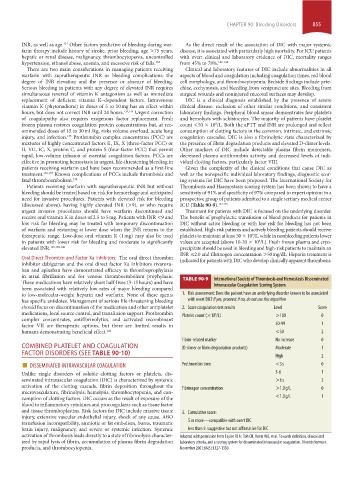
                    patients receiving warfarin and have been recommended as a first-line   Given  the  complexity  of  the  clinical  conditions  that  cause  DIC  as
                    treatment. 136,137  Known complications of PCCs include thrombosis and   well as the nonspecific individual laboratory findings, diagnostic scor-
                    fatal thromboembolism. 138                            ing systems for DIC have been proposed. The International Society for
                     Patients receiving warfarin with supratherapeutic INR but without   Thrombosis and Haemostasis scoring system has been shown to have a
                    bleeding should be treated based on risk for hemorrhage and anticipated   sensitivity of 91% and specificity of 97% compared to expert opinion in a
                    need for invasive procedures. Patients with elevated risk for bleeding    prospective group of patients admitted to a single tertiary medical center
                    (discussed  above),  having  highly  elevated  INR  (>9),  or  who  require   ICU (Table 90-9). 142,145
                    urgent invasive procedures should have warfarin discontinued and   Treatment for patients with DIC is focused on the underlying disorder.
                    receive oral vitamin K in doses of 2.5 to 5 mg. Patients with INR <9 and   The benefit of prophylactic transfusion of blood products for patients in
                    low  risk for  bleeding  may be  treated with  temporary  discontinuation   DIC without active bleeding or with low risk for bleeding has not been
                    of warfarin and restarting at lower dose when the INR returns to the   established. High-risk patients and actively bleeding patients should receive
                    therapeutic  range.  Low-dose  oral  vitamin  K  (1 mg)  may  also  be  used   platelets to maintain at least 50 × 10 /L, while in nonbleeding patients lower
                                                                                                  9
                    in patients with lower risk for bleeding and moderate to significantly   values are accepted (above 10-20 × 10 /L). Fresh frozen plasma and cryo-
                                                                                                    9
                    elevated INR. 136,139,140                             precipitate should be used in bleeding and high-risk patients to maintain an
                                                                          INR ≤2.0 and fibrinogen concentration >50 mg/dL. Heparin treatment is
                    Oral Direct Thrombin and Factor Xa Inhibitors:  The oral direct thrombin   indicated for patients with DIC who develop clinically apparent thrombosis.
                    inhibitor dabigatran and the oral direct factor Xa inhibitors rivaroxa-
                    ban and apixaban have demonstrated efficacy in thromboprophylaxis
                    in  atrial  fibrillation  and  for  venous  thromboembolism  prophylaxis.     TABLE 90-9     International Society of Thrombosis and Hemostasis Disseminated
                    These medications have relatively short half-lives (5-15 hours) and have
                    been associated with relatively low rates of major bleeding compared   Intravascular Coagulation Scoring System
                    to low-molecular-weight heparin and warfarin. None of these agents     1.  Risk assessment: Does the patient have an underlying disorder known to be associated
                    has specific antidotes. Management of serious life-threatening bleeding   with overt DIC? If yes, proceed; if no, do not use this algorithm
                    should focus on discontinuation of the medication and other antiplatelet     2.  Score coagulation test results   Level  Score
                    medications, local source control, and transfusion support. Prothrombin   Platelet count (×10 /L)  >100  0
                                                                                      9
                    complex concentrates, antifibrinolytics, and activated recombinant
                    factor VII are therapeutic options, but there are limited results in                  50-99           1
                    humans demonstrating beneficial effect. 141                                           <50             2
                                                                          Fibrin-related marker           No increase     0
                    COMBINED PLATELET AND COAGULATION                     (D-dimer or fibrin degradation products)  Moderate  1
                    FACTOR DISORDERS (SEE Table 90-10)                                                    High            2
                        ■  DISSEMINATED INTRAVASCULAR COAGULATION         Prothrombin time                <3 s            0

                    Unlike single disorders of soluble clotting factors or platelets, dis-                3-6             1
                    seminated intravascular coagulation (DIC) is characterized by systemic                >6 s            2
                    activation of the clotting cascade, fibrin deposition throughout the   Fibrinogen concentration  >1.0 g/L  0
                    microvasculature, fibrinolysis, hemolysis, thrombocytopenia, and con-
                    sumption of clotting factors. DIC occurs as the result of exposure of the             <1.0 g/L        1
                    blood to inflammatory cytokines and procoagulants such as tissue factor
                    and tissue thromboplastins. Risk factors for DIC include massive tissue     3.  Cumulative score:
                    injury, extensive vascular endothelial injury, shock of any cause, ABO
                    transfusion incompatibility, amniotic or fat embolism, burns, traumatic      5 or more—compatible with overt DIC
                    brain injury, malignancy, and severe or systemic infection. Systemic      less than 5: suggestive but not affirmative for DIC
                    activation of thrombosis leads directly to a state of fibrinolysis character-  Adapted with permission from Taylor FB Jr, Toh CH, Hoots WK, et al. Towards definition, clinical and
                    ized by rapid lysis of fibrin, accumulation of plasma fibrin degradation   laboratory criteria, and a scoring system for disseminated intravascular coagulation. Thromb Haemost.
                    products, and thrombocytopenia.                       November 2001;86(5):1327-1330.


            section07.indd   855                                                                                       1/21/2015   7:42:45 AM

