


Page 1252 - Hall et al (2015) Principles of Critical Care-McGraw-Hill
P. 1252
CHAPTER 91: TTP, HUS, and Other Thrombotic Microangiopathies  859


                    MECHANISMS OF THE DISEASES                            the UL-VWF multimers anchored on endothelial cell surface 72-74  or
                        ■  HISTOLOGIC FINDINGS                            in the identification and molecular cloning of ADAMTS13 has greatly
                                                                          those circulating in blood under arterial shear stress.
                                                                                                                     The success
                                                                                                                 75,76
                    TMA, a pathologic term, describes histologic findings of hyaline   accelerated our understanding of pathogenesis of TTP, HUS, and other
                                                                          condition/disease-related TMAs.
                    thrombi in the terminal arterioles and capillaries, 1,66,67  which is the hall-
                    mark of TTP and HUS. However, the organ involvement and thrombus   Hereditary and Acquired Idiopathic TTP:  Levy et al  first reported
                                                                                                                 7
                    composition in cases of TTP may differ from those of HUS. Hosler   12 mutations in the ADAMTS13 gene, accounting for 14 of the 15
                    et al  performed histology analysis in 56 autopsied cases of TTP and   disease alleles studied. Subsequently, more mutations in ADAMTS13
                       67
                    HUS. In 25 cases of diagnosed TTP, platelet-rich thrombi were present,   were identified in cases of hereditary TTP. 16,23,77-82  Mutations were
                    in decreasing severity, in heart, pancreas, kidney, adrenal gland, and   found throughout the ADAMTS13 gene including point mutations,
                    brain. In 31 cases of diagnosed HUS, fibrin/red cell-rich thrombi were   frame  shifts,  deletion,  and  alternative  splicing.  A  majority  of  these
                    predominant, largely confined to the kidney and often severe, and only   mutations are compound heterozygous, but a few are in homozygous
                    6 cases showed pancreas involvement, 4 adrenal gland involvement,    form.  Nearly all mutations in ADAMTS13 cause protein misfolding
                                                                              83
                    2 brain involvement, and 1 heart involvement. Immunohistochemical   and intracellular retention of the mutants, leading to severe deficiency
                    studies have confirmed these findings: the predominance of VWF/   of plasma ADAMTS13 activity. 77,81
                    platelets thrombi in cases of TTP, but fibrin in cases of HUS or dissemi-  In 1998, Tsai and Lian  first reported the presence of inhibitory auto-
                                                                                           84
                    nated intravascular coagulation. 68-70  These differences in the propensity of   antibodies against ADAMTS13 protein in most adult cases of acquired
                    organ involvement and thrombus composition underscore the potential   TTP; these inhibitory autoantibodies are immunoglobulin Gs (IgGs) in
                    difference in the mechanisms between TTP and HUS (or other TMAs).  nature. Mapping studies demonstrate that nearly all patients harbor IgGs
                        ■  TTP                                            that target at the Cys-rich/spacer domain of ADAMTS13 protein, 84-88  a
                                                                                                       89-94
                    The initial hint that suggested the deficiency of a plasma protease that   critical region for substrate recognition.   Mutations in ADAMTS13
                                                                          or inhibition of ADAMTS13 activity by anti-ADAMTS13 IgGs results
                    breaks  down VWF  polymers  came  from the  seminal   observation by   in an accumulation of hyperactive ULVWF multimers, leading to exces-
                    Dr  Joel  Moake  in  1982.   He  and  his  colleagues  reported  that  ultra-  sive platelet aggregation and disseminated microvascular thromboses
                                      71
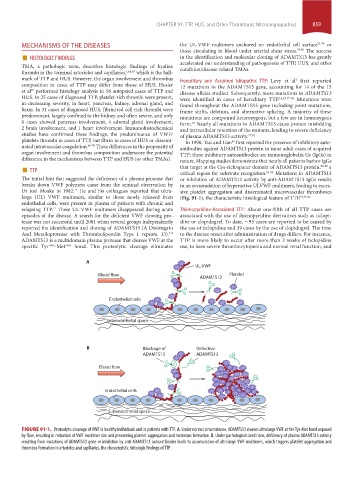
                    large (UL) VWF multimers, similar to those newly released from   (Fig. 91-1), the characteristic histological feature of TTP. 93,95,96
                    endothelial cells, were present in plasma of patients with chronic and
                    relapsing TTP.  These UL-VWF multimers disappeared during acute   Thienopyridine-Associated TTP:  About one-fifth of all TTP cases are
                              71
                    episodes of the disease. A search for the deficient VWF cleaving pro-  associated with the use of thienopyridine derivatives such as ticlopi-
                    tease was not successful until 2001 when several groups independently   dine or clopidogrel. To date, ∼93 cases are reported to be caused by
                    reported the identification and cloning of ADAMTS13 (A Disintegrin   the use of ticlopidine and 39 cases by the use of clopidogrel. The time
                    And  Metalloprotease  with  ThromboSpondin Type  1 repeats, 13).    to the disease onset after administration of drugs differs. For instance,
                                                                      5-8
                    ADAMTS13 is a multidomain plasma protease that cleaves VWF at the     TTP is more likely to occur after more than 2 weeks of ticlopidine
                    specific Tyr 1605 -Met 1606  bond. This proteolytic cleavage eliminates    use, to have severe thrombocytopenia and normal renal function, and

                                          A
                                                                               UL-VWF
                                              Blood flow                                  Platelet
                                                                                ADAMTS13


                                                 Endothelial cells


                                                 Subendothelial space


                                          B                  Blockage of       Defective
                                                             ADAMTS13          ADAMTS13

                                              Blood flow


                                                Endothelial cells


                                                 Subendothelial space

                    FIGURE 91-1.  Proteolytic cleavage of VWF in healthy individuals and in patients with TTP. A. Under normal circumstance, ADAMTS13 cleaves ultralarge VWF at the Tyr-Met bond exposed
                    by flow, resulting in reduction of VWF multimer size and preventing platelet aggregation and thrombus formation. B. Under pathological conditions, deficiency of plasma ADAMTS13 activity
                    resulting from mutations of ADAMTS13 gene or inhibition by anti-ADAMTS13 autoantibodies leads to accumulation of ultralarge VWF multimers, which triggers platelet aggregation and
                    thrombus formation in arterioles and capillaries, the characteristic histologic findings of TTP.


            section07.indd   859                                                                                       1/21/2015   7:42:47 AM

