


Page 1253 - Hall et al (2015) Principles of Critical Care-McGraw-Hill
P. 1253
860     PART 7: Hematologic and Oncologic Disorders


                 to  exhibit  severely  deficient  plasma  ADAMTS13  activity. 44,97   These   E coli
                 observations suggest two different mechanisms (autoimmune vs non-
                 immune) underlying the pathogenesis of TTP caused by ticlopidine      Shiga toxin (Stx1 and Stx2)
                 versus clopidogrel. Patients with ticlopidine-associated TTP often
                 have severe deficiency of plasma ADAMTS13 activity as a result of       Binds to leukocytes
                 autoantibodies against ADAMTS13 and respond rapidly to plasma
                 exchange. 44,97  However, patients with clopidogrel-induced TTP rarely
                 show severe deficiency of plasma ADAMTS13 activity and positive   Glomerulus              Endothelial cells
                 anti-ADAMTS13 autoantibodies in their plasma. 43,44
                 Pregnancy-Associated TTP:  Pregnancy has been shown to cause TTP
                 de novo or act as an inciting factor that triggers an acute episode of   B subunit  A subunit
                 TTP in women who have hereditary or acquired deficiency of plasma
                 ADAMTS13 activity. 23,98,99  In a review of 350 cases by Veyradier et al,      UL-VWF    Protein synthesis
                                                                    99
                 TTP episodes are observed in their first, second, and third trimesters of     Tissue factor    Apoptosis
                 pregnancy, as well as during the postpartum period. The time to onset     Cytokines    Damage of
                 may suggest the cause: hereditary or acquired. For instance, a woman     TM        endothelium
                 with hereditary deficiency of plasma ADAMTS13 activity may develop
                 TTP in her first pregnancy, primarily in her third trimester, whereas a
                 woman with acquired deficiency of plasma ADAMTS13 activity due to     Platelet adhesion and aggregation
                 autoantibodies may present her first episode during the first trimester     Complement activation
                 and often after 20 weeks of her gestation.  TTP during pregnancy is asso-    Fibrin formation
                                              99
                 ciated with high maternal mortality or long-term morbidity rate. 100-102
                 Preterm delivery and intrauterine fetal death are frequent complica-  FIGURE 91-2.  Mechanism of E coli toxin-induced HUS. After infection with a Shiga toxin
                 tions of such pregnancies. Therefore, aggressive treatment with plasma   (Stx)–producing organism, Stx enters the circulation, possibly via Gb4 receptors. Upon enter-
                 transfusion or plasma exchange 100-102  is required to improve survival rate.  ing the circulation, it binds polymorphonuclear leukocytes and is transferred to vulnerable
                   When TTP occurs in the third trimester or at term, it should be dif-  endothelial cells expressing Gb3 receptors. The A subunit enters the cells and inhibits protein
                 ferentiated from the Hemolytic anemia, Elevated Liver enzymes, and Low   synthesis and triggers endothelial cell apoptosis and injury, whereas the B subunit triggers the
                 Platelets (HELLP) syndrome. Severe damage to the liver, but not the central   release of UL-VWF, tissue factor, proinflammatory cytokines, and downregulates the thrombo-
                 nervous system, suggests HELLP syndrome. Plasma ADAMTS13 activity   modulin (TM) expression in endothelial cells. The end results are to increase platelet adhesion
                 may be reduced, but severe deficiency of plasma ADAMTS13 activity is not   and aggregation, complement activation, and fibrin formation.
                 a frequent finding in these patients.  Therefore, plasma exchange therapy
                                          103
                 is often not effective. Prompt delivery is the treatment of choice for patients   aHUS:  aHUS is primarily caused by abnormalities in complement
                 with HELLP syndrome.                                  regulatory proteins including complement factor H (CFH),  CFI,
                     ■  HUS                                            membrane cofactor protein (MCP), and TM or the components in the
                                                                       activation pathway such as CFB and C3. These abnormalities result in
                 HUS, another clinical term, describes a syndrome of acute renal    uncontrolled activation of complements and formation of membrane
                 failure, thrombocytopenia, and MAHA. Approximately 90% of HUS   attack complexes (MAC) (Fig. 91-3), leading to endothelial injury
                 cases are caused by infection with a toxin-producing strain of E coli or   and microvascular thrombosis.
                 Shigella. 104,105   This  syndrome  is  primarily  seen  in  children.  However,   CFH is a 150-kDa serum glycoprotein, consisting of 20 complement
                                                                                              133,134
                 approximately 10% of HUS cases are not caused by the E coli infection;   control protein (CCP) modules.   It is synthesized in the liver, func-
                 its etiology is quite heterogeneous. Of those, nearly 60% of cases are   tioning as a cofactor for degradation of active complement component
                 associated with the loss-of-function mutations in a gene encoding one   C3b by CFI. Mutations in  CFH, usually (60%-70%) clustered in the
                                                                                                                   64,137
                                                                                               108,133,135,136
                 or several complement regulatory proteins 106-112  or the gain-of-function   C-terminal CCP19-20 modules,   or autoantibodies   target-
                 mutations of a complement activation component such as complement   ing these terminal modules reduce the binding of CFH to polyanionic
                 factor B (CFB) or C3. 113-115  In rare cases, there is an IgG autoantibody   glycosaminoglycans on endothelial cells and the exposed base mem-
                 against a complement regulator such as factor I (CFI), 116-118  which results   brane surface, and C3b. CFI is an 88-kDa serine protease, consisting of
                 in acquired deficiency of complement regulators.      a heavy chain and light chain that are linked by a disulfide bond. CFI
                                                                       is also synthesized in the liver, and cleaves C3b and C4b in the pres-
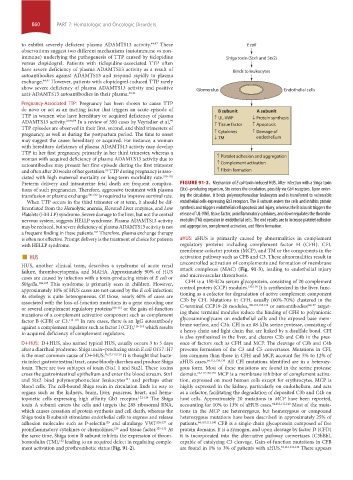
                 D+HUS:  D+HUS, also named typical HUS, usually occurs 3 to 5 days   ence of factors such as CFH and MCP. The cleavage of C3b and C4b
                 after a diarrheal prodrome. Shiga toxin–producing strain E coli O157 : H7    prevents formation of the C3 and C5 convertases. Mutations in  CFI,
                 is the most common cause of D+HUS. 56,57,119,120  It is thought that bacte-  less common than those in CFH and MCP, account for 5% to 12% of
                 ria infect gastrointestinal tract, cause bloody diarrhea and produce Shiga   aHUS cases. 64,112,138,139  All CFI mutations identified are in a heterozy-
                 toxin. There are two subtypes of toxin (Stx1 1 and Stx2). These toxins   gous  form.  Most  of  these  mutations  are  found  in  the  serine  protease
                 cross the gastrointestinal epithelium and enter the blood stream. Stx1   domain. 64,112,138,139  MCP is a membrane inhibitor of complement activa-
                 and Stx2 bind polymorphonuclear leukocytes  and perhaps other   tion, expressed on most human cells except for erythrocytes. MCP is
                                                     121
                 blood cells. The cell-bound Shiga toxin in circulation finds its way to   highly expressed in the kidney, particularly on endothelium, and acts
                 organs such as  the kidneys, brain, liver, pancreas, heart, and hema-  as a cofactor, facilitating the degradation of deposited C3b and C4b on
                 topoietic cells expressing high affinity Gb3 receptor. 122-124  The Shiga   host  cells.  Approximately 20  mutations  in  MCP have  been  reported,
                 toxin A subunit enters the cells and targets the 28S ribosomal RNA,   accounting for 10% to 13% of aHUS cases. 64,110,111,140  Most of the muta-
                 which causes cessation of protein synthesis and cell death, whereas the   tions in the  MCP are heterozygous, but homozygous or compound
                 Shiga toxin B subunit stimulates endothelial cells to express and release   heterozygous mutations have been described in approximately 25% of
                 adhesion  molecules  such as  P-selectin  and ultralarge  VWF 126,127  or   patients. 64,110,111,140  CFB is a single-chain glycoprotein composed of five
                                              125
                 proinflammatory cytokines or chemokines,  and tissue factor. 129-131  At   protein domains. It is a zymogen, and upon cleavage by factor D (CFD)
                                                 128
                 the same time, Shiga toxin B subunit inhibits the expression of throm-  it is incorporated into the alternative pathway convertases (C3bBb),
                 bomodulin (TM),  leading to an acquired defect in regulating comple-  capable of catalyzing C3 cleavage. Gain-of-function mutations in CFB
                              132
                 ment activation and prothrombotic status (Fig. 91-2).  are found in 1% to 3% of patients with aHUS. 64,113,141,142  There appears


            section07.indd   860                                                                                       1/21/2015   7:42:48 AM

