


Page 1255 - Hall et al (2015) Principles of Critical Care-McGraw-Hill
P. 1255
862     PART 7: Hematologic and Oncologic Disorders


                                                                       thrombi are present and largely confined to the kidney in cases of HUS.
                                                                                                                          67
                                                                       These differences in organ involvement and thrombus composition sug-
                                                                       gest a fundamental difference in pathogenesis of TTP and HUS. They
                                                                       do not represent a spectrum of the same disease process, although a
                                                                       recent study indicates that D+HUS, aHUS, and TTP are all diseases of
                                                                       complement activation in the end.  The hypothesis remains to be tested
                                                                                                15
                                                                       in future research, and may have implications for therapy.
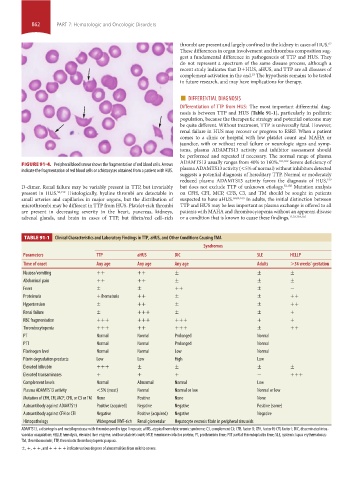
                                                                           ■  DIFFERENTIAL DIAGNOSIS

                                                                       Differentiation of TTP from HUS:  The most important differential diag-
                                                                       nosis is between TTP and HUS (Table 91-1), particularly in pediatric
                                                                       population, because the therapeutic strategy and potential outcome may
                                                                       be quite different. Without treatment, TTP is universally fatal. However,
                                                                       renal failure in HUS may recover or progress to ESRF. When a patient
                                                                       comes to a clinic or hospital with low platelet count and MAHA or
                                                                       jaundice, with or without renal failure or neurologic signs and symp-
                                                                       toms, plasma ADAMTS13 activity and inhibitor assessment should
                                                                       be performed and repeated if necessary. The normal range of plasma
                                                                       ADAMTS13 usually ranges from 40% to 160%. 161,162  Severe deficiency of
                 FIGURE 91-4.  Peripheral blood smear shows the fragmentation of red blood cells. Arrows
                 indicate the fragmentation of red blood cells or schistocytes obtained from a patient with HUS.   plasma ADAMTS13 activity (<5% of normal) without inhibitors detected
                                                                       suggests a potential diagnosis of hereditary TTP. Normal or moderately
                                                                       reduced plasma ADAMTS13 activity favors the diagnosis of HUS,
                                                                                                                         159
                 D-dimer. Renal failure may be variably present in TTP, but invariably   but does not exclude TTP of unknown etiology. 53,158  Mutation analysis
                 present in HUS. 50,159  Histologically, hyaline thrombi are detectable in   on CFH, CFI, MCP, CFB, C3, and TM should be sought in patients
                 small arteries and capillaries in major organs, but the distribution of   suspected to have aHUS. 63,64,163  In adults, the initial distinction between
                 microthrombi may be different in TTP from HUS. Platelet-rich thrombi   TTP and HUS may be less important as plasma exchange is offered to all
                 are  present  in  decreasing  severity  in  the  heart,  pancreas,  kidneys,    patients with MAHA and thrombocytopenia without an apparent disease
                   adrenal glands, and brain in cases of TTP, but fibrin/red cell–rich   or a condition that is known to cause these findings. 11,53,164,165


                   TABLE 91-1    Clinical Characteristics and Laboratory Findings in TTP, aHUS, and Other Conditions Causing TMA
                                                                               Syndromes
                  Parameters               TTP           aHUS        DIC                         SLE         HELLP
                  Time of onset            Any age       Any age     Any age                     Adults      >34 weeks’ gestation
                  Nausea/vomiting          ++            ++          ±                           ±           ±
                  Abdominal pain           ++            ++          ±                           ±           ±
                  Fever                    ±             ±           ++                          ±           −
                  Proteinuria              +/hematuria   ++          ±                           ±           ++
                  Hypertension             ±             ++          ±                           ±           ++
                  Renal failure            ±             +++         ±                           ±           +
                  RBC fragmentation        +++           +++         +++                         +           +
                  Thrombocytopenia         +++           ++          +++                         ±           ++
                  PT                       Normal        Normal      Prolonged                   Normal
                  PTT                      Normal        Normal      Prolonged                   Normal
                  Fibrinogen level         Normal        Normal      Low                         Normal
                  Fibrin degradation products  Low       Low         High                        Low
                  Elevated bilirubin       +++           ±           ±                           ±           ±
                  Elevated transaminases   +             +           +                            −          +++
                  Complement levels        Normal        Abnormal    Normal                       Low
                  Plasma ADAMTS13 activity  <5% (most)   Normal      Normal or low                Normal or low
                  Mutation of CFH, CFI, MCP, CFB, or C3 or TM None  Positive  None                None
                  Autoantibody against ADAMTS13  Positive (acquired)  Negative  Negative          Positive (some)
                  Autoantibody against CFH or CFI  Negative  Positive (acquired)  Negative        Negative
                  Histopathology           Widespread VWF-rich  Renal glomerular  Hepatocyte necrosis fibrin in peripheral sinusoids
                 ADAMTS13, a disintegrin and metalloprotease with thrombospondin type 1 repeats; aHUS, atypical hemolytic uremic syndrome; C3, complement C3; CFB, factor B; CFH, factor H; CFI, factor I; DIC, disseminated intra-
                 vascular coagulation; HELLP, hemolysis, elevated liver enzyme, and low platelet count; MCP, membrane cofactor protein; PT, prothrombin time; PTT partial thromboplastin time; SLE, systemic lupus erythematosus;
                 TM, thrombomodulin; TTP, thrombotic thrombocytopenic purpura.
                 ±, +, + +, and + + + + indicate various degrees of abnormalities from mild to severe.


            section07.indd   862                                                                                       1/21/2015   7:42:53 AM

