


Page 1254 - Hall et al (2015) Principles of Critical Care-McGraw-Hill
P. 1254
CHAPTER 91: TTP, HUS, and Other Thrombotic Microangiopathies  861


                                                                                      150
                     Classical pathway   Lectin pathway      Alternative  inhibitor (TAFI),  therefore regulating thrombosis and mediating cyto-
                     Immune complexes                        pathway      protective activity. Furthermore, TM negatively regulates the comple-
                    Nonimmune activators  Microbial carbohydrates  Activating surfaces  ment system through accelerating CFI-mediated inactivation of C3b in
                                                                          the presence of cofactors, CFH, or C4b binding protein. Delvaeye et al
                          C1q, C1r, C1s                         CFI       first reported identification of TM mutations in a cohort of 152 aHUS
                                                                CFH/MCP         151
                                                           C3b
                                                                TM        patients.  Most are missense mutations (A43T, D53G, V81I, P495S,
                                   C4 +  C2         CFB  CFD              P501L, and D486Y) in the heterozygous form. TM mutations are found
                                                                          now in 3% to 5% of aHUS patients worldwide. 141,151,152  These mutations
                                     C4b              Bb    DAF           exhibited defects  in  suppressing  activation  of  the  alternative  comple-
                                        C2a         C3b     CFH           ment pathway through CFI-mediated C3b inactivation in vitro and are
                                                                          associated with the disease after infections. 141,151,152
                                  C3 convertase   C3 convertase
                                             C3
                           TM    TAFIa    C3a                             DIAGNOSIS AND DIFFERENTIAL DIAGNOSIS
                                                         CFI                  ■
                                                         CFH/MCP            CLINICAL PRESENTATION
                                             C3b
                                                         TM
                                                                          Diagnosis of TTP or HUS should be considered in a patient with follow-
                                 C4b C2a  C3b      C3b  Bb  C3b           ing findings: thrombocytopenia with a platelet count usually less than
                                                                                9
                              C5 convertase          C5 convertase        150 × 10 /L, MAHA (with a hemoglobin level less than 10 g/dL, elevated
                                                                          lactate dehydrogenase, a negative Coombs test, and fragmentation of red
                                             C5                           blood cells) with or without organ ischemia resulting in neurological
                                                                          and/or renal abnormalities. 13,50,52,152  The classic “pentad” of MAHA and
                           TM     TAFIa  C5a           C6                 thrombocytopenia, neurologic and renal abnormalities, and fever was
                                                     C5b  C9              only found in 7% of patients. 153
                                             C5b        C8                 Examples of when to suspect hereditary TTP include severe hemolytic
                                                      C7
                                                                          disease in newborn; infant with thrombocytopenia and jaundice 19,154 ;
                                                      MAC
                                                                          episodic “immune mediate thrombocytopenia” in a child with concurrent
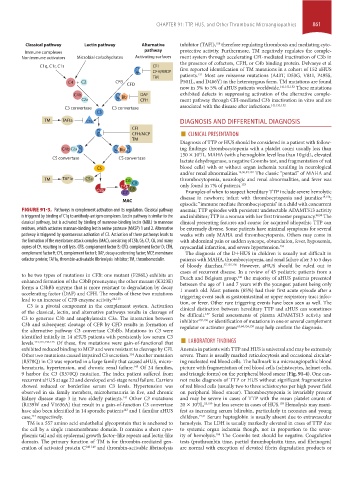
                    FIGURE 91-3.  Pathways in complement activation and its regulation. Classical pathway   anemia; TTP episodes with persistent undetectable ADAMTS13 activity
                    is triggered by binding of C1q to antibody-antigen complexes. Lectin pathway is similar to the   and inhibitor; TTP in a woman with her first trimester pregnancy. 98,99  The
                    classical pathway, but is activated by binding of mannose-binding lectin (MBL) to mannose   clinical presenting features and course for acquired idiopathic TTP can
                    residues, which activates mannan-binding lectin serine protease (MASP) 1 and 2. Alternative   be extremely diverse. Some patients have minimal symptoms for several
                    pathway is triggered by spontaneous activation of C3. Activation of these pathways leads to   weeks with only MAHA and thrombocytopenia. Others may come in
                    the formation of the membrane attack complex (MAC), consisting of C5b, C6, C7, C8, and many   with abdominal pain or sudden syncope, obtundation, fever, hypoxemia,
                    copies of C9, resulting in cell lysis. CFB, complement factor B; CFD, complement factor D; CFH,   myocardial infarction, and severe hypertension. 153
                    complement factor H; CFI, complement factor I; DAF, decay accelerating factor; MCP, membrane   The diagnosis of the D+HUS in children is usually not difficult in
                    cofactor protein; TAFIa, thrombin-activatable fibrinolysis inhibitor; TM, thrombomodulin.  patients with MAHA, thrombocytopenia, and renal failure after 3 to 5 days
                                                                          of bloody diarrhea. 57,155,156  However, aHUS should be ruled out in
                                                                          cases of recurrent disease. In a review of 45 pediatric patients from a
                    to be two types of mutations in CFB: one mutant (F286L) exhibits an   Dutch and Belgium group,  the majority of aHUS patients presented
                                                                                             141
                    enhanced formation of the C3bB proenzyme; the other mutant (K323E)   between the age of 1 and 7 years with the youngest patient being only
                    forms a C3bBb enzyme that is more resistant to degradation by decay   1 month old. Most patients (85%) had their first acute episode after a
                    accelerating factor (DAF) and CFH. The results of these two mutations   triggering event such as gastrointestinal or upper respiratory tract infec-
                    lead to an increase of CFB enzyme activity. 64,113    tion, or fever. Other rare triggering events have been seen as well. The
                     C3 is a pivotal component in the complement system. Activation   clinical distinction between hereditary TTP and aHUS can sometimes
                    of the classical, lectin, and alternative pathways results in cleavage of   be difficult.  Serial assessments of plasma ADAMTS13 activity and
                                                                                  157
                    C3  to  generate  C3b  and  anaphylatoxin  C3a.  The  interaction  between     inhibitor 157,158  or identification of mutations in one or several complement
                    C3b and subsequent cleavage of CFB by CFD results in formation of   regulator or activator genes 63,64,136,138  may help confirm the diagnosis.
                    the alternative pathway C3 convertase C3bBb. Mutations in  C3 were
                                 Of  these,  five  mutations  were  gain-of-functional  that   ■
                    identified initially in 14 aHUS patients with persistently low serum C3
                    levels. 114,115,143-145                                 LABORATORY FINDINGS
                    exhibited reduced binding to MCP and were resistant to cleavage by CFI.   Anemia in patients with TTP and HUS is universal and may be extremely
                    Other two mutations caused impaired C3 secretion.  Another mutation   severe. There is usually marked reticulocytosis and occasional circulat-
                                                        114
                    (R570Q) in C3 was reported in a large family that caused aHUS, micro-  ing nucleated red blood cells. The hallmark is a microangiopathic blood
                    hematuria, hypertension, and chronic renal failure.   Of  24  families,   picture with fragmentation of red blood cells (schistocytes, helmet cells,
                                                          145
                    9 harbor the C3 (R570Q) mutation. The index patient suffered from   and triangle forms) on the peripheral blood smear (Fig. 91-4). One can-
                    recurrent aHUS at age 22 and developed end-stage renal failure. Carriers   not make diagnosis of TTP or HUS without significant fragmentation
                    showed reduced or borderline serum C3 levels. Hypertension was   of red blood cells (usually two to three schistocytes per high power field
                    observed in six family members, microhematuria in five, and chronic   on peripheral blood smear). Thrombocytopenia is invariably present
                    kidney disease stage 3 in two elderly patients.  Other  C3 mutations   and may be severe in cases of TTP with the mean platelet counts of
                                                      145
                    (R139W and V1636A) that result in a gain-of-function C3 convertase   20 × 10 /L, 53,159  but less severe in cases of HUS.  Hemolysis may mani-
                                                                               9
                                                                                                           159
                    have also been identified in 14 sporadic patients  and 1 familiar aHUS   fest as increasing serum bilirubin, particularly in neonates and young
                                                      143
                    case,  respectively.                                  children. 19,21  Serum haptoglobin is usually absent due to extravascular
                       144
                     TM is a 557 amino acid endothelial glycoprotein that is anchored to   hemolysis. The LDH is usually markedly elevated in cases of TTP due
                    the cell by a single transmembrane domain. It contains a short cyto-  to systemic organ ischemia though, not in proportion to the sever-
                    plasmic tail and six epidermal growth factor–like repeats and lectin-like   ity of hemolysis.  The Coombs test should be negative. Coagulation
                                                                                      160
                    domain. The primary function of TM is for thrombin-mediated gen-  tests (prothrombin time, partial thromboplastin time, and fibrinogen)
                    eration of activated protein C 146-149  and thrombin-activable fibrinolysis   are normal with exception of elevated fibrin degradation products or


            section07.indd   861                                                                                       1/21/2015   7:42:48 AM

