


Page 1259 - Hall et al (2015) Principles of Critical Care-McGraw-Hill
P. 1259
866     PART 7: Hematologic and Oncologic Disorders


                   The goal of this chapter is to alert the intensivist to specific issues     TABLE 92-1    Initial Workup of a Patient with Suspected Acute Leukemia
                 unique to the management of patients with acute leukemias that can
                 directly impact the course of therapy in a medical ICU setting. We   Lab/Study Panel  Specific Tests
                 will focus on the diagnosis of leukemia and complications of patients   Characterization of blood   •  CBC with differential
                 with newly diagnosed or relapsed acute leukemia including cytopenias,   cell counts  •  Peripheral smear examination
                 tumor lysis syndrome, hyperleukocytosis, disseminated intravascular        ◦  Blasts/immature cells
                 coagulation (DIC), and infections. Specific classification and prognostic   ◦  Schistocytes
                 scoring for acute lymphoblastic and myeloid leukemias with special         ◦  Attention for promyelocytes
                 attention to acute promyelocytic leukemia will be discussed as well as
                 the general organization and composition of the current standard treat-  Bone marrow examination  •  Trephine bone marrow biopsy
                 ment protocols for each subtype of leukemia. Several biological and       •  Aspirate
                 chemotherapeutic drugs are infrequently used outside the treatment of      ◦  Morphology
                 acute leukemias and therapy-associated side effects could directly affect   ◦  Cytochemical staining (ie, MPO)
                 a patient’s acute management in an ICU setting. These will be specifi-     ◦  Cytogenetics/karyotype
                 cally highlighted at the end of this chapter.                              ◦  Flow cytometry
                                                                                            ◦   Specific molecular tests (ie, FLT3-IDT, NPM1, CEBPA)
                                                                        DIC panel          •  PT and aPTT
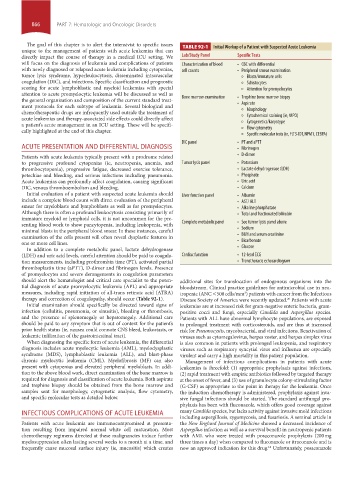
                 ACUTE PRESENTATION AND DIFFERENTIAL DIAGNOSIS                             •  Fibrinogen
                 Patients with acute leukemia typically present with a prodrome related    •  D-dimer
                 to progressive profound cytopenias (ie, neutropenia, anemia, and   Tumor lysis panel  •  Potassium
                 thrombocytopenia), progressive fatigue, decreased exercise tolerance,     •  Lactate dehydrogenase (LDH)
                 petechiae and bleeding, and serious infections including pneumonia.       •  Phosphate
                 Acute leukemias can profoundly affect coagulation, causing significant    •  Uric acid
                 DIC, venous thromboembolism and bleeding.                                 •  Calcium
                   Initial evaluation of a patient with suspected acute leukemia should   Liver function panel  •  Albumin
                 include a complete blood count with direct evaluation of the peripheral   •  AST/ ALT
                 smear for myeloblasts and lymphoblasts as well as for promyelocytes.      •  Alkaline phosphatase
                 Although there is often a profound leukocytosis consisting primarily of   •  Total and fractionated bilirubin
                 immature myeloid or lymphoid cells, it is not uncommon for the pre-
                 senting blood work to show pancytopenia, including leukopenia, with   Complete metabolic panel  •  See tumor lysis panel above
                 minimal blasts in the peripheral blood smear. In these instances, careful   •  Sodium
                 examination of the cells present will often reveal dysplastic features in   •  BUN and serum creatinine
                 one or more cell lines.                                                   •  Bicarbonate
                   In addition to a complete metabolic panel, lactate dehydrogenase        •  Glucose
                 (LDH) and uric acid levels, careful attention should be paid to coagula-  Cardiac function  •  12-lead ECG
                 tion measurements, including prothrombin time (PT), activated partial     •  Transthoracic echocardiogram
                 thromboplastin time (aPTT), D-dimer and fibrinogen levels. Presence
                 of promyelocytes and severe derangements in coagulation parameters
                 should alert the hematologist and critical care specialist to the poten-  additional sites for translocation of endogenous organisms into the
                 tial diagnosis of acute promyelocytic leukemia (APL) and appropriate   bloodstream. Clinical practice guidelines for antimicrobial use in neu-
                 measures, including rapid initiation of all-trans retinoic acid (ATRA)   tropenic (ANC <500 cells/mm ) patients with cancer from the Infectious
                                                                                             3
                 therapy and correction of coagulopathy, should occur (Table 92-1).  Disease Society of America were recently updated.  Patients with acute
                                                                                                            20
                   Initial examination should specifically be directed toward signs of     leukemias are at increased risk for gram-negative enteric bacteria, gram-
                 infection (cellulitis, pneumonia, or sinusitis), bleeding or thrombosis,   positive cocci and fungi, especially  Candida and  Aspergillus species.
                 and the presence of splenomegaly or hepatomegaly. Additional care   Patients with ALL have abnormal lymphocyte populations, are exposed
                 should be paid to any symptom that is out of context for the patient’s   to prolonged treatment with corticosteroids, and are thus at increased
                 prior health status (ie, nausea could connote CNS bleed, leukostasis, or   risk for Pneumocystis, mycobacterial, and viral infections. Reactivation of
                 leukemic infiltration of the gastrointestinal tract).  viruses such as cytomegalovirus, herpes zoster, and herpes simplex virus
                   When diagnosing the specific form of acute leukemia, the differential   is also common in patients with prolonged leukopenia, and respiratory
                 diagnosis includes acute myelocytic leukemia (AML), myelodysplastic   viruses such as respiratory syncytial virus and influenza are especially
                 syndrome (MDS), lymphoblastic leukemia (ALL), and blast-phase   virulent and carry a high mortality in this patient population.
                 chronic myelocytic leukemia (CML). Myelofibrosis (MF) can also   Management of infectious complications in patients with acute
                   present with cytopenias and elevated peripheral myeloblasts. In addi-  leukemias is threefold: (1) appropriate prophylaxis  against infections,
                 tion to the above blood work, direct examination of the bone marrow is   (2) rapid treatment with empiric antibiotics followed by targeted therapy
                 required for diagnosis and classification of acute leukemia. Both aspirate   at the onset of fever, and (3) use of granulocyte colony-stimulating factor
                 and trephine biopsy should be obtained from the bone marrow and     (G-CSF) as appropriate to the point in therapy for the leukemia. Once
                 samples  sent for  morphology,  cytogenetic  analysis, flow  cytometry,     the induction chemotherapy is administered, prophylaxis against inva-
                 and specific molecular tests as detailed below.       sive fungal infections should be started. The standard antifungal pro-
                                                                       phylaxis has been with fluconazole, which offers good coverage against
                 INFECTIOUS COMPLICATIONS OF ACUTE LEUKEMIA            many Candida species, but lacks activity against invasive mold infections
                                                                       including aspergillosis, zygomycosis, and fusariosis. A seminal article in
                 Patients  with acute leukemia are immunocompromised at presenta-  the New England Journal of Medicine showed a decreased incidence of
                 tion resulting from impaired normal white cell maturation. Most   Aspergillus infection as well as a survival benefit in neutropenic patients
                 chemotherapy regimens directed at these malignancies induce further   with  AML  who  were  treated  with  posaconazole  prophylaxis  (200 mg
                 myelosuppression often lasting several weeks to a month at a time, and   three times a day) when compared to fluconazole or itraconazole and is
                 frequently cause mucosal surface injury (ie, mucositis) which creates   now an approved indication for this drug.  Unfortunately, posaconazole
                                                                                                     12


            section07.indd   866                                                                                       1/21/2015   7:42:54 AM

